
 IT
IT  DE
DE  FR
FR  ES
ES  PT
PT 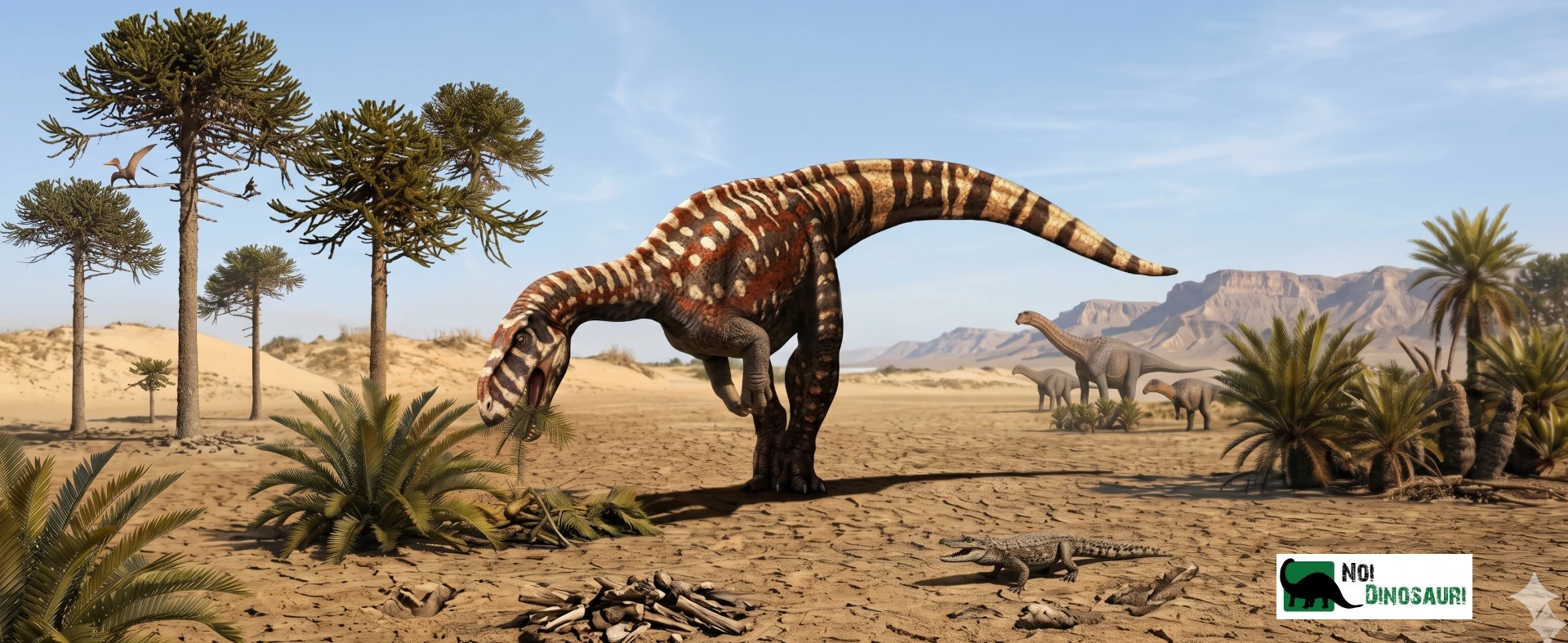
Aardonyx
Classification: Basal sauropodomorph dinosaur (a transitional form between bipedal "prosauropods" and true quadrupedal sauropods).
Why Aardonyx Matters
In the fossil record, catching an animal in the very act of changing its posture is exceptionally rare. Aardonyx is one of the few skeletons on Earth that documents—in a single individual—the exact evolutionary moment when a bipedal dinosaur began to transform into a quadrupedal colossus. It is not just another Jurassic herbivore. It is the missing link that allows paleontologists to observe, bones in hand, how sauropod gigantism actually began.
Aardonyx: History, Characteristics, and Facts
Its unearthing was a literal battle against stone. Paleontology student Marc Blackbeard spotted the first remains in 2004 at "Marc's Quarry", located on the Spion Kop 932 farm in South Africa's Free State province. Systematic excavation and study followed over the next few years, led by paleontologist Adam Yates. Yates and his colleagues (Bonnan, Neveling, Chinsamy, and Blackbeard himself) officially described the species in an early online publication in November 2009. It was later printed in Proceedings of the Royal Society B in March 2010. This dual release explains why both dates appear in scientific literature, depending on whether one cites the digital or print edition.
The name is a hybrid of Afrikaans and Ancient Greek meaning "Earth Claw", coined because its massive fossilized claws were found heavily encrusted in an almost impenetrable rock matrix. The specific epithet honors Celeste Yates, the preparator who spent years freeing these bones with surgical precision. Today, the holotype remains rest in the collections of the Bernard Price Institute for Palaeontological Research, now part of the Evolutionary Studies Institute at Wits University in Johannesburg.
At the time, the scientific community hailed the discovery as a crucial piece to fill a gap in our understanding of sauropod evolution. Independent paleontologists, including Paul Barrett of London's Natural History Museum, highlighted its incredible value: it showed precisely how a primarily bipedal animal acquired the preliminary traits needed for a life on all fours.
A Skeletal Excavator Bucket
The skull of Aardonyx functioned like the bucket of a mechanical digger: it did not chew, it tore. The morphological analysis conducted by Yates and colleagues revealed the absence of the lateral ridge on the dentary bone and the reduction of neurovascular foramina on the maxilla. These features prove the evolutionary loss of fleshy cheeks, allowing for an unusually wide gape for its group. You can almost hear the harsh, woody crunch of dense cycad branches brutally snapped off and swallowed whole without the slightest effort.
The Landing Gear of Evolution
This dinosaur was a bipedal walker, but its build was already yielding to gravity. Its arms worked like the landing gear of a massive cargo plane, heavily modified to receive its forward weight. The three-dimensional biomechanical study of the forearm demonstrated that the radius and ulna—though not yet able to fully rotate the palms downward—had already adapted to support massive loads. Imagine the deep, almost seismic thud vibrating through the Jurassic soil every time this ton of muscle dropped onto all fours to graze on low ferns.
Snowshoes for Jurassic Mud
Its feet mark an anatomical point of no return. Unlike its agile ancestors that walked on their toes, Aardonyx had developed a semi-plantigrade posture. It shifted part of its mass onto the inner side of the foot, featuring a fleshy heel pad that anticipated the fully plantigrade stance of mature true sauropods. It was a middle ground, not yet the final configuration of its giant descendants. The lower phalangeal joints measured on the type fossil show medially shifted loading axes. Visualize the cold, viscous texture of the floodplain clay mud, inexorably compressed and branded by the "earth claws" of this hybrid giant.
If you picture the ancestors of "Brontosaurs" as scaly skyscrapers towering dozens of meters high, you need to recalibrate your cinematic expectations. The measured fossil remains of Aardonyx indicate a length of roughly 7 to 9 meters and an estimated weight between 1.5 and 2 tons (the size of an armored van, not a building). Be careful, though: this is the observed data at the time of death, not the absolute biological limit. Bone histology (the microscopic analysis of internal tissue structure) proved the absence of lines of arrested growth in the ribs and scapulae. This reveals that the two recovered specimens were less than 10 years old and still actively growing. The maximum dimensions of a fully mature adult remain a fascinating scientific unknown today.
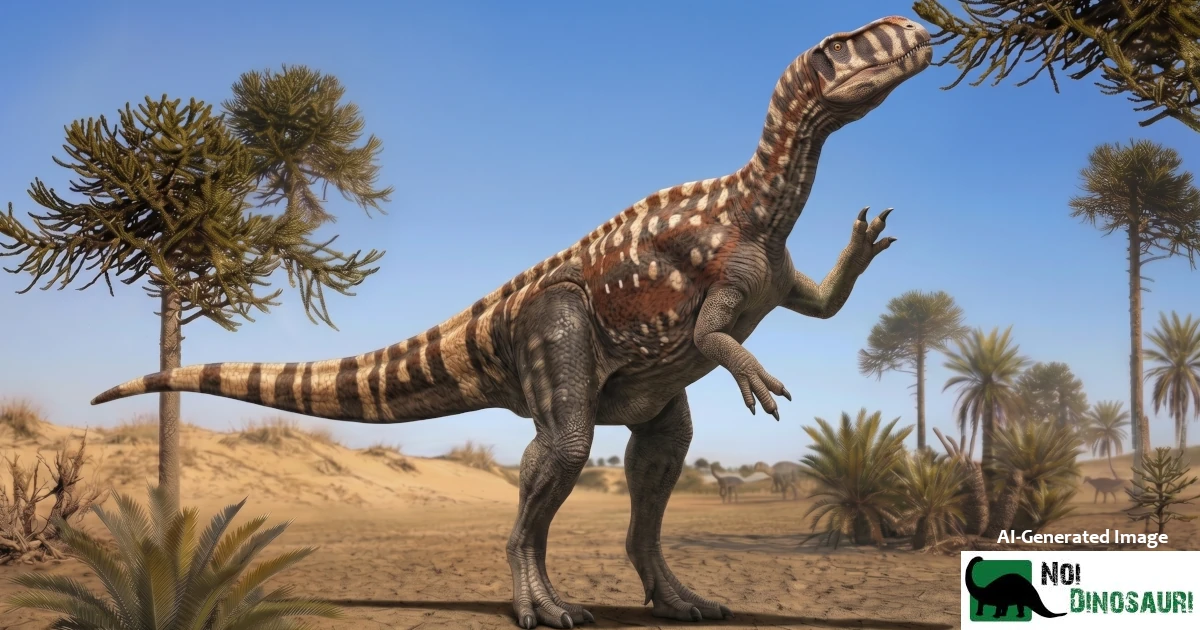
Its survival strategy was bulk-browsing: a massive and indiscriminate consumption of thick plant matter, stripped from the top down. Aardonyx roamed what is now the South African Free State, but roughly 195 million years ago (between the Hettangian and Sinemurian stages), this region was the continental heart of Gondwana. It lived on the fringes of a vast, semi-arid oasis carved by seasonal rivers. Its landscape was painted in the leathery green of cycads, tree ferns, and ancient conifers. It did not rule this ecosystem alone. It shared the foliage with its bipedal cousin Massospondylus, while defending itself from the local apex predator, Dracovenator (a deadly theropod related to Dilophosaurus), and packs of small, swift Megapnosaurus.
Reproduction
Eggs Like Grapefruits (An Extrapolated Nest)
Paleontology requires honesty: to date, no egg or nest has ever been definitively attributed to Aardonyx. To reconstruct its genesis, scientists must use phylogenetic comparison with its closest, well-documented relative: Massospondylus. It is therefore estimated to be an oviparous animal, with females laying crowded clutches of spherical eggs. These eggs were about 6 to 7 centimeters in diameter (similar to large, hard-shelled grapefruits) and were incubated in the warm sands of riverbends.
A Childhood on the Ground
If Aardonyx followed the ontogenetic model of related sauropodomorphs, its life cycle was a miracle of reverse engineering. Based on scans of South African embryos and nests of related species, hatchlings were born purely quadrupedal. They had disproportionate heads and lacked teeth suited for chewing tough vegetation. This forced parents to feed them, pointing to advanced parental care. Only in its adolescent phase would Aardonyx develop the hindlimb muscle mass necessary to lift itself onto its two back legs.
The Extinction
The lineage of Aardonyx was not vaporized by a meteorite impact, but erased by a world undergoing a severe ecological shift. The paleontological community debates two contributing factors. On one hand, the climate of the Karoo basin suffered a progressive and fatal desertification during the Early Jurassic (visible in the sedimentary transition to the Clarens Formation). This reduced the gallery forests necessary to support herds of medium-sized herbivores. On the other hand, evolutionary obsolescence played a crucial role. The more derived descendants of Aardonyx—the first true sauropods, biologically locked to four legs and equipped with titanic necks—proved to be vastly superior foraging machines. They monopolized the ecological niche for large herbivores, driving transitional and "undecided" forms like Aardonyx to extinction.
It must be noted that its exact position on the sauropodomorph family tree remains subject to revision: more recent phylogenetic studies have partially revised the relationships proposed in the original description, and the picture may sharpen further with new discoveries.
Curiosity - Did you know?
How did Aardonyx feed so efficiently without cheeks? To feed with maximum efficiency, Aardonyx achieved an extraordinary biomechanical paradox. Almost all large herbivores (from Triceratops to modern cows) develop cheeks to hold food while grinding it. Aardonyx lost them completely. By abandoning fleshy cheeks and shifting its jaw articulation backward, it could open its mouth much wider than normal for its group. This transformed its head into giant shears for whole branches. Functionally, it is the equivalent of abandoning a knife and fork to swallow an entire bucket of salad in a single bite.