
 IT
IT  DE
DE  FR
FR  ES
ES  PT
PT 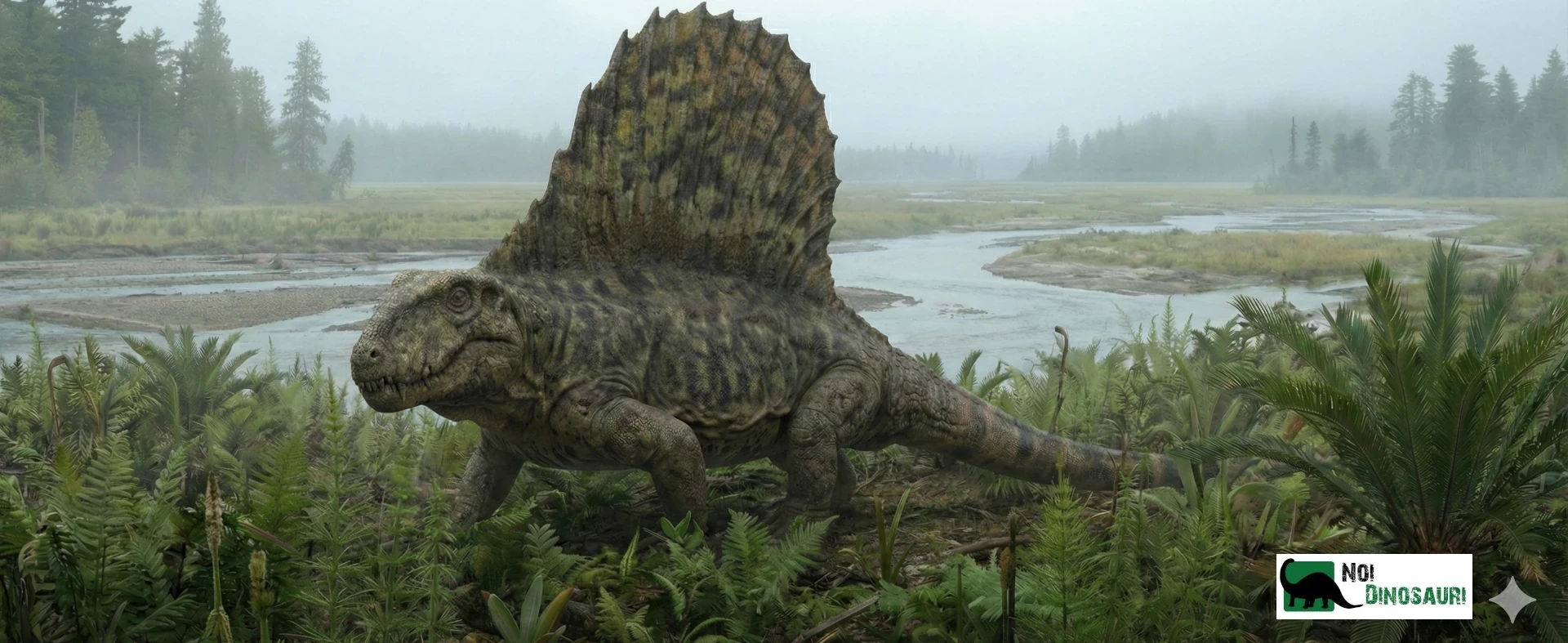
Dimetrodon
Dimetrodon stands as one of the most iconic prehistoric animals, yet popular culture consistently gets it wrong. People routinely mistake this formidable carnivore for a dinosaur or drop it into Jurassic dioramas alongside creatures it never shared a world with. In reality, it is a primitive synapsid belonging to the sphenacodontid family. Thriving during the Early Permian (the Cisuralian epoch, roughly 295 to 272 million years ago), it represents a crucial evolutionary branch that split early from reptiles, ultimately paving the way for modern mammals.
Dimetrodon: History, Characteristics, and Facts
The discovery of this predator traces back to the late nineteenth century, during the Bone Wars — an era of fierce and legendary American fossil hunting. Legendary paleontologist Edward Drinker Cope first described the animal in 1878, analyzing rich fossil deposits excavated from the Red Beds formation stretching across Texas and Oklahoma. The scientific name translates to "two measures of teeth," a direct reference to its highly specialized heterodont dentition that pairs massive incisors with shorter, shearing blades. Today, major institutions worldwide — including the American Museum of Natural History in New York and the Field Museum in Chicago — proudly display these spectacular specimens.
The Biological Heat Engine
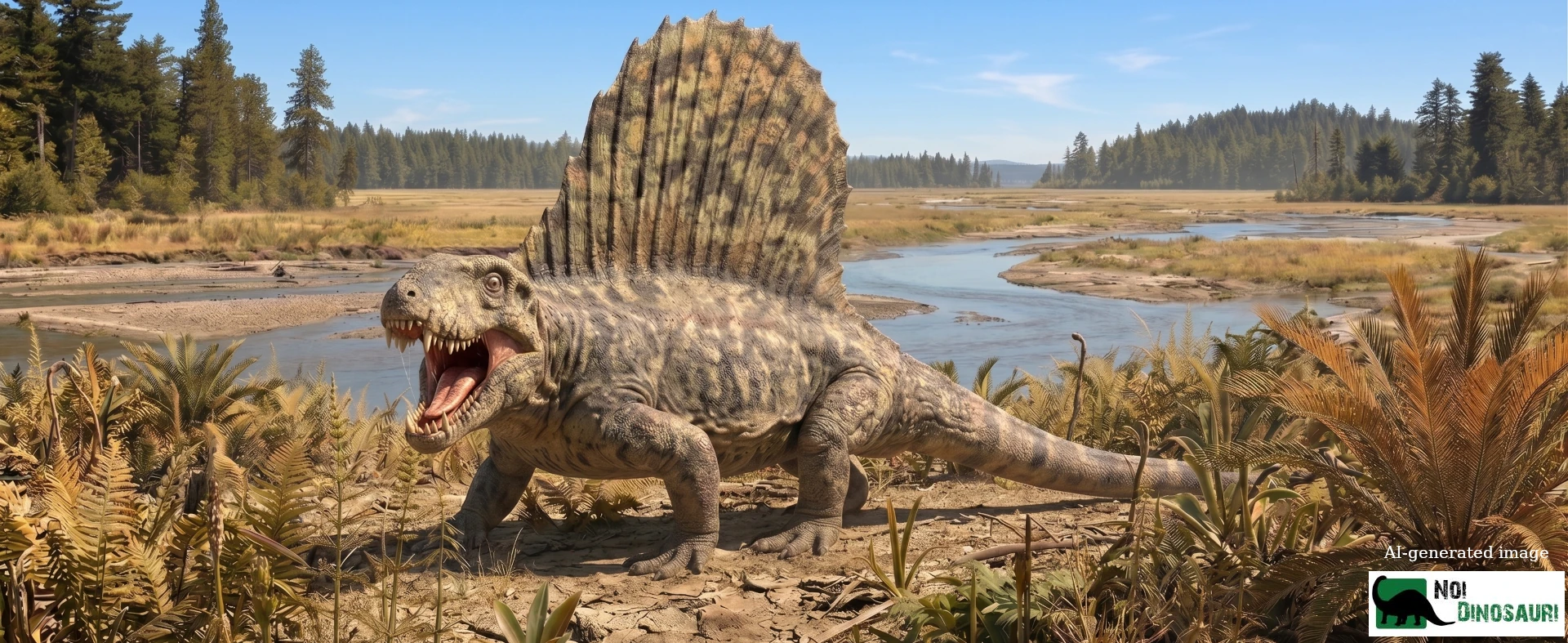
The animal's defining feature was its towering dorsal sail, reaching up to 1.5 meters in height. Elongated neural spines, connected by a richly vascularized membrane of skin, formed this remarkable structure. Microscopic analysis of the bones reveals a complex architecture of grooves and channels — the unmistakable imprint of a dense vascular network, proving unequivocally that blood flushed the sail, keeping it warm to the touch. It functioned as a biological solar panel: by absorbing early morning sunlight, the predator brought its body up to hunting temperature long before cold-blooded prey had a chance to stir, securing a decisive speed advantage over a still-sluggish world. During territorial disputes or mating displays, this blood-flushed sail likely blazed with vivid color, becoming a visual signal visible from a considerable distance.
A Surgical Arsenal
Contemporary reptiles typically possessed uniform, interchangeable teeth. The jaws of Dimetrodon operated on an entirely different principle. Fossilized skulls reveal a sharp spatial division: the front section housed massive incisors built to puncture and lock onto struggling prey, while the rear featured curved canines designed to slice cleanly through muscle and tendon. The result was a devastating mechanical bite — powerful enough to crush the solid skulls of the heavily armored amphibians that shared its swamps.
Built for the Permian Terrain
Forget the cold, glossy scales of a giant lizard dragging its belly through the mud. The biomechanics of the pelvis indicate a semi-erect stance, with sturdy joints lifting the trunk clear of the ground and enabling explosive, short-range sprints. A low center of gravity and exceptionally dense musculature made this animal a remarkably stable hunter across the muddy, uneven terrain of the Permian floodplain. Its close phylogenetic proximity to mammals also points toward a leathery, naked hide — rough and porous, far closer to rhinoceros skin than to traditional reptilian scales.
Popular culture tends to exaggerate the true size of Dimetrodon, pitting it against Mesozoic titans that would only appear tens of millions of years later. Among the dozen currently recognized species, actual size varied considerably: the dwarf species Dimetrodon teutonis measured a modest 60 centimeters, while the late-Permian giants stretched up to 4.5 meters in length, with estimated weights reaching 250 kilograms. Modest by the standards of what came later — but more than enough to make it the undisputed terrestrial apex predator of its entire era.
The Early Permian ecosystem occupied the arid equatorial region of the supercontinent Pangea, a world in a state of constant and rapid transformation. Dimetrodon silently patrolled vast seasonal floodplains and swamps, moving through primitive forests of giant horsetails, tree ferns, cycads, and the earliest conifers. As an opportunistic apex predator, it ruthlessly targeted armored amphibians such as Eryops, bizarre boomerang-headed creatures like Diplocaulus, and the first vulnerable terrestrial tetrapods. It shared this harsh landscape with Edaphosaurus — a similarly sail-backed but herbivorous synapsid, stockier in build, and one that ended up on the predator's menu with unfortunate regularity.
Curiosity - Did you know?
Despite its permanent residence in Jurassic-themed toy sets, Dimetrodon went extinct nearly 40 million years before the first true dinosaur set foot on Earth. Even more surprising: as a synapsid, this sail-backed hunter sits firmly on the same evolutionary lineage that would eventually give rise to mammals. Trace the family tree far enough back, and Dimetrodon turns out to be biologically closer to a human being than to a crocodile, an iguana, or a Tyrannosaurus rex. The next time you spot one standing next to a Triceratops on a toy shelf, you'll know with complete scientific confidence that the pairing is off by approximately 230 million years.