
 IT
IT  DE
DE  FR
FR  ES
ES  PT
PT 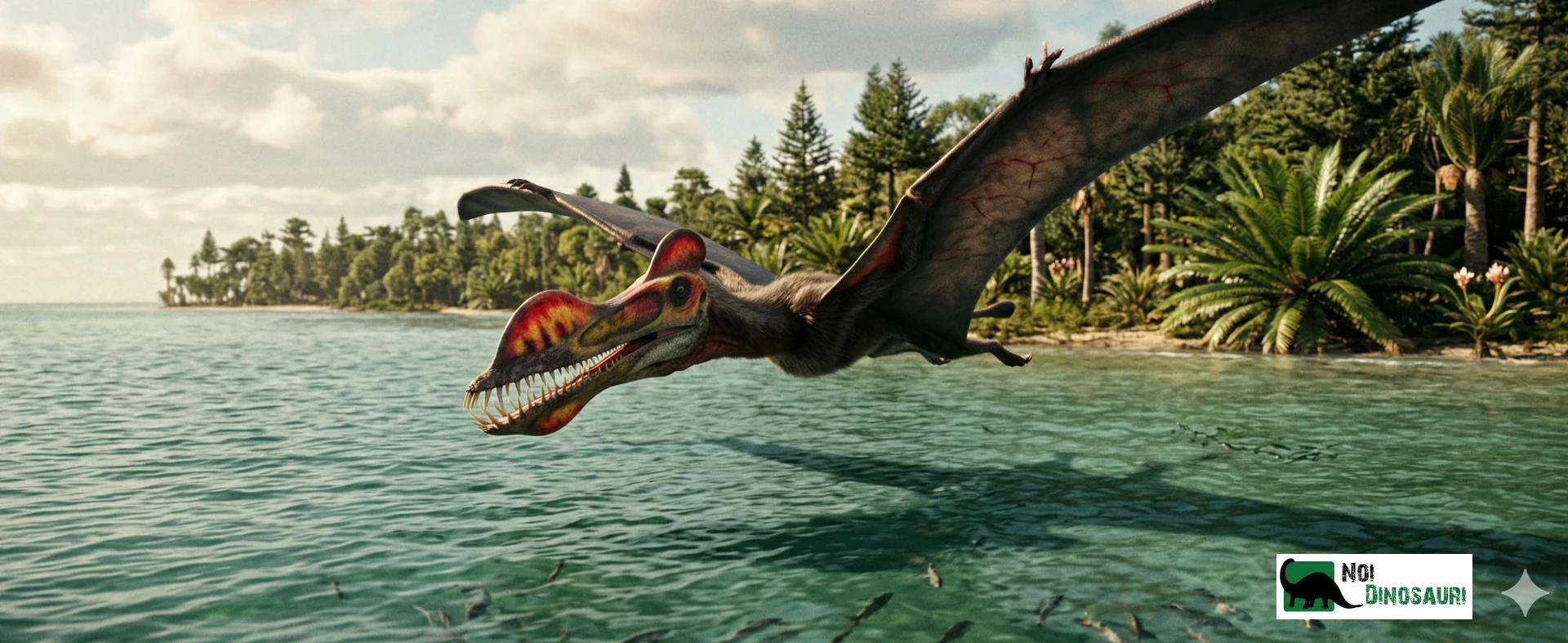
Anhanguera
Anhanguera blittersdorffi was a prehistoric flying reptile—not a dinosaur—that dominated the skies of South America during the Early Cretaceous. Belonging to the Pterosauria order, this formidable aerial predator represents a spectacular example of evolutionary adaptation for hunting fish. It patrolled the coastlines of the ancient supercontinent with a massive wingspan and an unmistakable snout, armed with a highly developed array of sharp teeth.
Anhanguera: History, Characteristics, and Facts
The scientific unearthing of Anhanguera dates back to the 1980s. Paleontologists Diogenes de Almeida Campos and Alexander Kellner officially described it in 1985. They based their research on exceptionally preserved remains extracted from the Romualdo Formation in Brazil's Araripe Basin. The name is deeply evocative: drawn from the indigenous Tupi language, it translates to "old devil" (from anhanga, meaning spirit, and uera, meaning ancient).
The secret to this extraordinary preservation lies sealed within the rock itself. The remains of Anhanguera were not crushed flat like dried flowers in a book. Instead, they fossilized inside spherical limestone nodules. By dissolving the rock with acid, scientists extracted flawless, three-dimensional skulls. Through micro-CT scans, they mapped the inner ear. The orientation of the semicircular canals—the organs of balance—revealed a fascinating detail. In its neutral posture, this flying reptile kept its snout angled downward, its eyes perpetually locked on the water in an endless hunt.
A Mid-Air Snare
When the shadow of this apex predator blocked the sun, a perfect trap snapped shut. Anhanguera rode the thermal currents exhibiting a highly specialized skull. Two rounded crests sat at the tip of its snout and lower jaw, acting like the keel of an icebreaker ship to stabilize its beak as it sliced through the water. Long, sharp teeth erupted from its jaws, pointing outward and locking together. Once this interlocking bite clamped down on slippery prey, escape was impossible.
Glider Build, Hunter's Heart
A wingspan of nearly five meters—roughly the size of a small light aircraft—was supported by a body weighing no more than a mid-sized dog. Anhanguera was a marvel of extreme bioengineering, built to kill while minimizing mass. Its bones featured extreme pneumatization. These hollow tubes had incredibly thin walls, reinforced by internal struts akin to the lattice framework of a construction crane. The membrane of its massive wings was taut and resilient like a diver's wetsuit. Its torso was covered in pycnofibers, a primitive fuzz resembling proto-feathers that provided warm insulation.
Prehistoric Neons on the Waves
Those crescent-shaped crests served more than a mechanical purpose. Beyond stabilizing the beak, they acted as vibrant display structures. To attract a mate or issue a territorial warning, these crests would gorge with blood, flushing with vivid reds and yellows. Once the courtship ended, the hunter returned. Anhanguera glided mere inches above the waves, relying on dynamic soaring, waiting for a silver flash to betray its next meal.
Pop culture frequently exaggerates the size of flying reptiles. However, the wingspan of Anhanguera is scientifically confirmed at 4.5 to 5 meters.
Despite this massive width, its true weight shatters the myth of winged monsters weighing tons. Thanks to a highly specialized skeleton, an adult specimen weighed a mere 8 to 15 kilograms. This extraordinarily lightweight build categorically debunks the cinematic notion that it could lift large prey out of the water.
The ecosystem of Anhanguera was a vibrant coastal and lagoon environment on the ancient supercontinent of Gondwana. As a specialized piscivore, it flew low over the brackish waters of the Araripe Inland Sea. It snatched fish near the surface with swift strikes of its toothed snout, never needing to plunge completely into the water.
Its tropical habitat featured coastlines lined with coniferous forests, cycads, and the earliest rudimentary flowering plants. The waters below teemed with immense schools of fish like Vinctifer, its primary prey. On the shores, it shared the ecosystem with predatory dinosaurs like the spinosaurs (such as Irritator) and other heavily crested pterosaurs like Tupandactylus.
Curiosity - Did you know?
Contrary to the popular image of pterosaurs throwing themselves off cliffs to take flight, recent biomechanical studies reveal a different reality. Anhanguera employed a quadrupedal launch technique. By leveraging the immense power of its arm and wing muscles, it could execute an explosive vault from the ground. This four-limbed pole vault allowed it to take off effortlessly even from flat surfaces like beaches, requiring no natural springboard whatsoever. Built to fly, designed to conquer.