
 IT
IT  DE
DE  FR
FR  ES
ES  PT
PT 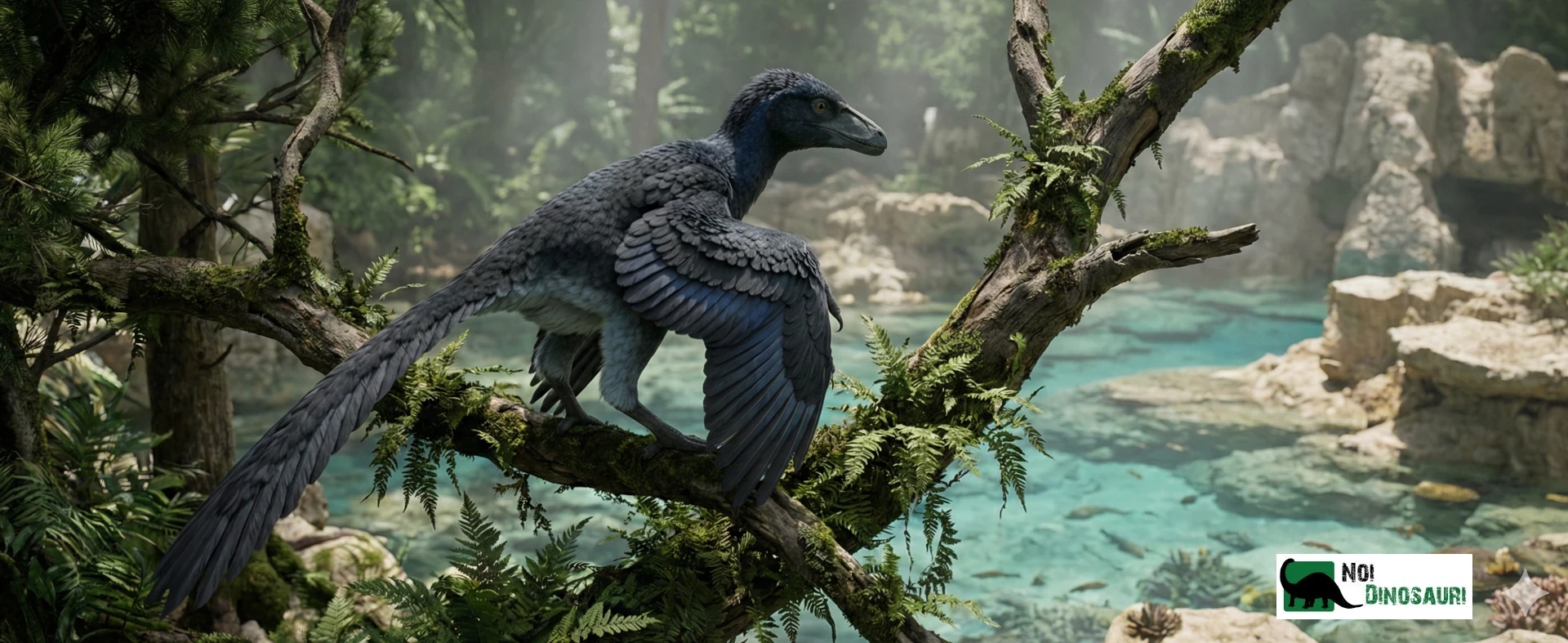
Archaeopteryx
Archaeopteryx lithographica remains one of the most precious and fiercely debated fossils in the history of paleontology. It sits exactly at the evolutionary crossroads between theropod dinosaurs and modern birds. Thriving during the Late Jurassic, scientists classify it within the Avialae clade—the group comprising basal avian dinosaurs. Archaeopteryx wasn't simply a "dinosaur" or a "bird." Rather, it offered the world concrete proof that theropod dinosaurs gradually conquered the skies by evolving increasingly complex plumage.
Archaeopteryx: History, Characteristics, and Facts
Miners unearthed the first clue to this revolutionary creature from the Solnhofen limestone quarries in Germany, and the timing could not have been more historically perfect. Discovered in 1861—just two years after Charles Darwin published On the Origin of Species—a single fossilized feather and a subsequent complete skeleton provided unequivocal confirmation of the theory of evolution.
Paleontologist Christian Erich Hermann von Meyer coined its scientific name by fusing the Greek words archaios (ancient) and pteryx (wing or feather). Today, research institutes around the globe fiercely guard the twelve known, priceless specimens. The London specimen remains the crown jewel of the Natural History Museum, while the Museum für Naturkunde in Berlin proudly displays the most complete fossil ever found.
General Structure
The anatomy of Archaeopteryx represents a stunning mosaic of archaic reptilian traits and avian innovations. Its skull instantly betrayed its dinosaurian origins. The elongated jaws housed a row of small, sharp, conical teeth—acting like precision tweezers that allowed the animal to snatch elusive prey like insects and small lizards with a lightning-fast snap.
The Pioneer's Rudder
Forget the fan-shaped tail of modern birds. This winged pioneer sported a long reptilian appendage consisting of about twenty distinct vertebrae. Feathers flanked this tail in perfect symmetry, creating the aerodynamic rudder of a prehistoric kite. Furthermore, instead of the fused wing bones seen in modern raptors, the center of its wings featured three free, articulated fingers. Each digit ended in a sharp, curved claw. These acted as essential climbing hooks, allowing the creature to scale tree bark or securely grasp its dinner.
Hollow Bones and the Wishbone
Unlike today's great flyers, Archaeopteryx lacked a keeled sternum—the massive bone that anchors powerful pectoral muscles. Instead, independent abdominal ribs called gastralia protected its belly, serving as a bony corset inherited directly from its reptilian ancestors. However, its collarbones had already fused to form the famous furcula (wishbone). In birds, this structure functions like a spring and provides a crucial anchor for flight muscles. Pneumatic, hollow bones completed the skeletal chassis, providing a vital evolutionary adaptation that drastically cut weight without sacrificing structural rigidity.
The Secret of the Black Feathers
Its wings boasted asymmetrical flight feathers. Asymmetry unlocks the secret of aerodynamics, utilizing the exact same physical principle that allows a modern airplane wing to generate lift. In 2012, and definitively confirmed in 2020, electron microscope analyses of a fossilized wing feather revealed perfectly intact melanosomes. These structures proved that the wingtips sported a deep, matte black color.
This wasn't just a stylistic choice. The melanin fused with keratin proteins, densifying the feathers like Kevlar filaments to reinforce them against severe aerodynamic stress and daily wear. This raven-black plumage also acted as an invisibility cloak in the dense undergrowth of ferns and conifers. Simultaneously, it functioned as a biological solar panel, absorbing morning rays to recharge the energy Archaeopteryx needed to sprint, climb, and glide at dawn.
The Reptile's Boot
Plumage did not cover the entire body. Following the evolutionary thread connecting theropod dinosaurs to birds, we know its legs were far from smooth. Exactly like the feet of a modern falcon, the legs of Archaeopteryx featured robust scales and rigid scutes—an indelible dinosaurian signature. Its snout still lacked the rigid keratin beak of modern birds. Instead, soft labial tissue likely covered its jaws, similar to modern lizards, concealing its sharp teeth behind an unmistakable reptilian smile.
The Hunter's Eyes
Dominating a three-dimensional environment of tangled branches and sudden leaps required extraordinary vision. The fossilized skull houses enormous orbits relative to head size. A 2011 study analyzing the sclerotic ring (the bony structure supporting the eyeball) confirmed that Archaeopteryx hunted strictly during the day. Its slightly forward-facing eyes guaranteed binocular vision, allowing it to calculate depth to the millimeter—a matter of life and death when navigating forest canopies. It also likely possessed tetrachromatic vision, meaning it could see ultraviolet light. This extraordinary gift allowed it to easily unmask camouflaged insects hiding within the foliage.
Pop culture often imagines this pioneer of the skies as a massive, primordial eagle. Science tells a very different story. Biomechanical estimates confirm that Archaeopteryx was roughly the size of a modern crow or magpie. It reached a maximum length of about 50 centimeters (including its long feathered tail) and weighed a mere 0.8 to 1 kilogram. This tiny, lightweight build proved absolutely essential, allowing a primitive muscular system to successfully lift the animal off the ground.
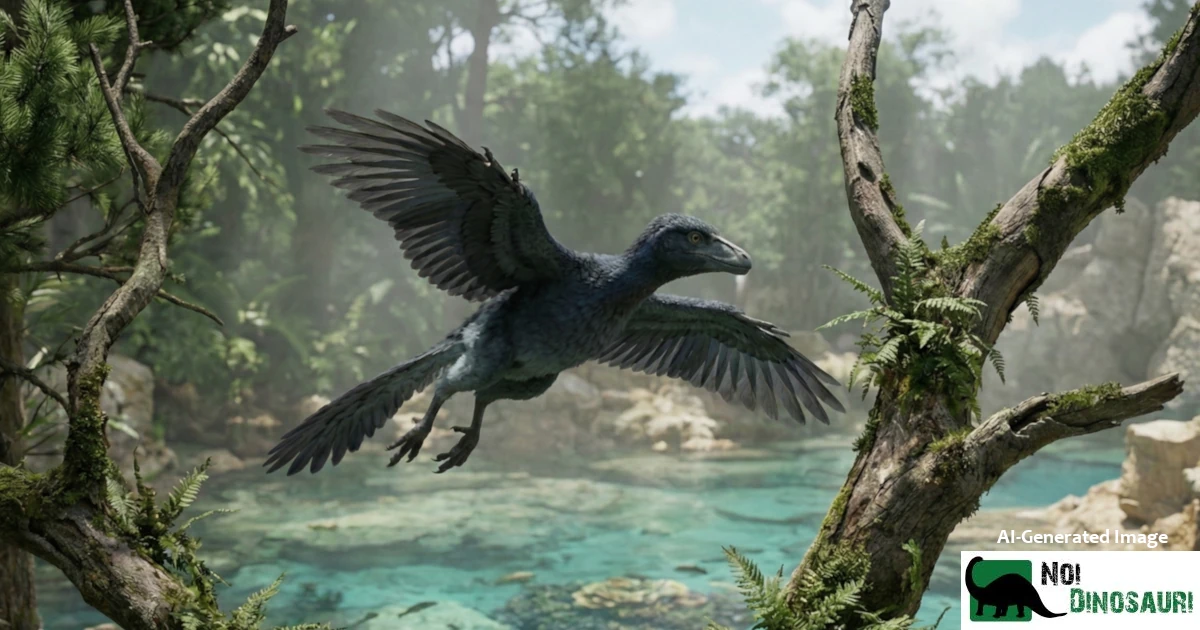
Archaeopteryx functioned as an agile, opportunistic predator. It fed primarily on insects, small lizards, and primitive mammals. Its micro-carnivorous diet perfectly matched the shape of its teeth, which easily pierced tough chitinous exoskeletons.
Geographically, its home looked radically different from modern continental Germany. Archaeopteryx inhabited the supercontinent of Laurasia, specifically within a tropical archipelago bathed by the shallow, warm waters of the Tethys Sea. Brackish lagoons and arid islands defined the landscape, supporting drought-resistant flora like cycads, seed ferns, and low conifers (such as Brachyphyllum).
It shared these islands with highly competitive prehistoric fauna. Pterosaurs like Pterodactylus and Rhamphorhynchus dominated the skies above, while the small, voracious theropod Compsognathus stalked the ground below. In the neighboring shallow waters, crustaceans and ancient horseshoe crabs (Mesolimulus) thrived in abundance.
Curiosity - Did you know?
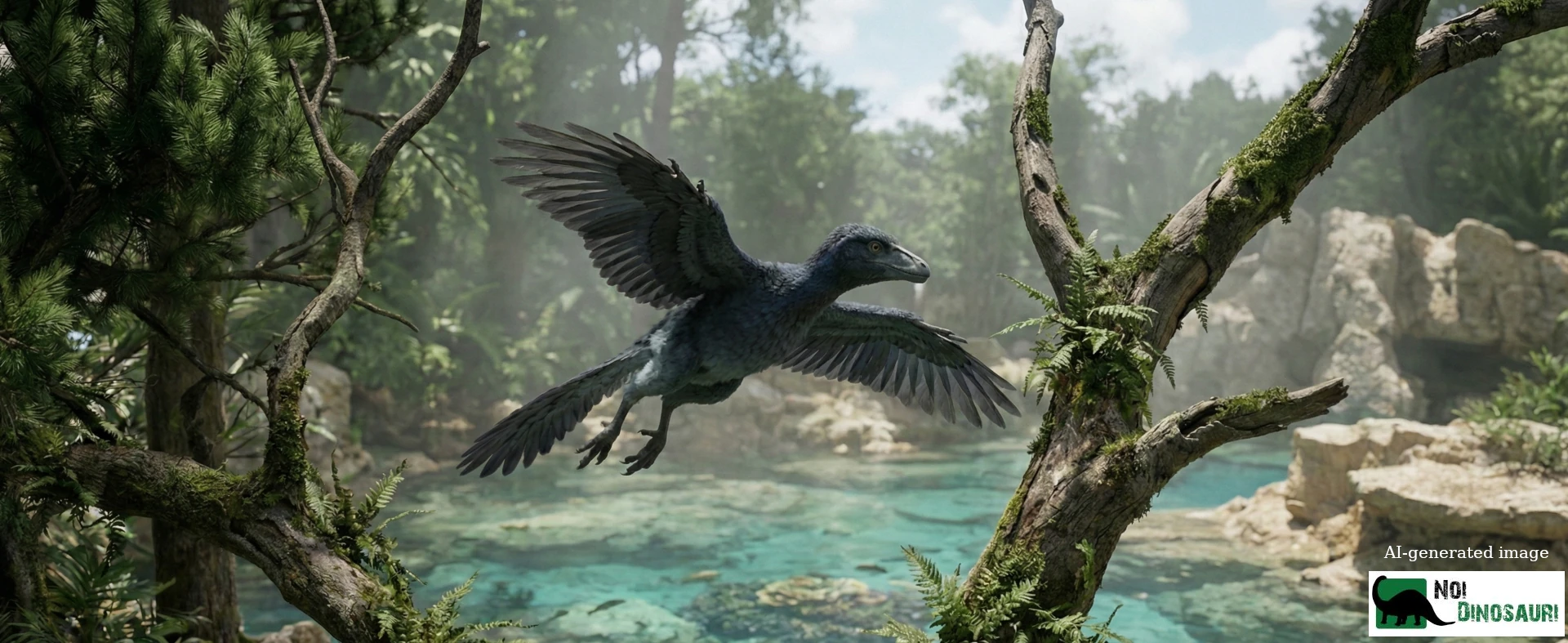
For over a century, paleontologists debated whether Archaeopteryx actively flapped its wings or merely glided from high branches. In 2018, scientists utilized synchrotron X-ray microtomography on its long bones and finally solved the enigma.
The scans revealed that the bone walls of its arms possessed a thickness and torsional resistance matching modern birds capable of active burst flight over short distances, much like today's pheasants. Lacking the complex shoulder joint of modern birds, its wing strokes must have looked incredibly peculiar. While it lacked efficient, long-distance flight capabilities, it generated more than enough power to escape ground predators or leap agilely from branch to branch!