
 IT
IT  DE
DE  FR
FR  ES
ES  PT
PT 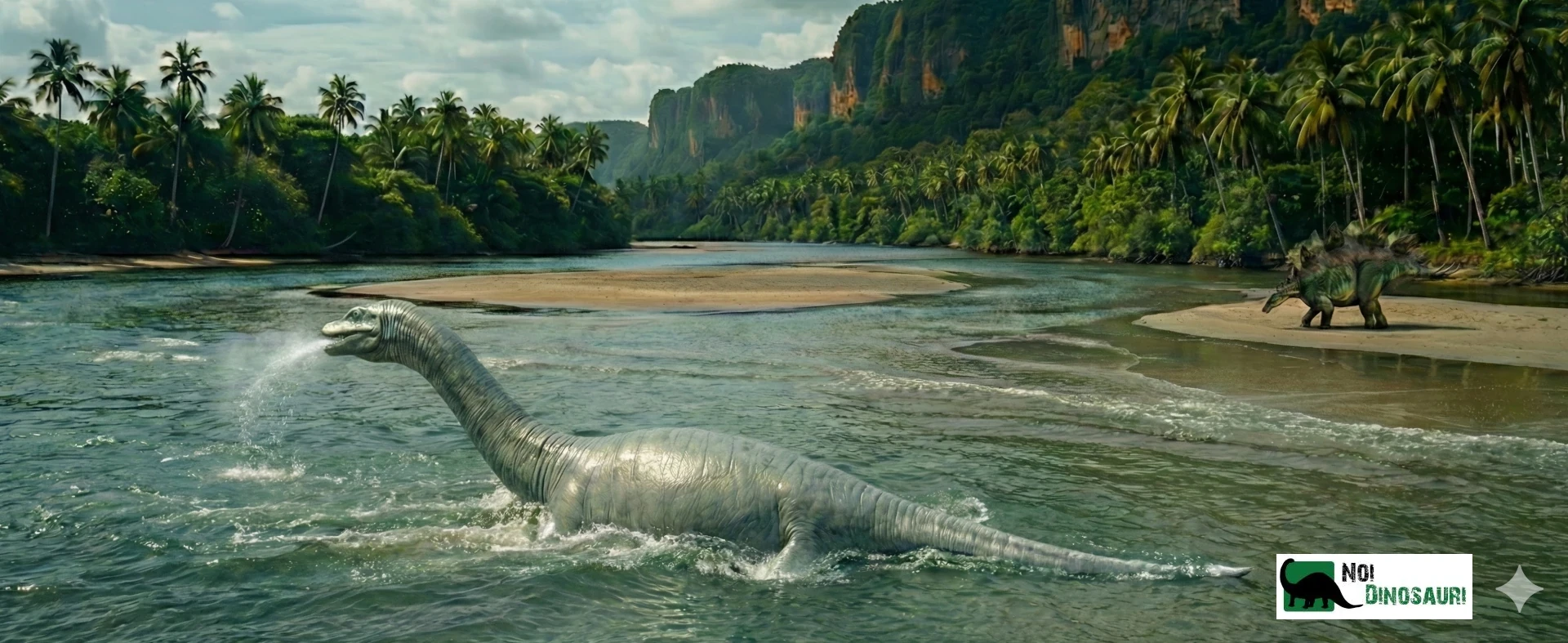
Plesiosaurus
The Plesiosaurus was an extinct marine reptile of the Plesiosauria clade. It dominated oceanic ecosystems during the Early Jurassic (199–190 million years ago). Often mistaken for a dinosaur. A common taxonomic error. This aquatic predator belonged to the Sauropterygia superorder. A separate evolutionary branch. These reptiles severed their ties with dry land to entirely reconquer the planet's waters.
Plesiosaurus: Curriculum Vitae of the species
History and Discovery
The fossil record of the Plesiosaurus bears the signature of Mary Anning. In 1823, scaling the unstable cliffs of the Jurassic Coast in Lyme Regis (Dorset, England), the pioneering paleontologist extracted the world's first complete skeleton. Geologists William Conybeare and Henry De la Beche had coined the scientific name a few years prior, analyzing fragmented bones. They combined the Ancient Greek plesios ("near to") and sauros ("lizard"). The terminology established a boundary. It marked a departure from the archaic anatomy of the Ichthyosaurus and certified a bone structure closer to modern squamate reptiles. Today, the holotype of Plesiosaurus dolichodeirus anchors the galleries of the Natural History Museum in London.
Anatomy and characteristics
The anatomy of the Plesiosaurus was pure biomechanical engineering for the pelagic environment. It possessed a barrel-shaped trunk. Stout, flat, and rigid. A chassis akin to a sea turtle stripped of its carapace. Hydrodynamic stability relied on four massive, paddle-shaped flippers. Their simultaneous beat generated an "underwater flight." A propulsion dynamic identical to modern penguins.
The tail was short, thick, and straight. No motor thrust: it operated strictly as a directional rudder.
The tactical pivot was the neck. A tapering structure supported by roughly 40 cervical vertebrae, ending in a compact head with a flattened skull. Ligaments prevented the contortions of a snake. The mobility radius served a single purpose: ballistic frontal lunges to intercept prey.
Nostrils set high near the eyes allowed lightning-fast surface gas exchanges. No gills. The Plesiosaurus breathed atmospheric oxygen. Deep dives challenged buoyancy physics through pachyostosis. Hyper-dense, heavy bones. An anatomical ballast. They counteracted the upward lift of air-filled lungs, pinning the animal in neutral buoyancy at mid-water. Zero caloric waste. The thorax was armored by a dense grid of ribs, including abdominal ribs (gastralia). They formed a rigid cage shielding vital organs and hypertrophic lungs from hydrostatic pressure. A low-gear metabolism completed the system, optimizing muscle oxygen consumption during extended apnea.
The 2025 Skin Revolution
Science long assumed Plesiosaurus skin was naked and smooth. A paradigm overturned in February 2025 by Current Biology. Researchers from Lund University (Sweden) scanned intact soft tissues from a 183-million-year-old German fossil. The dermis was a functional mosaic. Trunk and tail exposed a smooth, scaleless surface. Tissue mimicking the modern leatherback turtle to slice through fluids and cancel drag. The flippers hid a different blueprint. Subtriangular scales lined their trailing edge, mirroring the green sea turtle. Applied biomechanics: they stiffened the paddle's profile and offered an abrasive shield against submarine rocks.
Microscopic analysis mapped fossilized melanosomes. The chromatic report indicates dark tones: lead gray, black, and saturated brown on the dorsal area. A dual-mandate pigmentation. Capture solar radiation upon surfacing (thermoregulation) and activate bidirectional camouflage. Darkness against the seabed for observers above, a broken silhouette in surface glare for predators below.
Actual Size (Myth vs. Reality)
Cryptozoological narratives distort the fossil record. The Loch Ness Monster is a literary construct. The Early Jurassic Plesiosaurus lacked the gigantism of the Cretaceous Elasmosaurus. Its maximum extension capped at 3.5 meters. Tonnage fluctuated between 400 and 500 kilograms. A predator the size of an adult dolphin. Compact dimensions for a rapid hunter. Programmed for millimeter agility, not massive bulk.
Diet and Paleoecology
Jurassic Europe was submerged. A labyrinth of shallow tropical seas. The Tethys Sea wedged between the supercontinents of Laurasia north and Gondwana south. Volcanic archipelagos hosted dense forests of tree ferns, cycads, and early conifers.
Hunting relied on ambush. The mobile neck cleaved through fish formations. Long, needle-like conical teeth formed an interlocking trap. Fatal for slippery tissues. A regime of strict carnivory. The target matrix included small bony fish and armored cephalopods like belemnites and ammonites. It shared submarine hunting routes with the hyper-fast Ichthyosaurus. The aerial zone was patrolled by early toothed pterosaurs like Dimorphodon.
Curiosity - Did you know?
Erase the image of the neck erected out of the water in a swan curve. A biomechanical error rooted in 19th-century illustration. Tomographic scans of the cervical vertebrae prove the joints and ligaments were inflexible. Raising the head vertically against gravity would have shattered the spine. The neck operated horizontally. A vector of stealth approach. Below the surface, the head infiltrated schools of prey fractions of a second before the hydrodynamic mass of the body triggered flight receptors.