
 IT
IT  DE
DE  FR
FR  ES
ES  PT
PT 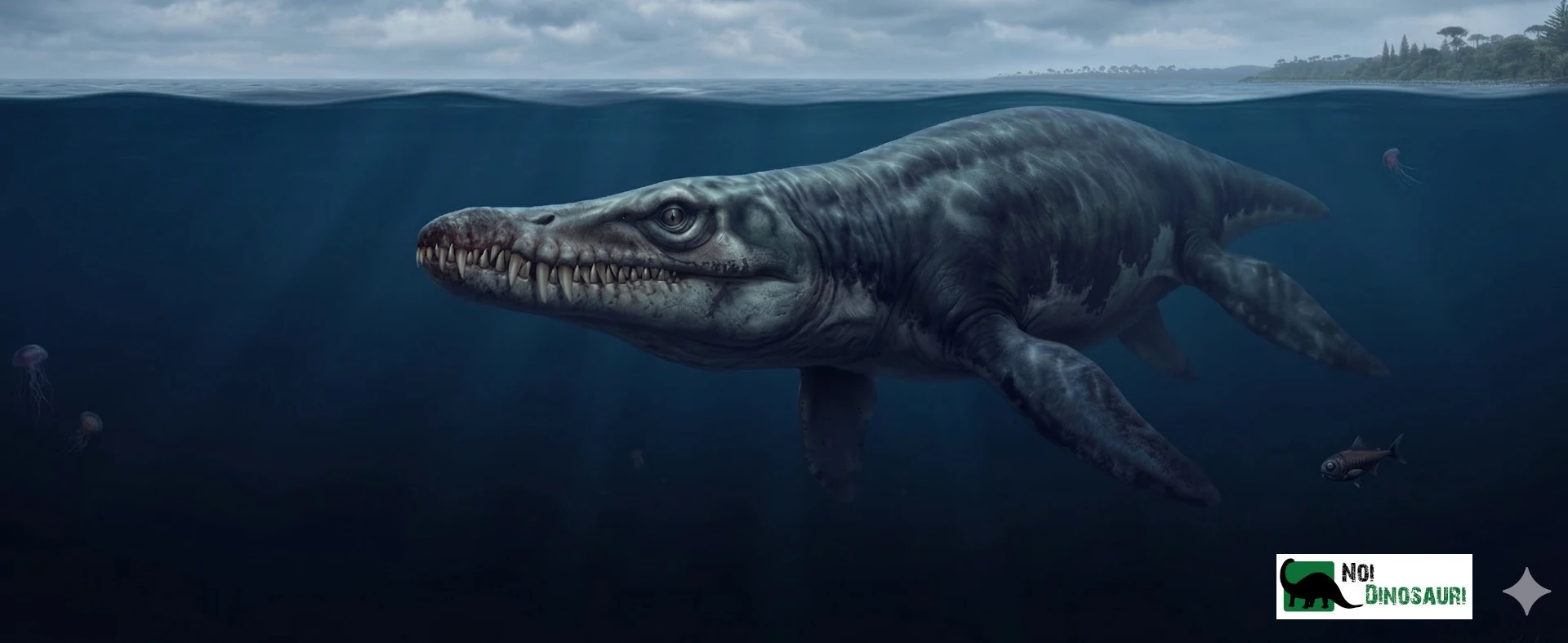
Kronosaurus
Kronosaurus was a colossal marine reptile belonging to the clade Pliosauridae—and importantly, it was not a dinosaur. This apex predator ruled the oceans during the Early Cretaceous period, roughly 120 to 100 million years ago. Widely recognized as one of the most formidable carnivores in Earth's history, this leviathan combined exceptional hydrodynamics with devastating jaw power, securing its undisputed place at the absolute top of the aquatic food chain.
Kronosaurus: History, Characteristics, and Facts
The story of Kronosaurus begins in 1889, in the arid outback of Queensland, Australia, where the first fossil fragments hinted at a true titan of the abyss. Paleontologist Heber Longman officially named the creature in 1924. He combined "Cronus"—the Greek Titan who devoured his own children—with "sauros" (lizard), a fitting tribute to the predator's relentless nature. Today, the most significant Australian specimens reside at the Queensland Museum.
A controversial chapter in the pliosaur's history involves the famous "Harvard skeleton" housed at the Museum of Comparative Zoology. Reconstructed in the 1950s, the mount incorporated massive amounts of plaster and an excess of vertebrae, earning it the affectionate, if critical, nickname "Plasterosaurus."
Today, the taxonomy of Kronosaurus remains highly dynamic. Between 2022 and 2024, heated debates erupted as new studies suggested the best-preserved Australian fossils actually belong to a new genus, Eiectus, while the Colombian species was reclassified as Monquirasaurus. Consequently, Kronosaurus taxonomy is currently one of the most intensely debated topics in modern paleontology.
A Cathedral of Bone and Fang
The skull of Kronosaurus was more than just a head; it was a biological siege weapon spanning nearly three meters, making up almost a quarter of the animal's total length. Measuring the Harvard skeleton's jaw cavities revealed spaces for massive, conical teeth the size of ripe bananas. Lacking serrations, these teeth evolved not to slice, but to puncture and hold. Unlike great white sharks, Kronosaurus possessed deep, heavily anchored tooth roots. This structural integrity allowed the jaws to withstand some of the highest bite pressures ever generated by a marine reptile. The most dramatic evidence of this power comes from the fossilized remains of an Eromangasaurus—a long-necked plesiosaur—which display bite marks perfectly matching the spacing and shape of Kronosaurus teeth. It is the unmistakable signature of a prehistoric ambush.
Flying Through the Abyss
While sharks and most fish rely on tail propulsion, Kronosaurus essentially flew underwater. It utilized four enormous flippers, moving them with the powerful, synchronized rhythm of a giant prehistoric penguin. This method generated lightning-fast acceleration, perfect for launching surprise attacks. Deep bone scars on the massive fossilized shoulder and pelvic girdles confirm this: the vast muscle attachment areas indicate the flipper muscles were incredibly powerful and built for explosive bursts of speed. Its skin was likely smooth and taut, similar to modern cetaceans like orcas, minimizing hydrodynamic drag. Evolutionary biology also suggests the animal exhibited countershading: a dark dorsal side to blend with the murky depths, and a light ventral side to vanish against the sunlit surface above.
The Ultimate Sensory Array
Kronosaurus possessed immense eyes. An analysis of the sclerotic ring—the bony structure supporting the eyeball—in the best-preserved fossils reveals a massive internal diameter. This indicates the pupils could dilate widely to capture every available photon in the dimly lit ocean depths. However, its greatest predatory advantage was directional olfaction. CT scans of fossilized skulls reveal complex internal channels connecting the external nostrils to the choanae (openings in the palate). This system allowed a constant flow of water across sensory tissues, enabling the pliosaur to "taste" the water and pinpoint the exact direction of prey from miles away, even in terrible visibility.
The Armor Crusher
Kronosaurus was not a picky eater; it was the ocean's premier crushing machine. Rather than chewing, it seized its prey and violently thrashed it, dismembering victims with brute jaw strength. No natural armor could withstand the assault. Paleontologists have found the fossilized remains of other plesiosaurs and shattered ammonite shells within the abdominal cavities of Australian specimens. Researchers have also discovered gastroliths—smooth stones swallowed from the seafloor—mixed with semi-digested cephalopod remains in the ribcages of some individuals. These stones likely acted as a gastric mill, grinding down whatever the teeth had not already pulverized.
For decades, museum displays exaggerated the true size of Kronosaurus before modern biomechanics grounded the myth. Thanks to the flawed Harvard reconstruction and its superfluous plaster vertebrae, textbooks long cited lengths of around 13 meters. Today, rigorous comparative studies with more complete pliosaur skeletons indicate that mature adults reached a maximum length of 9 to 10.5 meters. Yet, even scaled down, Kronosaurus remains an awe-inspiring colossus. Weighing an estimated 10 to 12 tons, it possessed the sheer bulk of a modern female sperm whale, easily dominating every other creature in its habitat.
Kronosaurus prowled the Eromanga Sea, a vast, shallow epicontinental waterway that split the ancient supercontinent of Gondwana. Now the arid Australian outback, this region was once a nutrient-rich marine ecosystem bordered by coastlines dense with conifer forests (Araucariaceae), tree ferns, and cycads. In this vibrant underwater world, Kronosaurus reigned supreme. Its varied diet included giant cephalopods, ammonites, and large marine reptiles. It shared its waters with ichthyosaurs like Platypterygius, marine turtles, and armored fish. Fossilized stomach contents, including the remains of the elasmosaurid Eromangasaurus, prove this predator routinely ambushed its long-necked cousins with devastating, high-speed strikes.
Curiosity - Did you know?
The dentition of Kronosaurus defies the typical expectations for an apex superpredator. Unlike the serrated, meat-slicing teeth of a Tyrannosaurus rex or a Great White Shark, the teeth of Kronosaurus (reaching up to 30 cm in length) were thick, smooth, and conical. This unique biomechanical design, paired with a devastating bite force estimated at up to 30,000 Newtons (nearly double that of an adult saltwater crocodile), made its jaws the ultimate crushing tools. They were perfectly engineered to shatter the hard carapaces of giant turtles and crush the dense skulls of ichthyosaurs, allowing the leviathan to swallow massive chunks of bone whole.