
 IT
IT  DE
DE  FR
FR  ES
ES  PT
PT 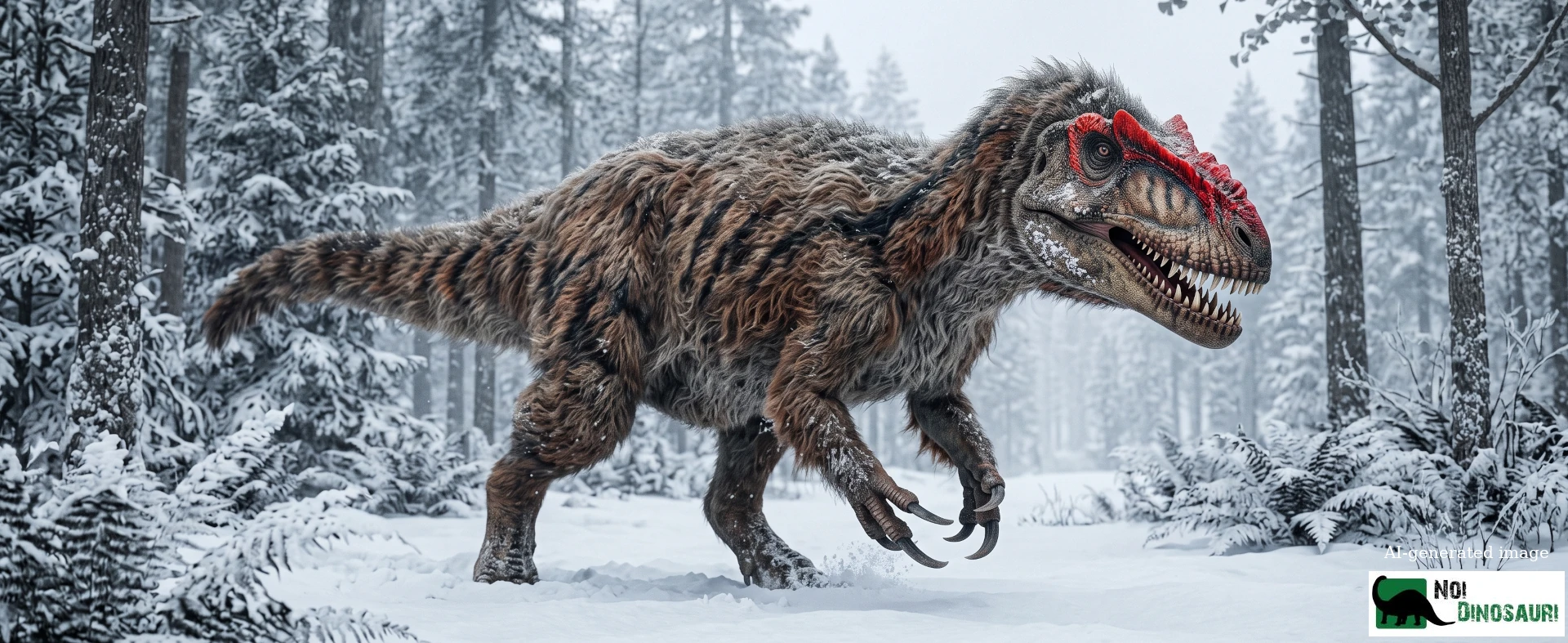
Yutyrannus
Yutyrannus huali is a massive theropod dinosaur from the superfamily Tyrannosauroidea. It roamed the Earth during the Early Cretaceous period, roughly 125 million years ago. This formidable predator sparked a pivotal shift in modern paleontology. It provides undeniable proof that even the giant cousins of Tyrannosaurus rex sported a thick coat of feathers. This discovery forever changed our visual understanding of the great carnivorous dinosaurs.
The full name literally translates as "feathered tyrant."
Yu: From the Chinese word yǔ (羽), meaning "feather."
Tyrannus: From the Latinized Greek týrannos (τύραννος), meaning "tyrant."
Yutyrannus: History, Characteristics, and Facts
Paleontologist Xu Xing and his team discovered this predator in 2012, instantly shaking the scientific world. Its scientific name blends Latin and Mandarin to mean "beautiful feathered tyrant." Researchers unearthed three exceptionally well-preserved fossil specimens from a quarry in China's Liaoning Province. These remains lay hidden within a famous geological deposit known as the Yixian Formation. Today, scientists study and display these priceless fossil specimens at the Shandong Tianyu Museum of Nature.
The Feathered Paradox
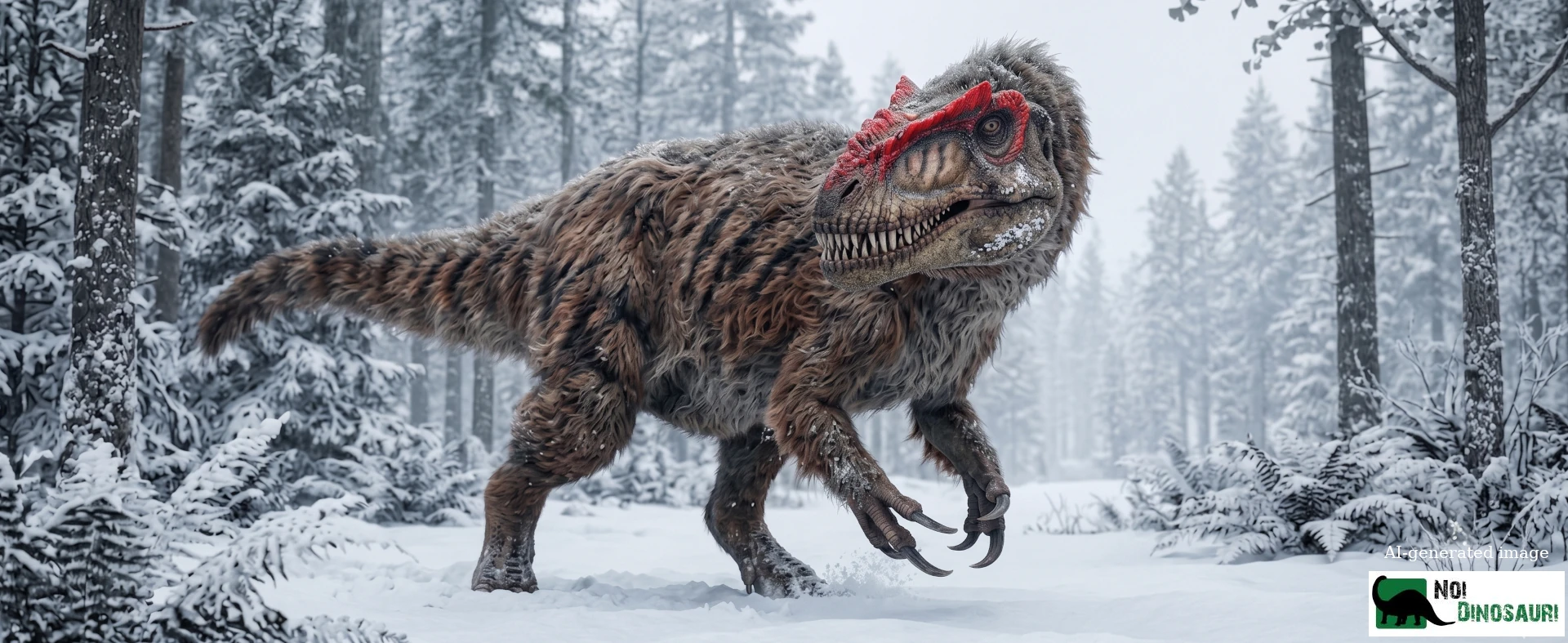
Imagine the ultimate nightmare. A predator as long as a school bus charges toward you, covered in a soft mantle resembling a giant wolf pup. Forget the scaly movie monsters. Running a hand along its flank would reveal the coarse texture of dense filamentous feathers. It would feel much like the boiled wool of a heavy winter coat. This animal embodies the perfect prehistoric paradox: a ruthless killing machine wrapped in a fleece blanket.
An Unexpected Lineage: The Proceratosaurids
Scientists classify this dinosaur as a tyrannosauroid, but with a crucial distinction. It belongs to the Proceratosauridae, a primitive branch located near the root of the evolutionary tree. It is not a direct ancestor of the famous North American tyrant, but rather an older, distant cousin. It shares this family with other small, feathered Chinese theropods like Guanlong. A 2016 phylogenetic analysis by paleontologists Thomas Carr and Stephen Brusatte confirmed this classification, helping explain why the species retains so many primitive physical traits.
The Tyrant's Arsenal
Its skull functions as a biological weapon designed to tear through flesh. The jaws conceal dozens of sharp, serrated teeth acting as biological steak knives. These teeth easily sliced between muscles to cause fatal hemorrhages. The animal heavily relied on its forelimbs, possessing long, muscular arms that ended in three curved claws. This represents a primitive, or plesiomorphic trait, typical of early tyrannosauroids — one that would only shrink away in the more derived, Late Cretaceous tyrannosaurids. Each deadly claw possessed the length and power of a machete blade, perfectly designed to harpoon fleeing prey.
Blood on the Snow
Picture the stark visual contrast of its ancient habitat. This carnivore thrived in the freezing environment of the Early Cretaceous, navigating coniferous forests often dusted with snow. Within this monochromatic landscape, its plumage created a dynamic display of mimicry and threat. Its body likely sported earthy tones broken by dark striations to blend with tree shadows. However, scientists hypothesize that a prominent bony crest on its snout flared with vivid red pigments. This flashy adaptation screamed territorial dominance to rivals without requiring a single sound.
The Volcanic Photocopier
We do not have to guess about this visual and tactile extravagance. We know this colossus weighed more than a subcompact car and sported feathers due to a remarkable taphonomic miracle. Paleontologists unearthed an adult and two juveniles buried together under a sudden downpour of volcanic ash. This ultra-fine ash acted as a high-resolution prehistoric photocopier, sealing the rock long before the soft tissues could decay. Etched directly into the stone slabs surrounding the bones are fossilized impressions of dense plumage. It stands as definitive proof, printed straight into the rock: even Earth's most terrifying giants had to bundle up to survive the cold.
This officially reigns as the largest feathered animal ever documented by science. This shatters the outdated myth that only small or medium-sized dinosaurs possessed plumage. Rigorous osteological estimates assign adult specimens a maximum length of roughly 9 meters (30 feet). Experts calculate a hypothetical body mass of around 1.4 tonnes, though all dinosaur mass estimates carry a margin of uncertainty. While it lacks the titanic bulk of Late Cretaceous cousins, its massive size unequivocally crowned it the apex predator of its ecosystem.
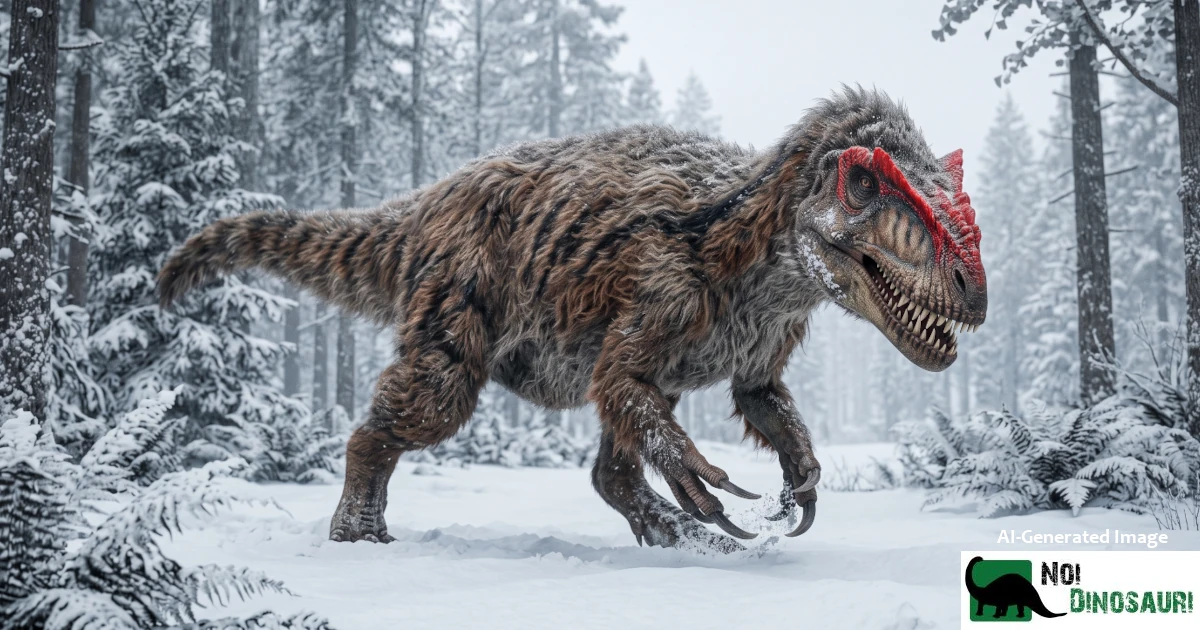
This ecosystem sat on the ancient supercontinent of Laurasia, offering a biome radically different from classic tropical jungles. The region featured a temperate-to-cold environment defined by harsh winters, heavy snowfall, and active volcanoes. Dense forests of ancient Ginkgo, conifers, and fern undergrowth blanketed the landscape. As the apex predator of this world, Yutyrannus hunted large herbivorous dinosaurs, taking down bulky prey like the sauropod Dongbeititan and local herds of iguanodontians. It shared this rugged territory with small ceratopsians like Psittacosaurus, other feathered theropods like Sinornithosaurus, and some of the earliest true birds, such as Confuciusornis.
Reproduction
Paleontologists have yet to find nests, eggs, or embryonic remains for this species. Our understanding of its growth relies entirely on comparing the three original specimens. This rare grouping includes an adult holotype and two smaller juveniles, one estimated to be roughly eight years younger than the other, providing a unique snapshot of the species' development. These comparisons reveal an allometric growth pattern: as the animal aged, its lower legs, feet, arms, and pelvis became proportionally smaller relative to the rest of the body, while the skull grew progressively more massive and deep. In other words, juveniles started out relatively leaner and lighter, only developing that imposing build and heavy-duty skull in adulthood. No direct evidence exists for courtship behavior, parental care, or clutch size — any claim along those lines, even by analogy with other tyrannosauroids, remains pure speculation.
The Extinction
We must separate fact from speculation regarding the demise of this predator. The fossil record shows no evidence of a sudden, catastrophic extinction event wiping out the species. While the three famous specimens likely died together in a single, localized event — possibly a volcanic mudflow — this only marks the end of one family group, not the entire species. Instead, we observe a gradual shift within the broader Jehol Biota ecosystem. Moving up the stratigraphic column into the younger Jiufotang Formation, Yutyrannus simply disappears from the fossil record, while the surrounding fauna of theropods, early birds, and other vertebrates changes alongside it. In the absence of further discoveries, the most cautious explanation points to ordinary evolutionary pressures rather than any single catastrophe: gradual habitat change, competition from emerging species, and the environmental instability driven by the region's intense volcanic activity.
Curiosity - Did you know?
Did Yutyrannus hunt in packs?
Yes, this predator likely hunted in packs or lived within close-knit family groups. In 2012, paleontologists discovered three original specimens fossilized close together in the exact same rock layer. Experts hypothesize that a lethal volcanic mudflow caught the trio off guard, killing them simultaneously as they moved or hunted together.