
 IT
IT  DE
DE  FR
FR  ES
ES  PT
PT 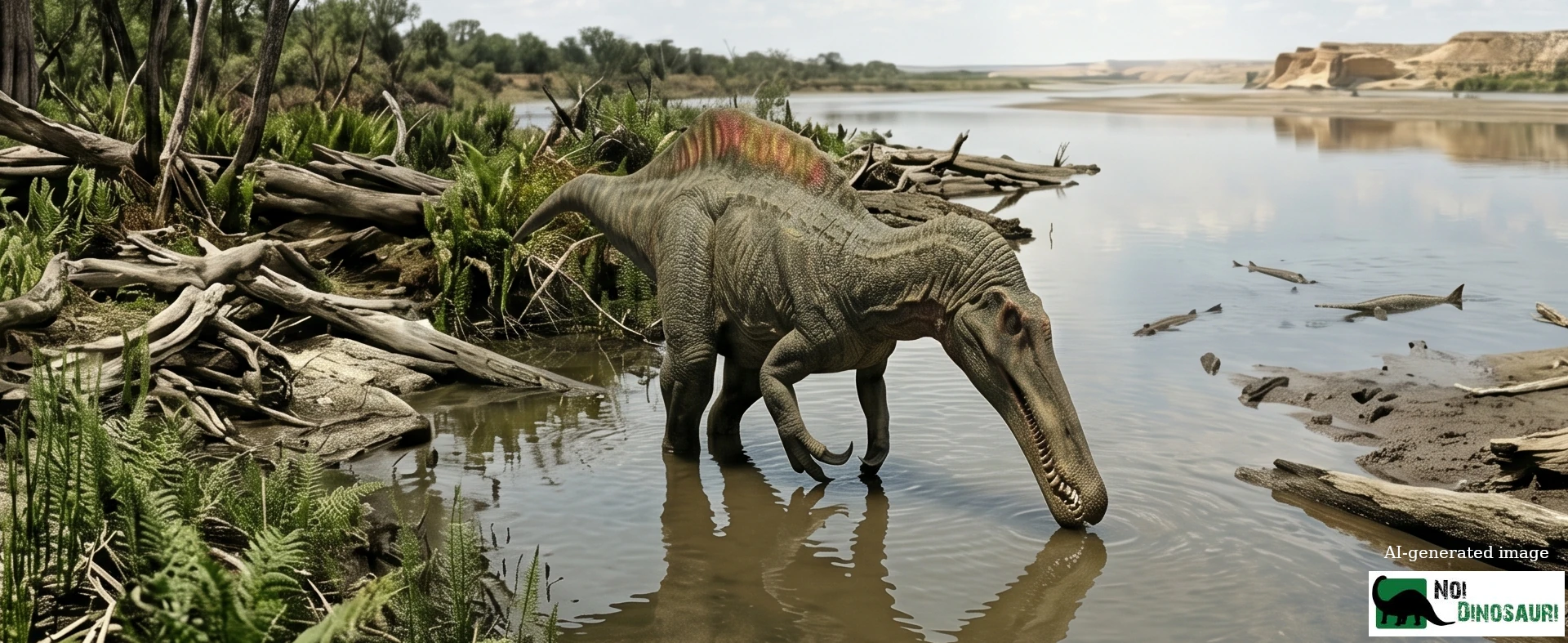
Suchomimus tenerensis
Suchomimus was a formidable theropod dinosaur that dominated African aquatic ecosystems during the Early Cretaceous, roughly 125 to 112 million years ago. A card-carrying member of the Spinosauridae family, it turned its back on the hunting grounds every other large carnivore fought over — a radical evolutionary departure, fusing the raw lethality of a theropod with the hyper-specialized cranial anatomy of a modern crocodile.
Suchomimus tenerensis: History, Characteristics, and Facts
The story of Suchomimus begins in 1997, in the scorching expanse of Niger's Ténéré Desert. A team led by renowned paleontologist Paul Sereno pulled exceptionally preserved remains from the sand and named their find Suchomimus tenerensis — literally, "crocodile mimic from the Ténéré," a direct tribute to that improbably elongated snout. Today, the holotype specimen and its meticulously reconstructed skeleton reside at the Field Museum of Natural History in Chicago, a cornerstone reference for the entire spinosaurid family tree.
The False Crocodile: A Snout Out of Place
Picture a skull stretching 1.2 meters — straight, narrow, streamlined as a racing bicycle frame. No bone-crushing block of a head. No T. rex arsenal. Suchomimus arrives as a lethal anomaly of the African Cretaceous. Its jaws didn't hide butchering blades but a terminal rosette packed with over a hundred sharp, conical teeth. How do we know? Electron microscopes turned on the fossilized enamel told the story: not a single serration — none of the trademark cutting edges found in terrestrial killers. These weren't knives. They were biological spikes, engineered to spear slippery, thrashing prey, not to carve flesh.
The Butcher's Scythes: An Inescapable Grip
The forelimbs of this giant were the nightmare of every river system it patrolled. Thick as concrete pillars, each arm ended in three robust fingers, and the thumb was a weapon of pure destruction: a 30-centimeter curved hook, sharp as an agricultural scythe. A biological tow hook. Deep muscle scars burned into the fossil bone don't lie — they describe a musculature capable of generating monstrous traction, enough to snag a thrashing prehistoric fish mid-current and haul it ashore with no possibility of escape.
The Sail: A Billboard in Blood
Running along its spine, Suchomimus raised a low, fleshy crest, braced by vertebral extensions nearly half a meter tall. Forget shark fins — this was a neon billboard. X-ray scans of the neural spines reveal obvious vascular channels: the area was drenched in blood supply. Picture that crest flooding red and gold under a merciless Cretaceous sun, blazing to intimidate rivals or signal dominance across the floodplain. And if you could reach out and press a hand against this four-ton creature's flank, you'd feel a hide thick, rough, and deeply creased — leathery armor with the texture of a tractor tire, built to survive in waters already patrolled by genuine prehistoric crocodilians.
The Motionless Ambush: Secrets of the Shallows
No crashing sprint through the undergrowth. Suchomimus hunted like a giant heron on steroids — perfectly still in the shallows, barely breathing. Snout just below the surface, it didn't need to see. Dozens of tiny pits called foramina, discovered on the fossilized snout tip, once housed a web of hypersensitive nerves: organic sonar, wired to detect the faintest pressure wave from a fish changing direction ten meters away. One lateral snap, and the trap closed. The final proof is written at the atomic level: oxygen and carbon isotope analysis of its teeth returns values identical to fully aquatic fauna — chemical confirmation that Suchomimus lived with its feet permanently in the water, the undisputed ruler of its river world.
Suchomimus sometimes gets swallowed into the inflated mythology of its later cousin, Spinosaurus. The fossil record, however, is precise. A fully grown adult reached 9.5 to 11 meters in length. Based on femoral circumference and overall skeletal robustness, estimated weight runs between 2.5 and 4 tons. This was no unstoppable terrestrial colossus — it was a relatively lean, well-balanced predator, its anatomy tuned for navigating mud and shallow water, not for wrestling sauropods twice its weight.
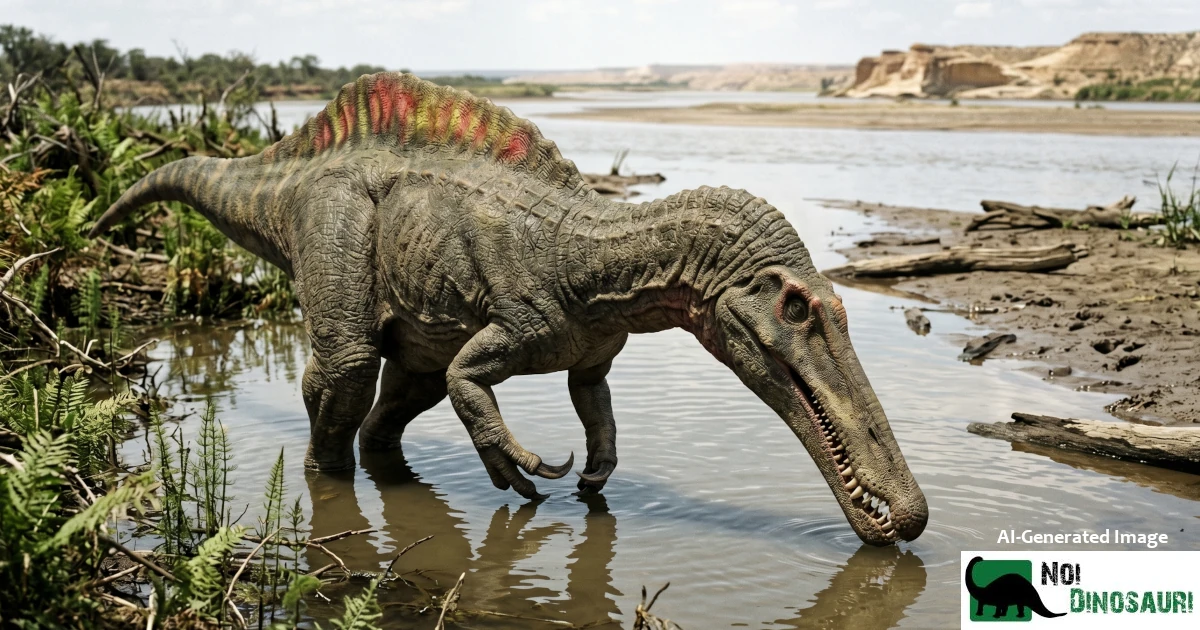
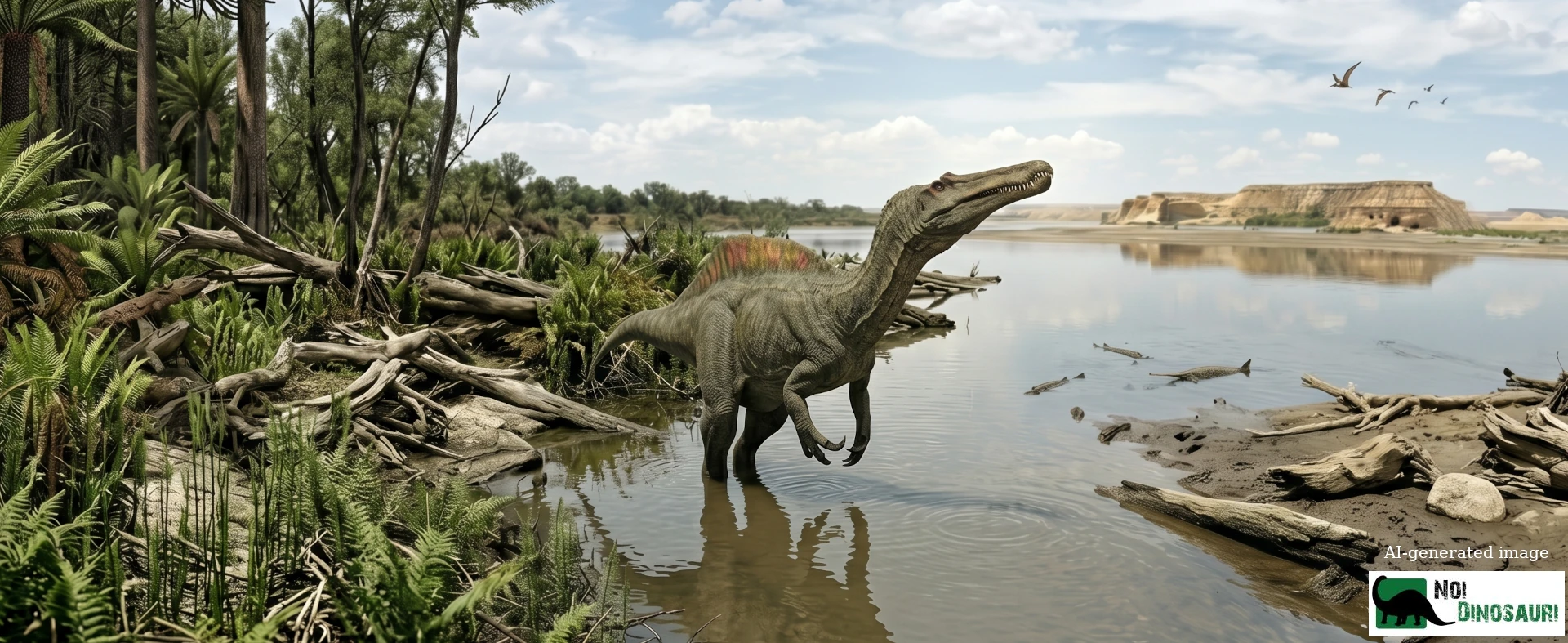
Forget the Sahara. Where this animal hunted, there was no sand — just a steaming, river-laced paradise that the desert buried millions of years later. Suchomimus was a strict piscivore here, occasionally rounding out its diet with small aquatic vertebrates or an opportunistic carcass. Its territory sat within the ancient supercontinent of Gondwana — specifically the Elrhaz Formation in modern-day central Niger — at a time when Africa and South America were just beginning to tear themselves apart. The landscape was a vast network of floodplains, estuaries, and river deltas, their banks thick with Araucaria-like conifers, giant tree ferns, horsetails, and the first tentative flowering plants pushing up through the undergrowth.
In these waterways, Suchomimus was forced to share its kingdom with Sarcosuchus imperator — a ten-meter crocodilian that was nobody's easy neighbor. Along the forested banks, bizarre herbivores like the sail-backed Ouranosaurus and the vacuum-mouthed Nigersaurus grazed in uneasy peace, while fierce terrestrial predators — the abelisaurid Kryptops and the carcharodontosaurid Eocarcharia — prowled the deeper shadows.
Curiosity - Did you know?
The snout of Suchomimus was a masterpiece of biomechanical and sensory engineering. The tip of its skull was riddled with dozens of small holes — foramina — that housed a complex neurovascular network virtually identical to that of modern crocodilians. This system functioned as a high-precision pressure receptor: the dinosaur didn't need to see its prey in the turbid Cretaceous waters. It simply submerged the tip of its snout and felt the pressure waves generated by a swimming fish — guaranteeing a lethal, unerring strike even in the thickest mud or complete darkness.