
 IT
IT  DE
DE  FR
FR  ES
ES  PT
PT 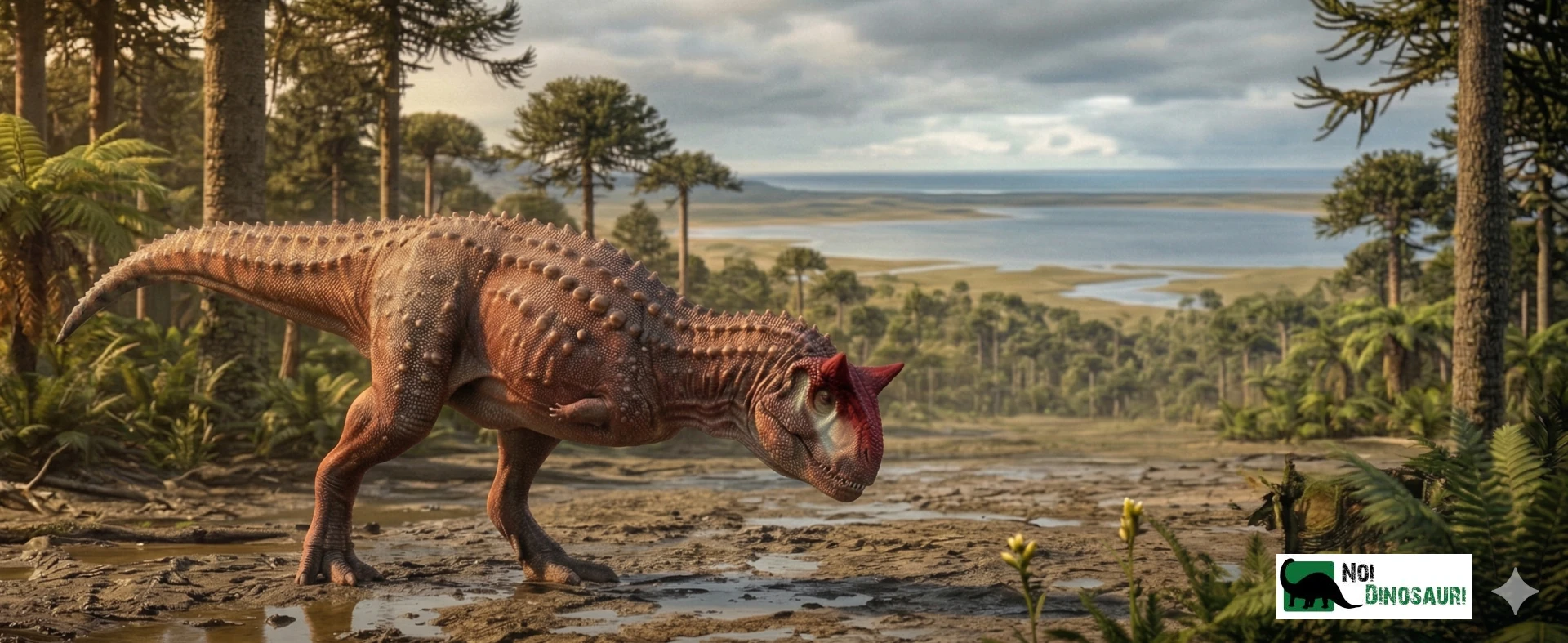
Carnotaurus sastrei
Carnotaurus stands out as one of the most bizarre and iconic predators of the Late Cretaceous. Despite the formidable appearance of its heavy brow horns, this theropod was not a close relative of Tyrannosaurus rex. Instead, it belonged to the Abelisauridae—a highly specialized family of meat-eaters that dominated the southern continents while tyrannosaurs ruled the north. This apex predator represents a parallel evolutionary branch that engineered its own radical solutions for hunting and survival. These adaptations were wildly different and, in some respects, far more extreme.
Carnotaurus sastrei: History, Characteristics, and Facts
The story of this unique predator surfaced in 1984 when Argentine paleontologist José Bonaparte unearthed an extraordinary skeleton in the Chubut Province of Argentina. His expedition discovered the remains slowly weathering out of the Huincul Formation — in Patagonia, centuries of relentless wind and rain constantly erode the rugged landscape, millimeter by millimeter, until ancient secrets are finally returned to the surface.
The genus name translates from Latin to "carnivorous bull," a direct nod to the distinct, bovine-like bony projections above its eyes. Today, the singular holotype specimen — Carnotaurus sastrei — resides at the Bernardino Rivadavia Natural Sciences Argentine Museum in Buenos Aires. Thanks to extensive patches of fossilized skin preserved across much of its body, it ranks among the best-preserved theropod skeletons ever found.
The Demonic Bull: Horns and Cranial Biomechanics
Two prominent bony horns above the eyes define the signature look of this dinosaur. Wear patterns on the skull suggest these structures saw action in intraspecific combat, with males likely shoving each other like modern bighorn sheep. In life, keratinous sheaths covered these horns and may have flashed vibrant colors to serve as visual warnings to territorial rivals.
Paleontologists continue to debate their exact function. Some researchers argue for purely visual displays, while others favor direct physical clashes. A few scientists even propose a secondary thermoregulatory role, similar to the cranial crests of modern chameleons or basilisks — structures that regulate heat exchange with the environment. Nature rarely wastes complex anatomy on a single task, so the truth likely involves a combination of all three.
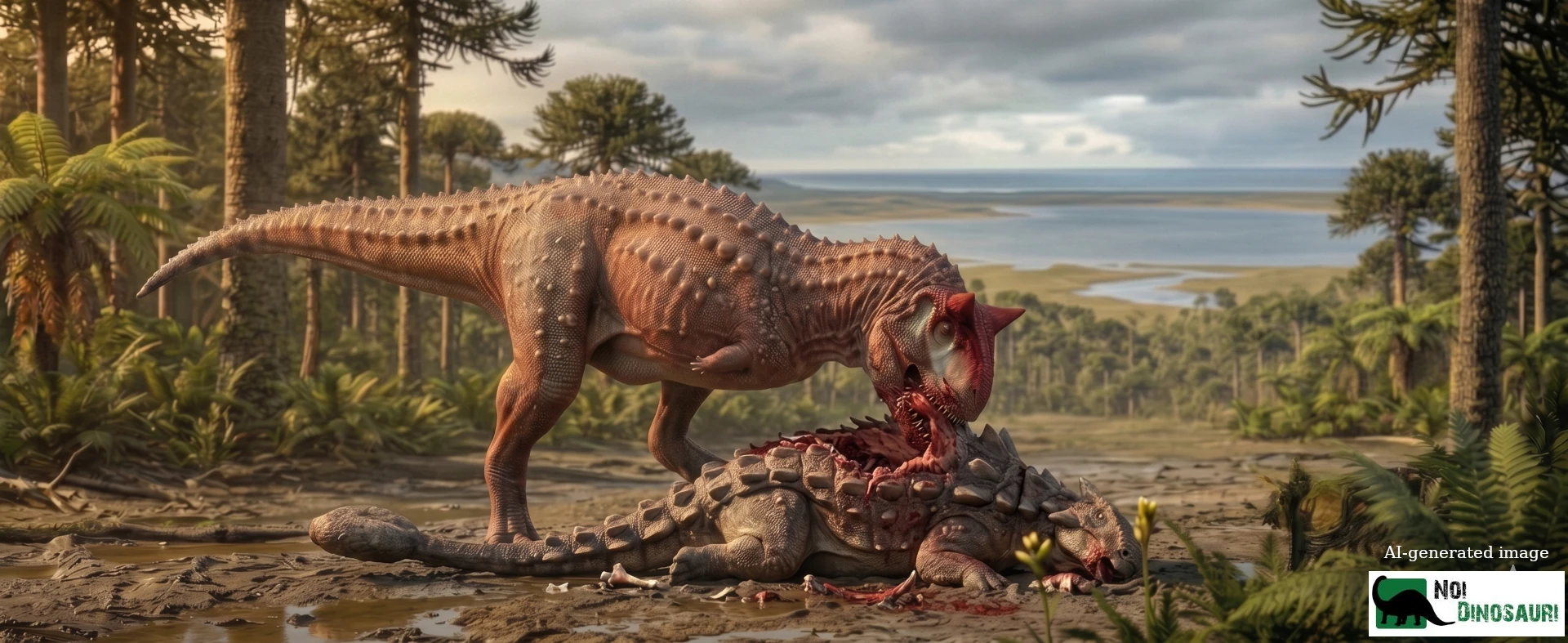
Beneath those horns sat a specialized jaw built for speed rather than power. Biomechanical models of its remarkably short skull reveal it lacked the bone-crushing bite force of an Allosaurus. Instead, its jaws functioned like a pair of precision shears — delivering rapid, deep snapping bites before quickly retreating to let the prey bleed out.
The Ultimate Paradox: Vestigial Arms and a Biological Engine
If you think T. rex had short arms, the Patagonian bull takes anatomical reduction to the absolute extreme. Its forelimbs dwindled into four tiny, atrophied fingers locked facing backward without any functional joints. These incredibly stiff, vestigial arms served no predatory or balancing purpose. Evolution likely shrank them until their metabolic cost became negligible, halting the pressure to erase them completely.
While evolution stripped power from the front, it packed massive muscle into the rear. The tail vertebrae featured sweeping, V-shaped lateral bones — a unique skeletal architecture that provided a massive anchor point for the caudofemoralis muscle, which physically linked the tail directly to the hind legs. This biological engine pumped raw power into the legs, enabling explosive, high-speed sprints matched by few apex predators of the Mesozoic.
Leather and Studs: A Unique Armor of Scales
Forget the image of smooth, lizard-like skin or a fluffy coat of feathers. We know exactly what this animal looked and felt like, thanks to one remarkably rare detail from Bonaparte's excavation: sweeping impressions of fossilized skin preserved across most of the body. To this day, it represents the most extensive skin preservation ever recorded for a large carnivorous dinosaur.
Its hide formed a dense mosaic of small, circular scales roughly five millimeters across. Large, cone-shaped bony tubercles — about the size of coins — interrupted this pebbled texture at regular intervals. This bumpy, stud-like pattern created a passive armor, perfectly evolved to deflect the glancing bites of rivals during intense territorial disputes.
High-Speed Ambush: Sensory Adaptations
It hunted like a scent-guided missile. Built exclusively for blistering straight-line sprints rather than tight, twisting pursuits, it simply locked onto a target and fired. CT scans of its braincase reveal a precisely tuned sensory system. While its hearing remained average for a theropod, its olfactory bulbs were enormous — proportionally, they occupied a share of total endocranial volume comparable to that of modern scent hounds relative to primates. It didn't just smell the air; it chemically mapped its environment, tracking unseen prey across vast open distances.
Once it pinpointed a scent trail, its slightly forward-facing eyes provided overlapping binocular vision. While not as sharp as a modern bird of prey, it offered enough depth perception to gauge striking distance with precision. Think of it as combining the nose of a bloodhound with the fast-twitch reflexes of a track sprinter — both functions seamlessly optimized for hunting across the open plains where a single straight-line burst was all it needed.
Pop culture often inflates this animal into a towering, building-sized monster. Disney's animated film Dinosaur (2000) depicted it as a near-titanic force of destruction, and video games like Ark: Survival Evolved amplified the distortion further, cementing its reputation as an oversized, unstoppable juggernaut. The scientific reality proves more grounded — and arguably more fascinating.
Fossil measurements confirm an adult reached a maximum length of 7.5 to 8 meters, standing roughly 3 meters tall at the hips. Accurate volumetric models estimate its mass between 1.3 and 2.1 tons — lighter than a full-grown Allosaurus. This firmly places it as a medium-sized theropod whose lean, muscular frame sacrificed bulk for pure, unadulterated speed.
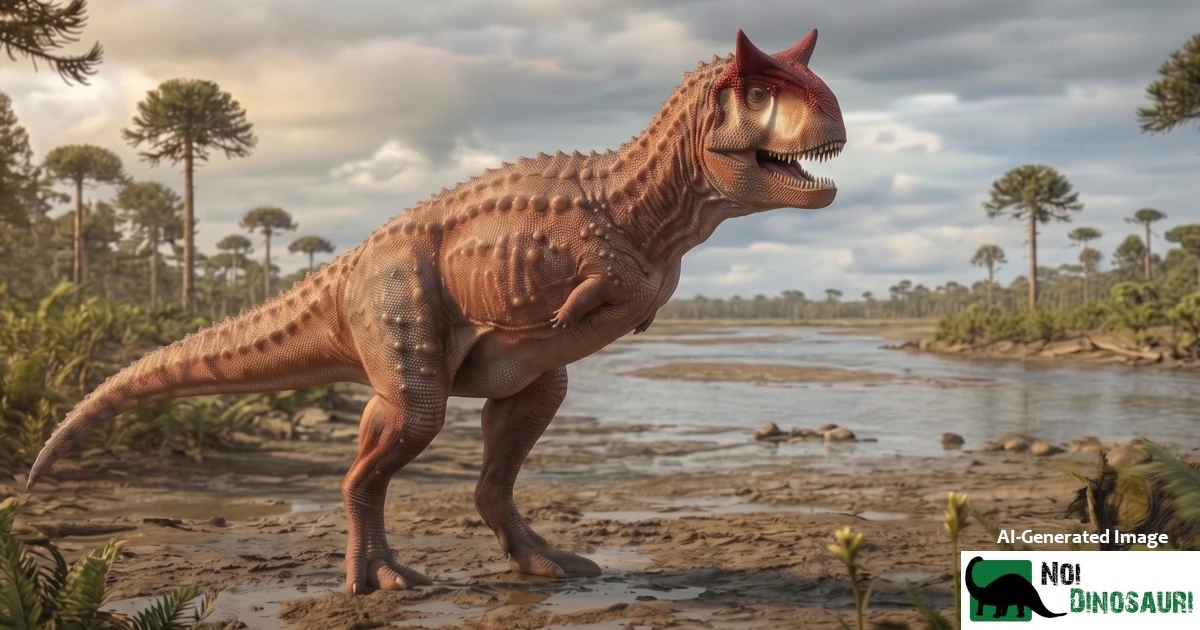
As a highly specialized apex predator, it dominated the isolated landmass of Gondwana (modern-day southern Argentina) during the Maastrichtian stage, around 70 to 72 million years ago. Relying on its rapid bite and blazing speed, it likely deployed hit-and-run tactics to take down small ornithopods and juvenile sauropods before they could mount a defense.
It stalked coastal plains and open forests dominated by towering conifers (Araucariaceae), massive tree ferns, and early flowering plants. It shared this territory with small herbivores like Gasparinisaura and colossal titanosaurs such as Antarctosaurus. To thrive here, it had to outmaneuver and outcompete a diverse array of rival abelisaurids for the exact same resources — a rivalry between southern predators fascinating enough to deserve an article of its own.
Curiosity - Did you know?
The Runner Who Couldn't Turn - Paleontologists consider Carnotaurus one of the fastest theropods ever to have walked the Earth, with estimated top speeds between 40 and 50 km/h — a record that makes it the undisputed sprint champion among the large predators of the South American Cretaceous. But this power came at a precise cost: the structural rigidity at the base of the tail, the very same feature that drove those explosive bursts of speed, made sharp turns nearly impossible. A T. rex may have been slower in a straight line, but in a twisting pursuit through the trees it would have stood a real chance of surviving the encounter. Carnotaurus was a weapon built for a single trajectory — and when that trajectory was the right one, there was no escape.