
 IT
IT  DE
DE  FR
FR  ES
ES  PT
PT 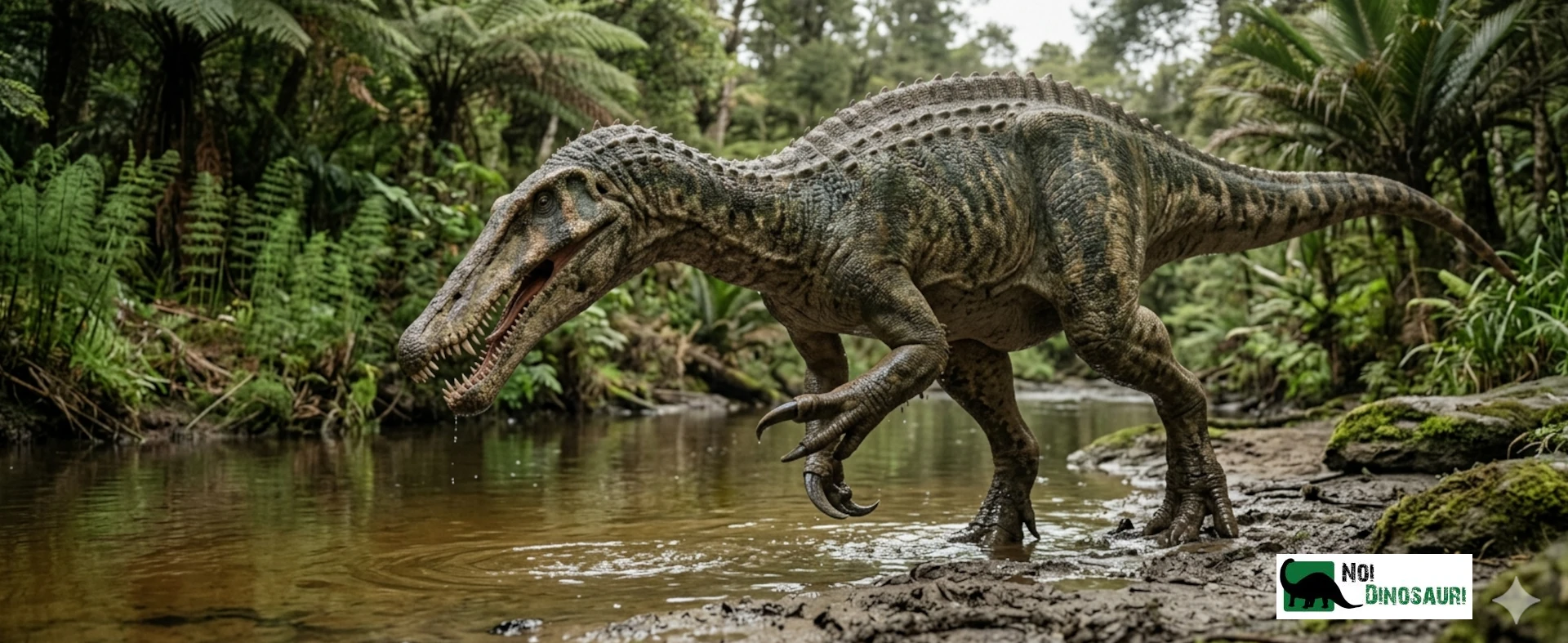
Baryonyx
Baryonyx was a large theropod dinosaur of the Spinosauridae family that thrived during the Early Cretaceous, roughly 130 to 125 million years ago. This formidable predator marks a turning point in our understanding of European paleontology. It showcases some of the earliest and most spectacular adaptations of a giant theropod to a semi-aquatic lifestyle, stalking the banks of ancient rivers with surgical precision.
Baryonyx: History, Characteristics, and Facts
The sensational 1983 discovery of Baryonyx walkeri revolutionized our understanding of European carnivorous dinosaurs. An amateur fossil hunter named William J. Walker — a plumber by trade with a passion for paleontology — rather than an academic team, made the initial find. While exploring a clay pit in Surrey, England, he unearthed an enormous fossilized claw. Paleontologists Alan Charig and Angela Milner officially described the holotype specimen in 1986. The genus name translates from Greek as "heavy claw," while the specific epithet honors its discoverer. Today, this skeleton remains one of the most complete theropods ever found in the United Kingdom, and the original claw is proudly displayed at the Natural History Museum in London.
The anatomy of Baryonyx reveals an extraordinary adaptation to aquatic hunting. It drastically departs from the traditional predatory dinosaur template. Its elongated, narrow skull closely mirrors that of modern gharials. A spatulate terminal rosette at the tip of the snout provided a structure perfectly evolved to trap slippery prey. This was a precision fishing machine, not a typical terrestrial hunter. Weighing around two tons, it moved through the rivers of Early Cretaceous Europe like a giant armored heron. Its presence was announced not by earth-shaking roars, but by the rustle of water and the lethal flash of a massive claw breaking the surface.
A Snout Designed to Hold
The skull of Baryonyx closely replicates a modern gharial's snout. Instead of serrated blades, it possessed 96 pointed, conical teeth functioning like steel nails. This formidable dental array evolved to pierce and secure writhing, slippery prey rather than tear flesh. Paleontologists suggest its belly featured smooth, flexible scales for gliding effortlessly through aquatic vegetation. Conversely, rigid dorsal scales likely deflected debris carried by swift river currents.
The Menu Etched in Stone
We do not have to guess what this amphibious hunter ate. The fossilized "crime scene" has remained pristine for 125 million years. Subsequent excavations in Surrey brought much of the skeleton to light and revealed irrefutable evidence right where the animal's stomach once rested. Researchers found the partially digested scales of Lepidotes — a large prehistoric fish — mixed with the crushed bones of a young Iguanodon. This fossilized gut content proves Baryonyx was a deadly fisher, but also an opportunistic scavenger willing to feed on dinosaur carcasses washed up on the riverbank.
Hidden Sensors and Swamp Colors
Vision was not the only weapon Baryonyx utilized in the murky world of Cretaceous swamps. Recent CT scans of spinosaurid skulls reveal a network of tiny holes, or foramina, concentrated at the tip of the snout. Highly developed nerve bundles passed through these cavities. These sensors functioned much like the lateral line organ in modern fish, allowing the dinosaur to detect pressure changes and vibrations in muddy water. To communicate in this dense environment, it could not rely on camouflage alone. Picture a body mottled in greens and muddy browns, abruptly interrupted by a bone crest on the snout blazing in vivid red or vibrant yellow — pulsing with blood, a visual signal as extreme as the casque of a modern cassowary, used to dominate territory without raising a single claw.
Pop culture often exaggerates the size of Baryonyx or conflates it with its massive North African relative, Spinosaurus. The fossil record actively dismantles the "15-meter monster" myth. The Surrey holotype belonged to an animal measuring roughly 7.5 to 9 meters in length, weighing an estimated 1.2 to 2 tons. However, cranial analysis and bone histology indicate this specific individual was a subadult. Even assuming a fully mature specimen, rigorous scientific estimates place its maximum length around 10 meters. It was an imposing predator, but far removed from the colossal giants of the Late Cretaceous.
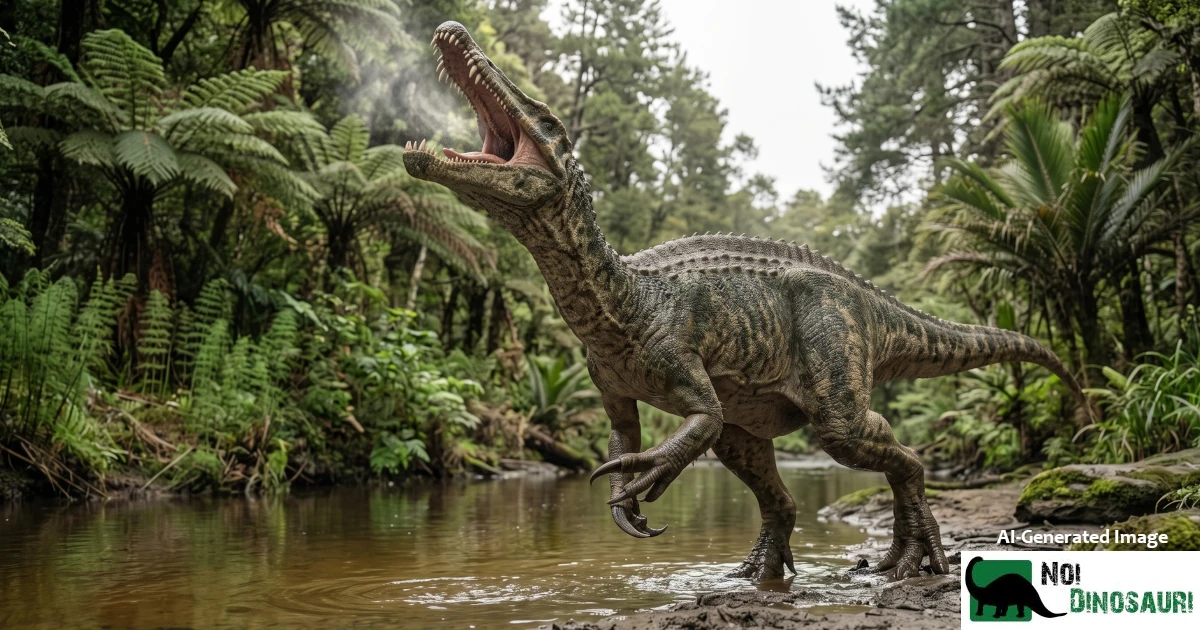
The Early Cretaceous ecosystem in Europe offered Baryonyx a paradise of lagoons, river deltas, and thriving swamps. It roamed the landmasses of the supercontinent Laurasia, specifically in areas now known as the Wealden Formation in England and across the Iberian Peninsula.
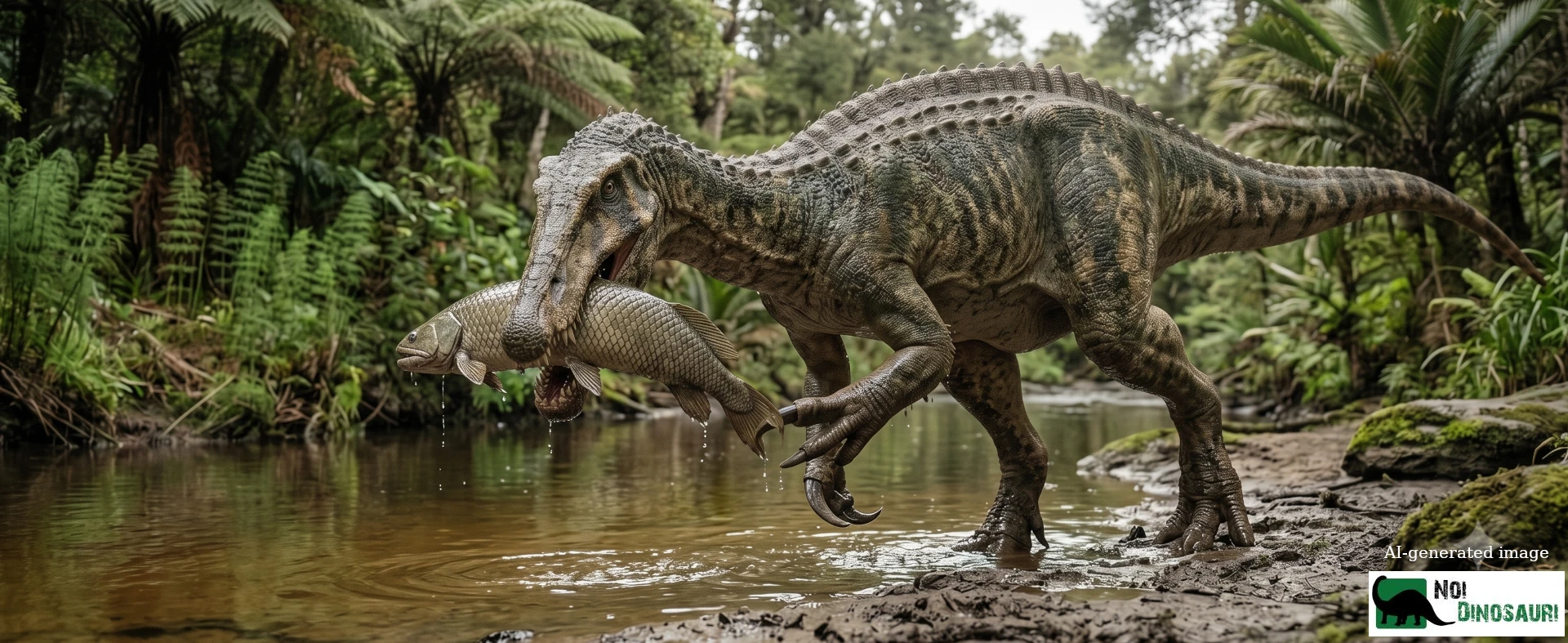
Diet and Strategy: It is the first dinosaur proven to be heavily piscivorous. It likely hunted by standing still along riverbanks or in shallows, harpooning prey with its great claw or snapping its long jaws. Yet it was equally an opportunistic predator and active scavenger.
Habitat and Flora: The landscape featured vast floodplains and primordial rainforests. Grass had not yet evolved; horsetails, massive ferns, and lush cycad groves dominated the ground, shadowed by towering primitive conifers.
Fauna: In the water, it shared its habitat with large bony fish such as Scheenstia and prehistoric crocodiles like Goniopholis. On land, it coexisted with herds of large ornithopods like Iguanodon and armored dinosaurs like Polacanthus, while keeping a watchful eye out for apex terrestrial predators like Neovenator.
Curiosity - Did you know?
Baryonyx holds a remarkable distinction in paleontology: it is one of the very few dinosaurs whose last meal is known with certainty. Right within the rib cage of the holotype, researchers found irrefutable proof of a mixed diet. Alongside numerous partially digested scales of the prehistoric fish Lepidotes (today reclassified as Scheenstia), they also recovered the bones of a juvenile herbivorous dinosaur, most likely a young Iguanodon. This confirms that, however specialized a fisher it was, this great theropod had no objection to fresh meat or an abandoned carcass whenever the opportunity arose.