
 IT
IT  DE
DE  FR
FR  ES
ES  PT
PT 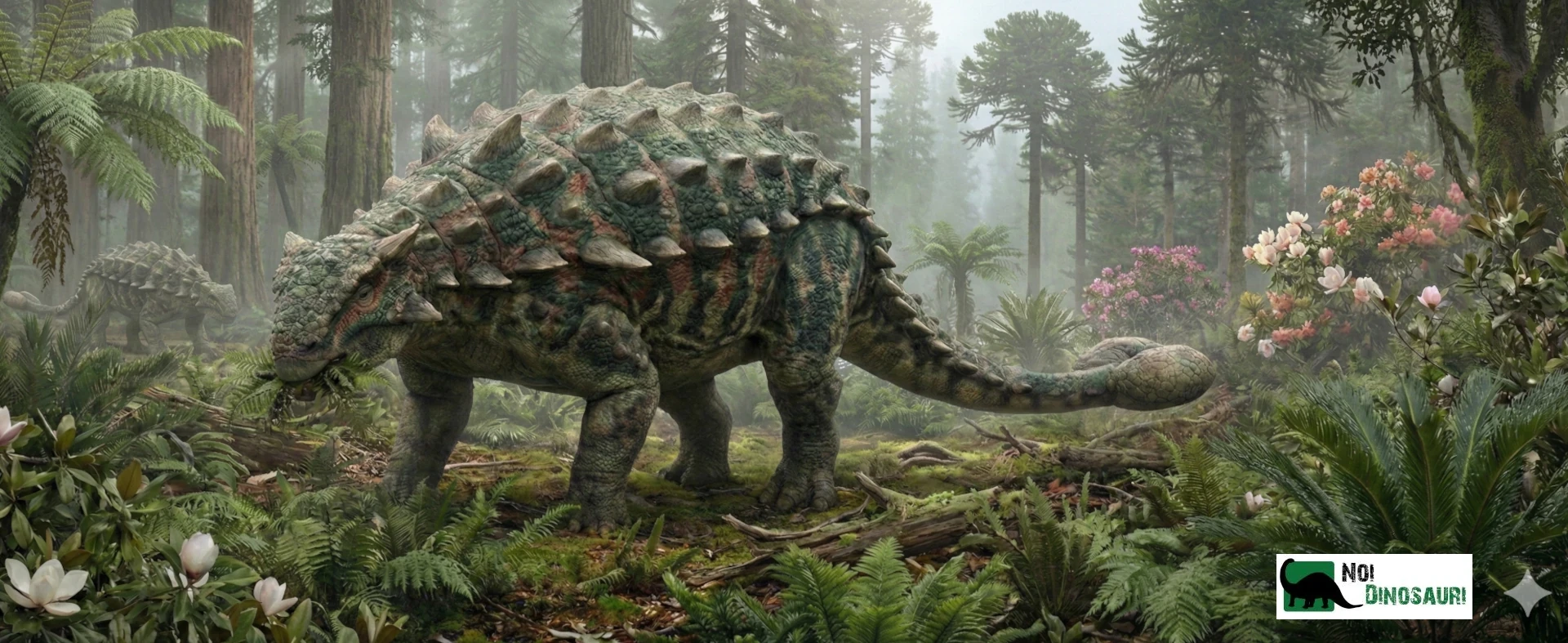
Ankylosaurus magniventris
Ankylosaurus magniventris was a massive herbivore belonging to the order Ornithischia and the family Ankylosauridae. It thrived during the Maastrichtian age of the Late Cretaceous, roughly 68 to 66 million years ago. This armored giant represented the evolutionary pinnacle of shielded dinosaurs. It moved like a living, organic juggernaut across North America right before the great extinction event that closed the dinosaur era.
Ankylosaurus magniventris: Curriculum Vitae of the species
History and Discovery
The story of this colossal creature began in the rugged badlands of the Hell Creek Formation in Montana, a legendary site for North American paleontology. In 1906, fossil hunter Barnum Brown led an expedition for the American Museum of Natural History and uncovered the fragmentary yet unmistakable remains of the beast.
By 1908, Brown officially named it Ankylosaurus magniventris. The etymology draws from the Greek ankylos (fused or stiff) and sauros (lizard). The Latin magniventris (great belly) highlights the immense ribcage required to house its extensive digestive system. Because complete skeletons remain scarce, the most thoroughly researched fossils reside at the American Museum of Natural History in New York and the Canadian Museum of Nature in Ottawa.
Anatomy and characteristics
The Living Tank: Build and Posture
The anatomy of Ankylosaurus functioned as a mobile fortress, engineered to deter the most formidable predators of its era. It featured a wide, stocky build positioned low to the ground and supported by four massive, pillar-like legs. The hind limbs grew slightly longer, giving the animal a distinctive forward-leaning posture. This stance created an extraordinarily low center of gravity, making it virtually impossible for attackers to flip the animal over.
Custom Armor: Osteoderms
A dense network of osteoderms—bony plates fused directly into the skin, much like modern crocodilians—completely shielded its back, neck, and tail. These shields ranged wildly in size, from broad, flat plates and sharp nodules to tiny, rounded ossicles linked together like chainmail. This brilliant design provided maximum protection without sacrificing flexibility. In life, a thick layer of keratin covered this dermal shield, rendering these defenses even more imposing than bare fossils suggest.
The Combat Helmet: Skull and Senses
The skull operated as a highly developed armored helmet, topped with small, backward-facing pyramidal horns. The snout ended in a toothless beak that served as a perfect set of shears for stripping vegetation. Further back in the jaw, small, leaf-shaped teeth ground down the tough plant matter. Even the eyelids ossified, dropping over the eyes like heavy steel shutters. However, the true biological engineering lay within: recent CT scans reveal complex, spiraling nasal passages. This bony labyrinth acted as an internal air conditioning system to cool the brain and heighten an already formidable sense of smell—the primary radar Ankylosaurus used to locate food and detect threats.
The Ultimate Weapon: Tail Club
Its most iconic feature sat at the opposite end of its body: a massive bone club seamlessly fused to the final vertebrae of the tail. The dinosaur swung this formidable counterweight with the momentum of a wrecking ball. It carried enough deadly power to shatter the legs of a towering Tyrannosaurus rex. Built to endure, Ankylosaurus was every inch a survivor.
The Ghost's Cloak: Coloration and Camouflage
Fossils cannot yet confirm its exact pigmentation, but science provides a clear picture. As a slow-moving herbivore navigating dense forests and floodplains, blending into the background was vital. Its appearance likely featured muted, earthy tones such as muddy brown, dark grey, or olive green. Its underbelly—the only soft, unarmored section of its body—was undoubtedly lighter. This countershading flattened its visual silhouette, effectively deceiving the eyes of passing predators.
Actual Size (Myth vs. Reality)
Pop culture has historically exaggerated the size of Ankylosaurus. Until the early 2000s, some estimates suggested lengths of up to 11 meters. However, rigorous osteological reviews published in 2017 corrected this misconception. Scientists now place its maximum length between 6.25 and 8 meters, with an estimated weight of 4.8 to 8 tons. Despite this downsizing, it remains the largest member of the Ankylosauridae family. Its wide, heavy frame made it one of the most difficult terrestrial animals to take down in the entire Cretaceous.
Diet and Paleoecology
Ankylosaurus lived as a bulk feeder. Using its broad, toothless front beak, it indiscriminately stripped massive quantities of low-lying vegetation. Digestion relied on prolonged gastric fermentation within its enormous gut.
It roamed Laramidia—the ancient landmass now making up western North America—patrolling coastal forests and flooded plains rich in ferns, cycads, and early flowering plants called angiosperms. It shared this vibrant ecosystem with herbivores like Triceratops and Edmontosaurus. Together, they navigated a landscape stalked by apex predators like T. rex and packs of the dromaeosaurid Dakotaraptor.
Curiosity - Did you know?
The Club Wasn't Just for Predators
The iconic tail club of Ankylosaurus is famous for its ability to crush the bones of attacking theropods. However, the true story is etched into the fossils themselves. Recent biomechanical studies suggest this structure evolved primarily for intraspecific combat. Much like modern deer using their antlers, rival Ankylosaurus likely delivered brutal blows to each other's flanks during territorial disputes or mating rituals.
While historically exaggerated, rigorous 2017 osteological reviews place the maximum length of Ankylosaurus between 6.25 and 8 meters (20.5 to 26 feet), with an estimated weight of 4.8 to 8 tons.
Ankylosaurus was a bulk-feeding herbivore. It used its toothless beak to strip low-lying vegetation like ferns, cycads, and early flowering plants, which it then processed through prolonged gastric fermentation.
It relied on a very low center of gravity, a heavy armor of fused bony plates called osteoderms, and a massive tail club capable of shattering the legs of large theropods.