
 IT
IT  DE
DE  FR
FR  ES
ES  PT
PT 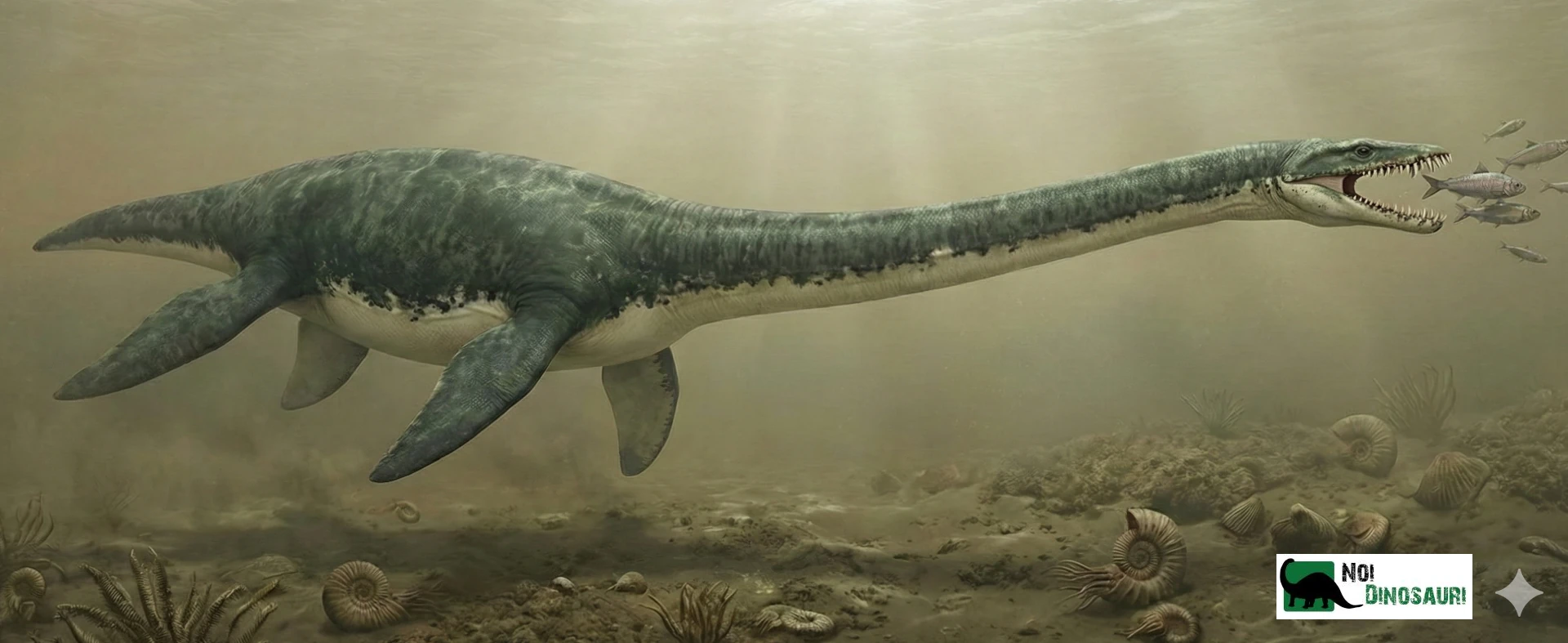
Elasmosaurus platyurus
Elasmosaurus stands out as one of the most iconic marine reptiles in Earth's history, roaming the oceans of the Late Cretaceous roughly 80.5 million years ago. As a member of the order Plesiosauria (and the family Elasmosauridae), we must first clear up a common misconception: Elasmosaurus was not a dinosaur. It was a fully aquatic reptile, highly adapted to a pelagic lifestyle in the open ocean. This remarkable predator boasted a body plan unlike anything else in the animal kingdom, defined by an absurdly long neck that accounted for more than half of its total length.
Elasmosaurus platyurus: History, Characteristics, and Facts
Paleontologist Edward Drinker Cope discovered Elasmosaurus platyurus in 1868, unknowingly sparking one of the most infamous and turbulent feuds in scientific history: the Bone Wars. The genus name stems from the Greek word elasmos, meaning "thin plate," which describes the flat, plate-like bones of its pelvis.
Miners unearthed the first fossil remains from the limestone deposits of Kansas. While piecing the skeleton together, Cope made a legendary blunder: he mounted the skull on the tip of the tail. His bitter rival, Othniel Charles Marsh, publicly humiliated him for this mistake. Today, the holotype—the original specimen used to define the species and a silent witness to this epic scientific rivalry—resides at the Academy of Natural Sciences in Philadelphia.
An Anaconda on a Turtle's Body
Picture an anaconda grafted onto the body of a giant sea turtle. That was Elasmosaurus: a marine reptile the size of a city bus, with a neck comprising more than half its total length. Its skeletal architecture was so extreme that it baffled the 19th-century scientific establishment. Cope’s infamous mistake of placing the head on the tail happened simply because a neck with 71 cervical vertebrae seemed biologically impossible. For perspective: humans, giraffes, and rhinoceroses all have exactly seven.
Wetsuits and Iron Traps
If you could touch an Elasmosaurus, its skin would feel taut and rubbery, much like a modern neoprene wetsuit. Evolution sculpted this smooth, hydrodynamic texture to slice through saltwater with minimal drag. The skull perched atop that endless neck was remarkably small, but its jaws functioned as a lethal trap. Lined with long, needle-like teeth that angled inward, the jaws interlocked like the prongs of two opposing forks. Elasmosaurus didn't chew its food; it used its mouth as a harpoon-like cage to snag fish and squid, swallowing them whole.
The Stealth Submarine
Its massive, muscular neck functioned like a horizontal boom, sweeping just below the surface like an invisible probe. By panning its head left and right, it could infiltrate schools of prey before its massive body triggered any visual alarms. Unlike earlier marine reptiles that undulated their bodies to swim, Elasmosaurus flapped its four gigantic, paddle-like flippers in unison. It literally "flew" through the water, utilizing a technique known as paraxial underwater flight, much like modern penguins or sea turtles. Paleontologists frequently unearth piles of smooth, polished stones—known as gastroliths—nestled within its ribcage. The animal deliberately swallowed these rocks, using them both as an internal millstone to grind up tough meals and as a natural ballast belt to maintain neutral buoyancy without expending energy.
The Bicolor Ghost of a Vanished Sea
Elasmosaurus prowled a vast ocean that no longer exists: the Western Interior Seaway, a deep, temperate inland sea that cleaved North America in half during the Mesozoic. It operated as a chromatic ghost, employing countershading for visual stealth. Its light underbelly blended with the sunlit surface above, while its dark back vanished into the murky depths below—perfect camouflage for a ten-meter-long predator. Isotope analyses of its bones indicate these waters maintained mild, subtropical temperatures, creating a thriving, biodiverse paradise that kept this giant's cold-blooded metabolism active and hunting.
Modern scientific estimates portray an animal that was astonishingly long but structurally slender. Fully grown adults reached a confirmed maximum length of around 10.3 meters (34 feet). Despite this impressive reach, Elasmosaurus was remarkably lightweight. Its estimated mass hovered around two tons, making it significantly lighter and less bulky than contemporary apex predators like the massive mosasaurs.
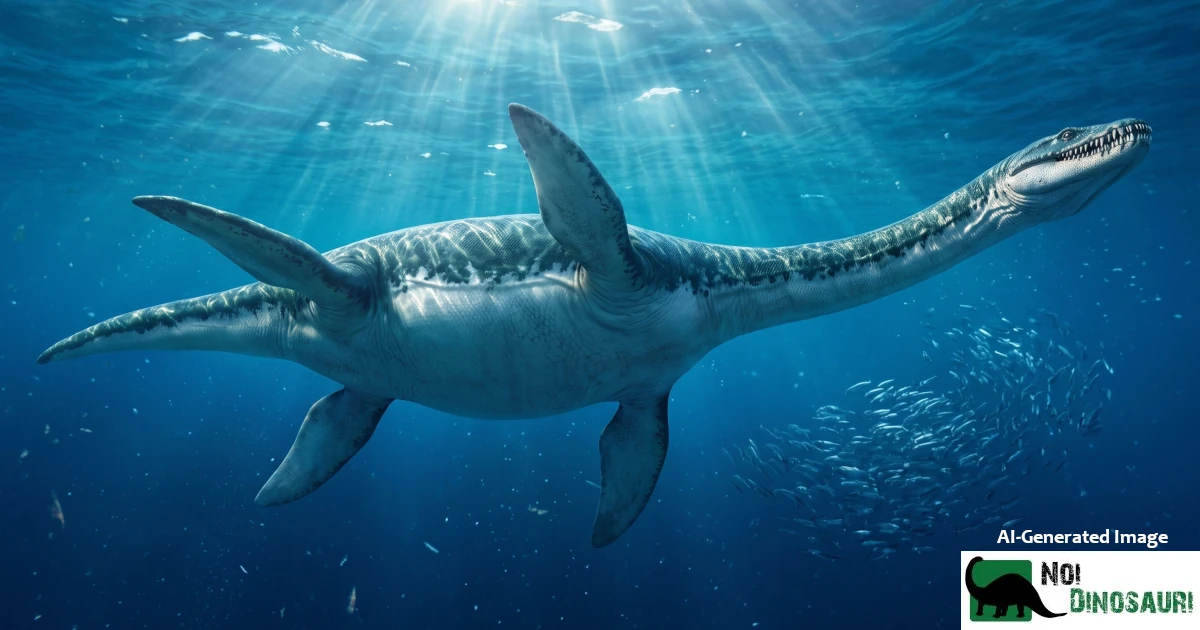
Patrolling the waters of the Western Interior Seaway, Elasmosaurus fed primarily on schools of fish and cephalopods, including ammonites and belemnites (squid-like mollusks with hard internal shells). Utilizing its exceptional neck, it ambushed schools of prey from below, darting its head upward before its massive body could give away its position. However, it wasn't the undisputed king of its ecosystem. It shared these waters with ruthless apex predators that posed a very real threat, including the gigantic mosasaur Tylosaurus and the formidable shark Cretoxyrhina.
Curiosity - Did you know?
The Neck That Couldn't Rise
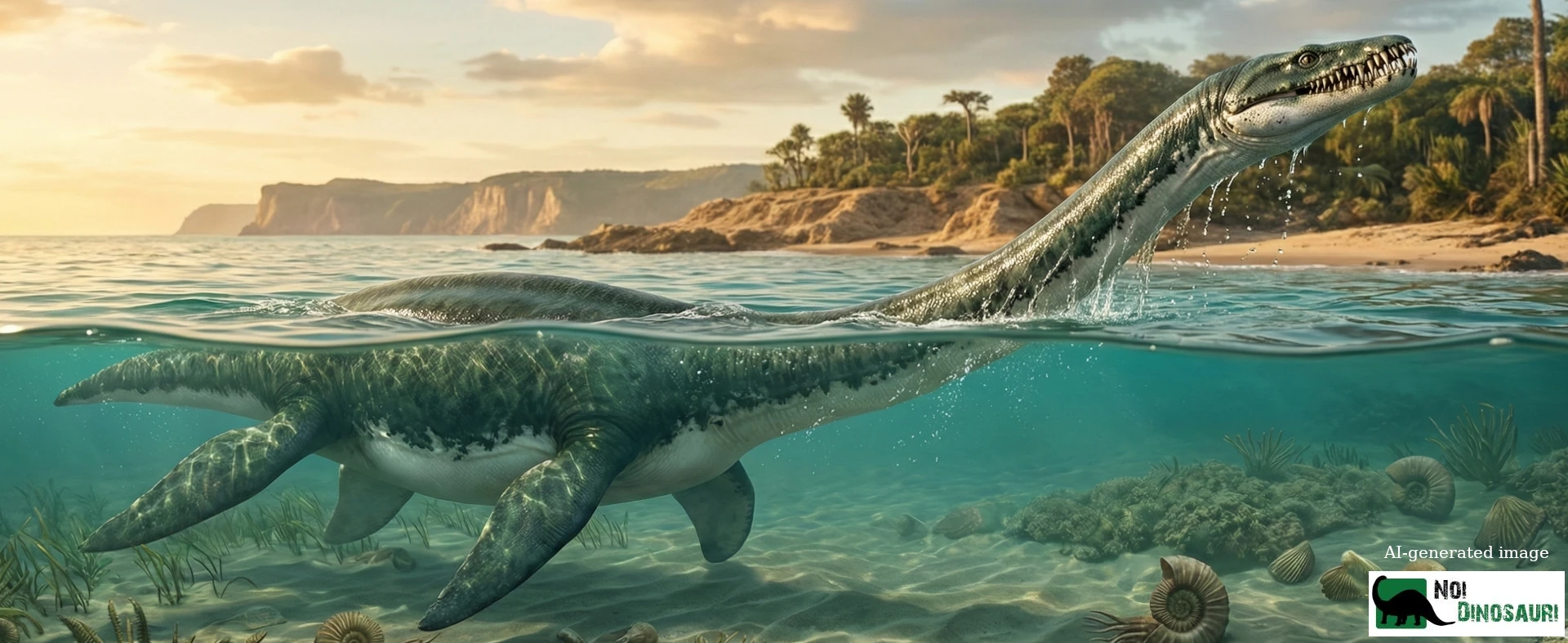
The classic, retro-paleontology image of an Elasmosaurus breaking the ocean surface and bending its neck into an "S" shape like a giant swan is biologically impossible. Recent biomechanical studies prove that its enormous neck was surprisingly stiff and had to be held straight and taut. The musculature and interlocking joints of its 71 cervical vertebrae simply didn't allow the animal to lift its head more than a few feet out of the water. If it had ever attempted to rear its head vertically, gravity would have dislocated its neck, turning this apex predator into a helpless victim.