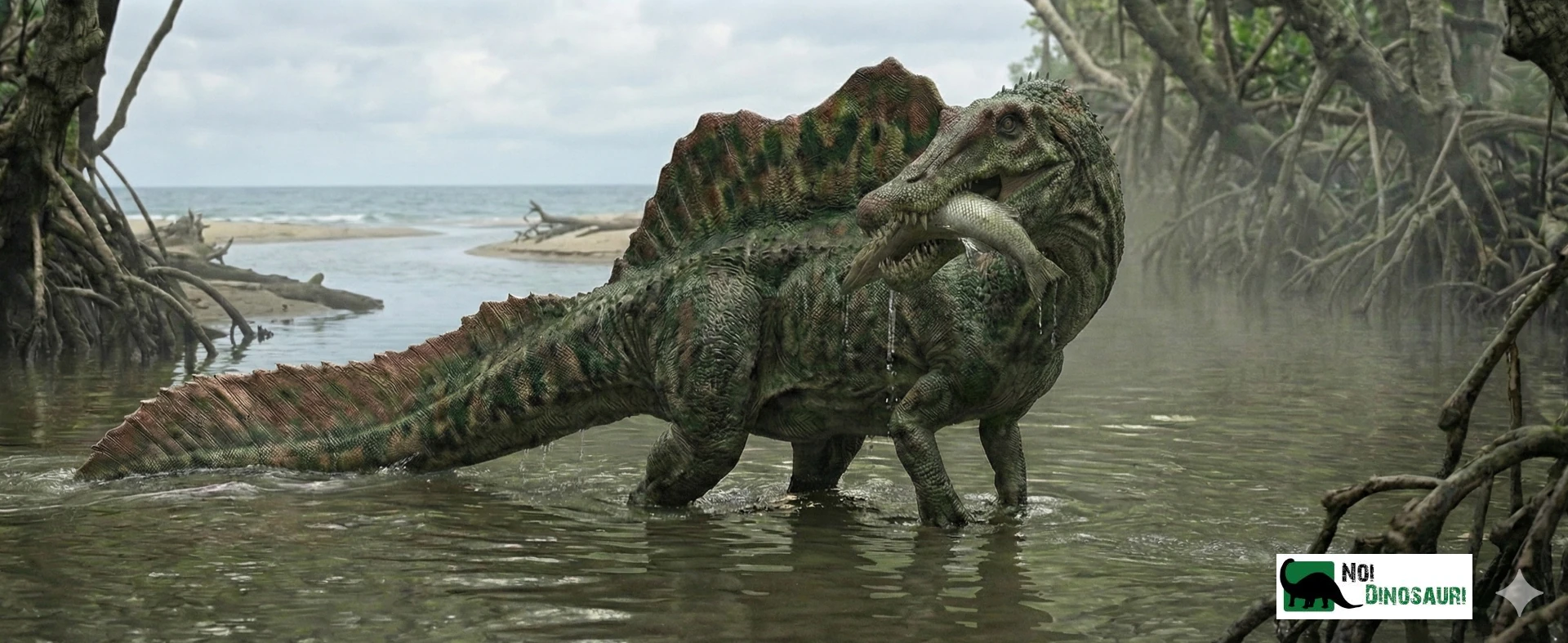
The Spinosaurus (Spinosaurus aegyptiacus) is the ultimate river enigma. A theropod dinosaur of the Spinosauridae family. It dominated the vast river networks of North Africa during the Late Cretaceous (between 99 and 93 million years ago). Representing one of the most extreme cases of aquatic adaptation in dinosaur history, this gigantic semi-aquatic predator boldly challenged the supremacy of the great terrestrial carnivores.
Scientific name
Spinosaurus
Diet
Spinosaurus aegyptiacus: Curriculum Vitae of the species
History and Discovery
Egypt, 1912. German paleontologist Ernst Stromer unearths the first remains in the Bahariya Oasis. He classifies the animal and coins its name: "spine lizard." Tragedy strikes in 1944. The original holotype is pulverized during an Allied bombing raid on Munich, shrouding the titan in mystery for decades.
The modern turning point arrives between 2014 and 2020 in the Kem Kem river beds of Morocco. A team led by paleontologist Nizar Ibrahim discovers exceptional new remains. The fossils excavated in 2020 lock perfectly into a skeleton found in 2014, revealing an enormous caudal paddle. Today, these fossils and digital casts are the subject of intense global study at the University of Chicago and the University of Casablanca.
Anatomy and characteristics
Actual Size (Myth vs. Reality)
Biomechanical reality dispels the cinematic myth of a titanic wrestler capable of overpowering a Tyrannosaurus rex on dry land. Yet, its true measurements remain staggering.
It reached an estimated maximum length of 14 to 15 meters, making it the longest theropod ever discovered. Recent 2024 estimates stabilize its mass between 6.5 and 7.5 tons. Despite this immense bulk, its short legs and dense skeletal structure made it clumsy and vulnerable on land. An encounter with a Carcharodontosaurus out of the water would likely have proven fatal. The Spinosaurus preferred to retreat to its natural domain: the water.
Diet and Paleoecology
The superpredator thrived in the vast river deltas of Gondwana (the modern-day Sahara Desert). A specialized piscivore and opportunistic predator. Cretaceous North Africa was a lush world of immense estuaries, river islands, and coastal lagoons, framed by mangrove forests and early angiosperms (flowering plants).
The warm, slow-moving waters teemed with colossal prey, such as the giant sawfish Onchopristis and the enormous coelacanth Mawsonia. It shared this lethal river basin with other terrifying giants: the terrestrial superpredator Carcharodontosaurus and the colossal crocodylomorph Sarcosuchus.
Curiosity - Did you know?
Between 2022 and 2024, the biomechanics of Spinosaurus became the center of the decade's most heated paleontological debate. While studies from 2020 and 2022 argued that its dense (pachyostotic) bones allowed it to swim fully submerged like a penguin, the latest research (Myhrvold et al., 2024) recalculated its hydrodynamics and bone density.
According to these new models, the Spinosaurus was too unstable to actively pursue prey deep underwater. Instead, the evidence strongly supports the "super-heron" wading hypothesis: it hunted by standing belly-deep along the riverbanks, using its powerful neck muscles to launch lightning-fast strikes just beneath the water's surface!
IMPORTANT - Some statements regarding behavior, coloration, and sensory abilities reflect ongoing scientific hypotheses, not established certainties.
We use cookies and similar technologies to improve your experience on our website.

 IT
IT  DE
DE  FR
FR  ES
ES  PT
PT