
 IT
IT  DE
DE  FR
FR  ES
ES  PT
PT 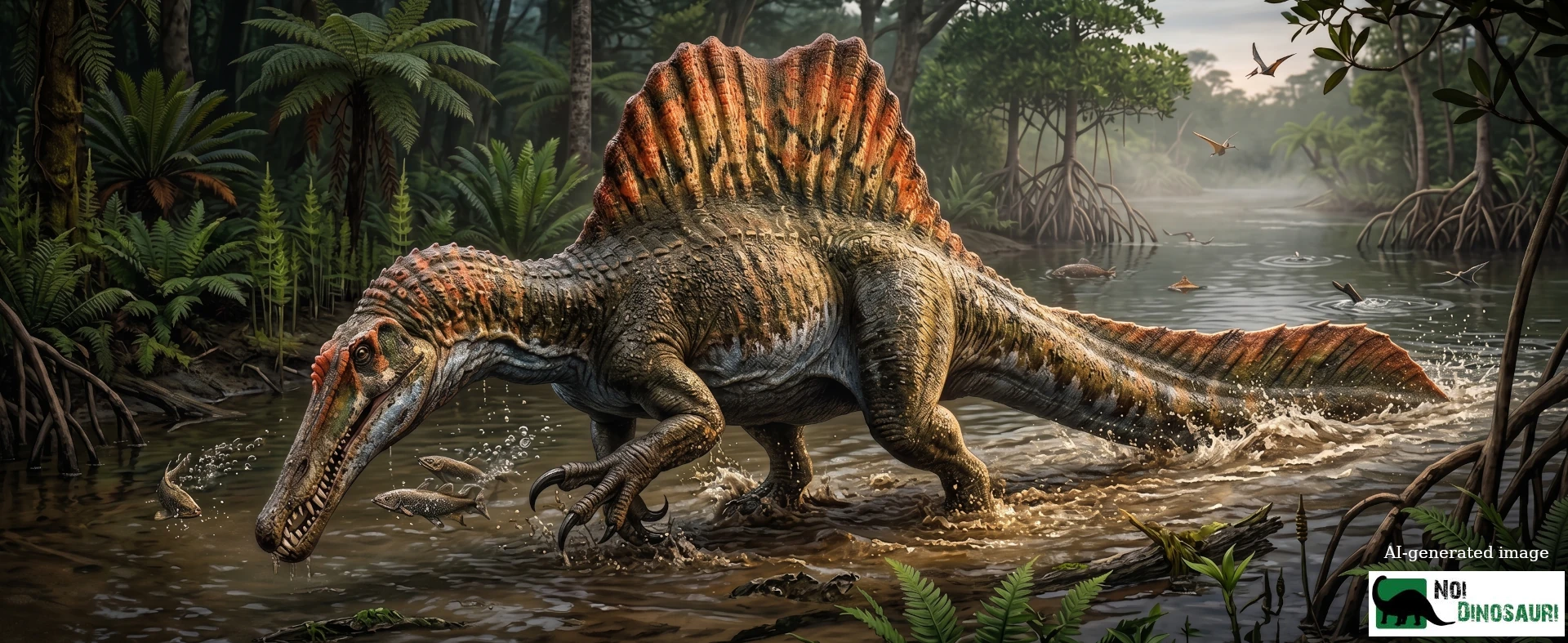
Spinosaurus
Spinosaurus was an imposing theropod dinosaur that prowled the waterways of the Late Cretaceous period roughly 99 to 93 million years ago. As the most famous member of the spinosaurid family, it represents one of the most extreme and hotly debated cases of aquatic adaptation in dinosaur history. This gigantic semi-aquatic predator dominated the vast river networks of North Africa, carving out an ecological niche entirely separate from the great terrestrial carnivores.
Spinosaurus: History, Characteristics, and Facts
The story of this enigmatic creature began in Egypt in 1912. German paleontologist Ernst Stromer unearthed the first remains in the Bahariya Oasis and named the animal "spine lizard." Tragically, an Allied bombing raid on Munich in 1944 pulverized the original holotype specimen. This devastating loss shrouded the dinosaur in mystery for decades.
The modern turning point occurred between 2014 and 2020 in the Kem Kem Group of Morocco. A team led by paleontologist Nizar Ibrahim discovered exceptional new remains that completely rewrote the creature's anatomy. Fossil pieces unearthed in 2020 locked perfectly into a skeleton found in 2014, revealing an enormous, paddle-like tail. Today, researchers at the University of Chicago and the University of Casablanca intensely study these fossils and their digital casts.
This animal stands as perhaps the most extraordinary carnivorous dinosaur ever discovered, sparking a true paleontological revolution. Over the last decade, new discoveries have completely reimagined its appearance. The evidence reveals history's first known semi-aquatic dinosaur—a bizarre morphological hybrid between a traditional meat-eater and a giant crocodile.
Its skull looked strikingly similar to that of a modern gharial. The snout was incredibly long, narrow, and tubular. The jaws held straight, conical teeth that lacked the serrations typical of other predatory dinosaurs. This dental setup proved perfect for skewering and holding slippery fish. Furthermore, fossils show a dense network of foramina (small holes) at the tip of the snout. These cavities housed pressure receptors that allowed the dinosaur to sense aquatic prey movements, even in murky water.
The dinosaur's most unmistakable and iconic feature was its immense dorsal sail. This structure consisted of neural spines that grew up to 1.6 meters long. Paleontologists still debate the sail's true function, proposing everything from thermoregulation and aquatic stabilization to a purely visual display for mating and species recognition.
Unusually short, robust hind legs supported its massive body. Paleontologists strongly suspect its toes were webbed. Because its center of gravity shifted heavily forward, it could not maintain the classic upright, bipedal pose seen in most theropods. Instead, it wielded long, muscular arms equipped with three fingers and enormous, curved claws—the ideal weapons for harpooning giant prehistoric fish.
A definitive breakthrough arrived in 2020 with the discovery of a nearly complete tail. Unlike the stiff, tubular tails of other dinosaurs, this appendage was deeply flattened laterally. Elongated spines on the caudal vertebrae formed a gigantic, flexible paddle similar to that of a newt or crocodile. By uniting these 2020 remains with the skull, pelvis, and limbs found six years earlier, scientists assembled the most complete skeleton to date. This ribbon-like, bony structure definitively proved the predator possessed a powerful aquatic engine capable of generating formidable thrust.
The staggering proportions of this creature have long fueled cinematic myths. Pop culture often depicts it as a titanic wrestler capable of overpowering a Tyrannosaurus rex on land. The biomechanical reality looks quite different, even if its measurements remain breathtaking. Reaching an estimated 14 to 15 meters in length, it holds the title of the longest theropod ever discovered.
Recent 2024 estimates stabilize its mass between 6.5 and 7.5 tons. Despite this massive bulk, its short legs and incredibly dense skeletal structure made it clumsy and vulnerable on dry land. A terrestrial encounter with a giant carnivore like Carcharodontosaurus would have likely proven fatal, prompting our aquatic specialist to retreat quickly to the safety of the water.
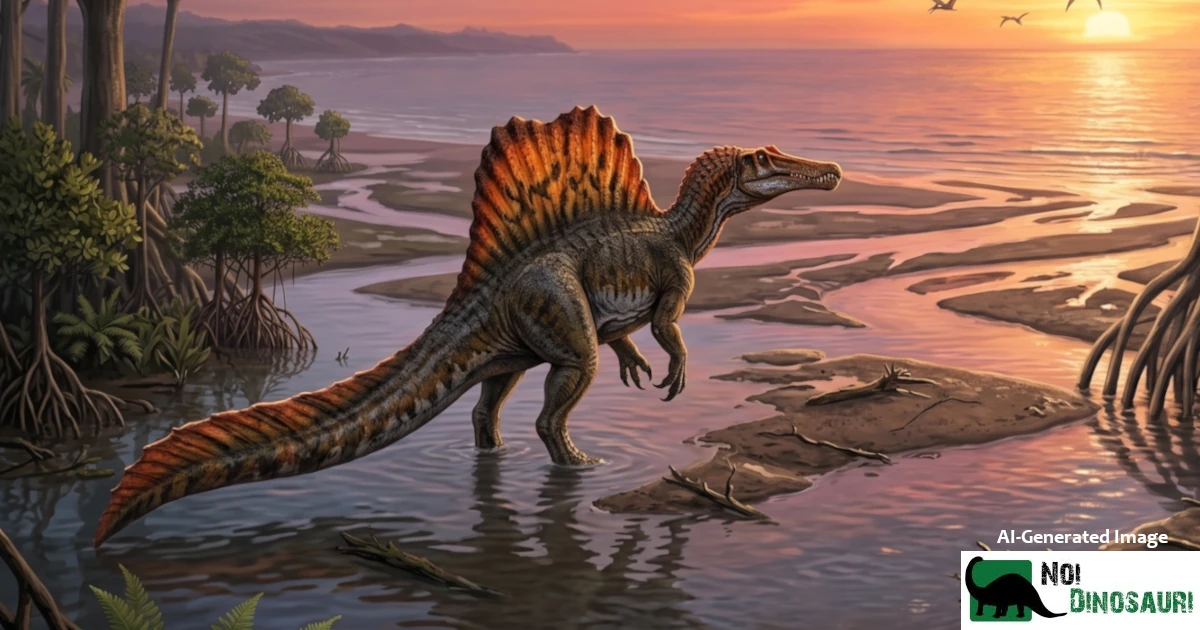
This apex predator thrived in a unique and lethal ecosystem located in the vast river deltas of the supercontinent Gondwana, which corresponds to today's Sahara Desert. It evolved as a specialized piscivore and an opportunistic hunter. Operating much like a gigantic heron, it used its conical teeth to spear slimy, aquatic prey in the shallows.
Cretaceous North Africa was a lush world of immense estuaries, river islands, and coastal lagoons. Intricate mangrove forests, tree ferns, and early flowering plants framed these warm, slow-moving waterways. The rivers teemed with colossal prey, including the giant sawfish Onchopristis and the enormous coelacanth Mawsonia. The "spine lizard" shared this humid basin with other terrifying apex predators, carefully avoiding terrestrial giants while navigating waters inhabited by the colossal crocodylomorph Sarcosuchus.

Curiosity - Did you know?
Between 2022 and 2024, the biomechanics of this dinosaur sparked the decade's most heated paleontological debate. Initial studies argued that its dense, pachyostotic bones allowed it to swim submerged like a giant penguin. However, recent research in 2024 recalculated its hydrodynamics and buoyancy. These new models suggest the dinosaur was too unstable to actively pursue prey deep underwater. Instead, scientists now favor the "super-heron" wading hypothesis. This theory paints a picture of a predator hunting belly-deep along the riverbanks, using powerful neck muscles to launch lightning-fast strikes just beneath the water's surface!