
 IT
IT  DE
DE  FR
FR  ES
ES  PT
PT 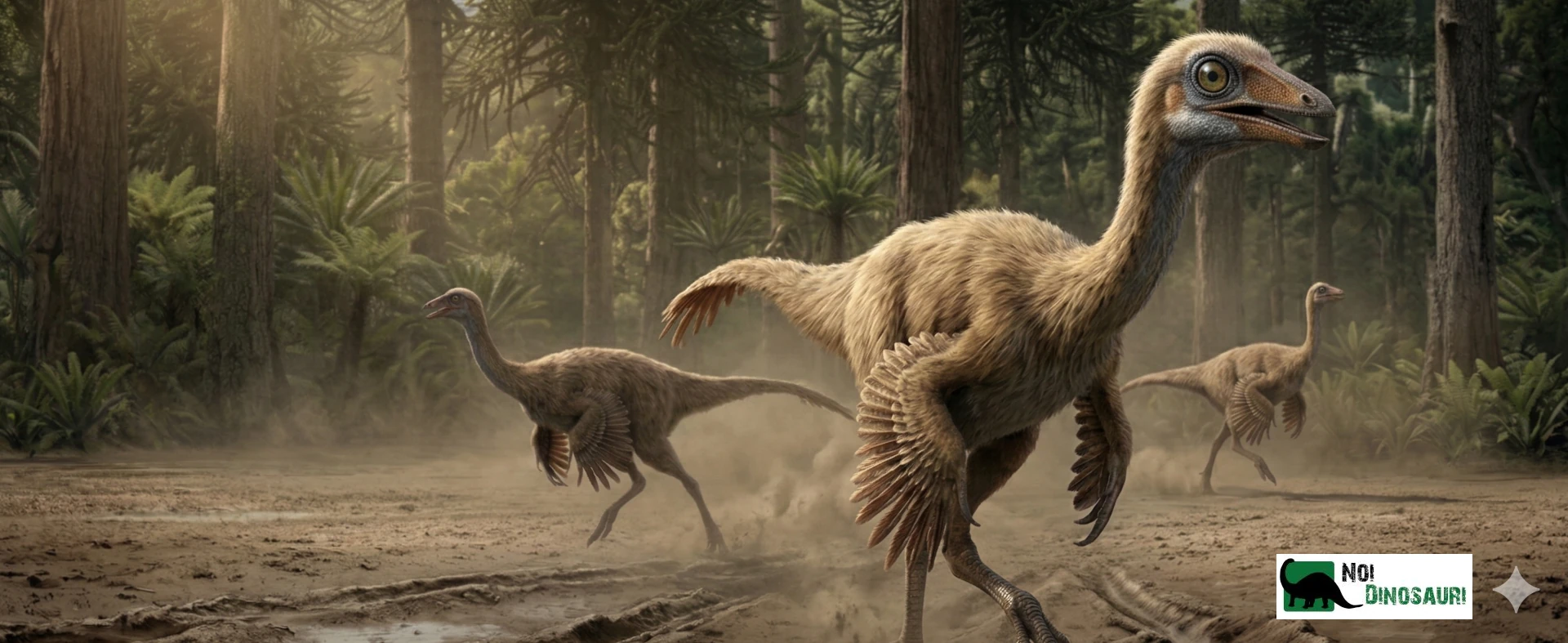
Ornithomimus
The Ornithomimus was a theropod dinosaur. It stalked the Late Cretaceous landscape between 76 and 66 million years ago. A core member of the ornithomimid family, this animal is a masterclass in cursorial adaptation and omnivory. It broke the mold of its carnivorous cousins. No heavy jaws. No serrated teeth. Just a lightweight frame and a specialized, toothless beak.
Ornithomimus: History, Characteristics, and Facts
The first Ornithomimus fossils surfaced in 1889 near Denver, Colorado. Geologist George Lyman Cannon pulled them from the earth. The following year, paleontologist Othniel Charles Marsh formalized the discovery, naming the species Ornithomimus velox. The translation is literal: "bird mimic." A direct nod to the hind legs, virtually indistinguishable from those of modern running birds.
The true paradigm shift arrived decades later. Today, the most pristine and complete specimens belong to Ornithomimus edmontonicus. These fossils, currently housed at the Royal Tyrrell Museum in Canada and the Denver Museum of Nature & Science, rewrote the anatomy of this theropod.
The Cretaceous dragster: legs and locomotion
The Ornithomimus was engineered to vanish. The hind legs functioned as elastic pistons, driving the animal to speeds near 70 km/h. No bony armor. No defensive horns. Just muscle fiber and kinetic balance. Biomechanical analysis of the fossilized bones confirms this. The tibia and metatarsals vastly outmeasured the femur. It is the exact structural ratio that propels modern racing greyhounds. The ground vibrated. A dust cloud billowed. The prey was already gone.
A mantle of silk and display feathers
Erase the image of the green, scaly reptile. The body of the Ornithomimus was swathed in soft, insulating down, similar to the plumage of a kiwi. The arms carried a different payload: long, stiff pennaceous feathers that fanned open on command. The hard evidence emerged in 2012 from the sandstones of Alberta. Paleontologists recovered fossils retaining millimeter-precise impressions of the calami (feather quills). The data is specific. Only adult specimens grew these ornamental wing structures, deploying them for courtship displays.
Sniper eyes and a multipurpose beak
A small, pivoting head anchored two eyes the size of billiard balls. They scanned the underbrush. They registered the slightest twitch. Fossilized sclerotic rings—the bony armor protecting the eyeball—and cranial endocasts prove it. The brain dedicated massive real estate to the optic lobes. The mouth ended in a keratinous beak. Half shears, half tweezers. It snapped insects from mid-air and severed fresh plant shoots with a single, sharp clack.
The elusive mirage: flight and herd behavior
In a world ruled by apex predators, survival meant becoming uncatchable. At full sprint, the stiff tail locked into place as an aerodynamic stabilizer. It pinned the center of gravity low, enabling hairpin turns at high velocity. The Ornithomimus did not run alone. It traveled in massive herds, mirroring the savanna dynamics of modern gazelles. Parallel fossil trackways discovered across North America lock this behavior in stone. Entire groups moved in sync. One snapped twig, and the feathered tide exploded into a blur of synchronized muscle.
The Ornithomimus shatters the trope of the hulking theropod. An adult measured 3.5 to 4 meters long from the beak's tip to the tail's end. It stood just over 1.5 meters at the hip.
The weight, historically inflated, clocked in between 150 and 170 kilograms. Hollow bones, elongated tibias, and a hyper-slender frame forged the ultimate Cretaceous sprinter, calibrated for top speeds of 60 to 70 km/h.
This theropod was an opportunistic omnivore. It thrived on the island continent of Laramidia (modern western North America). The keratinized beak compensated for the lack of teeth. It stripped tender leaves, crushed fruit, and snapped up shoots. When the environment offered protein, it adapted. It hunted insects, caught small vertebrates, and raided nests. A biological multi-tool.
The habitat consisted of coastal plains and alluvial forests. Giant conifers, ferns, and cycads formed the canopy and understory, while early angiosperms (flowering plants) rapidly gained ground. The ecosystem was shared with massive hadrosaurs and early ceratopsids. The primary threat? Tyrannosaurids. Apex predators like Albertosaurus—or the apex T. rex at the dawn of the extinction—forced the Ornithomimus to keep moving.
Curiosity - Did you know?
The sprinter's bare legs
A 2015 study on a pristine fossil exposed a critical biomechanical hack. The lower legs of the Ornithomimus—from the knee down—were completely featherless. Bare, scaly skin covered the bone. This was a targeted evolutionary adaptation. The bare legs functioned as thermal radiators. They dumped the massive heat load generated by the leg muscles during a sprint, preventing fatal heatstroke. It is the exact physiological solution utilized by modern ostriches traversing the African savanna.