
 IT
IT  DE
DE  FR
FR  ES
ES  PT
PT 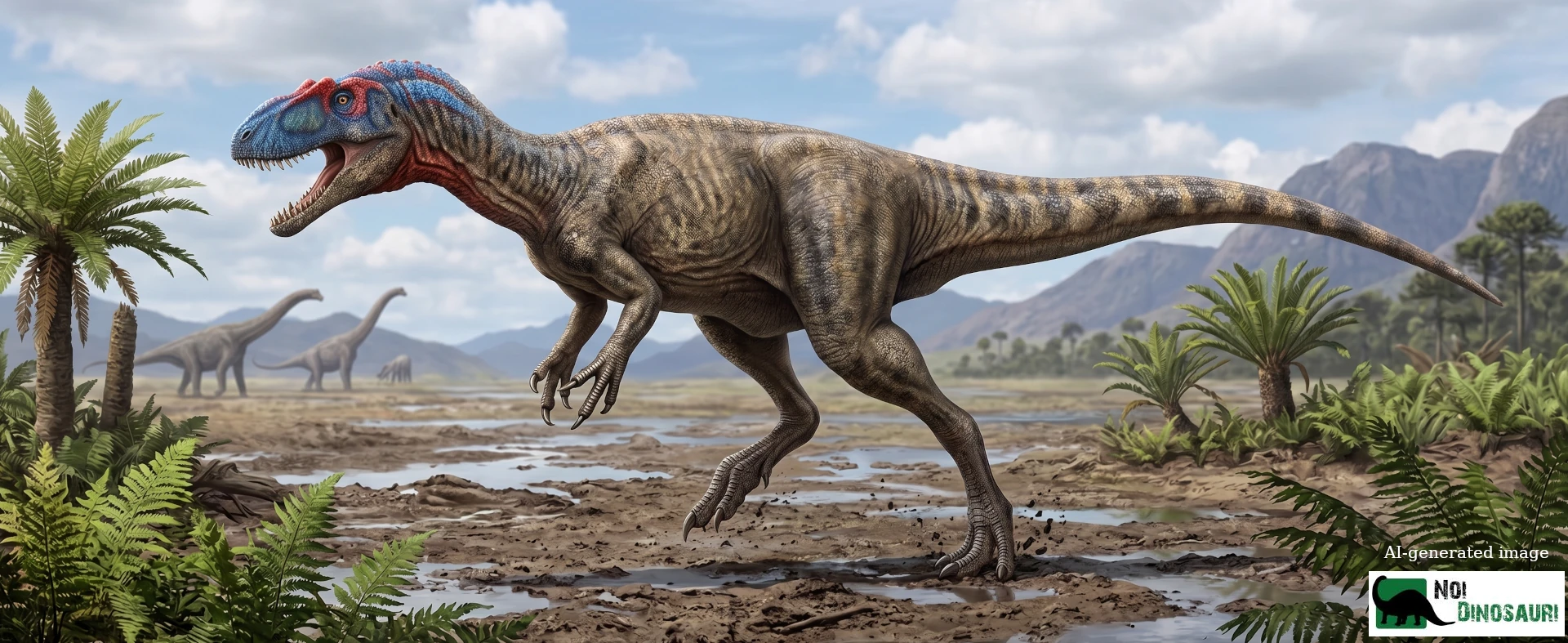
Gasosaurus
A sleek, carnivorous shadow haunting the landscapes of Middle Jurassic Asia, Gasosaurus (Gasosaurus constructus) was a masterpiece of early predatory evolution. This mid-sized, highly agile dinosaur sits near the base of the theropod family tree. It belongs to the tetanuran clade—the foundational group that would eventually give rise to both the massive carnosaurs and the bird-like coelurosaurs. Because of this basal position, Gasosaurus offers crucial clues into how these iconic predators evolved their lethal adaptations.
Gasosaurus: History, Characteristics, and Facts
The unearthing of Gasosaurus reads more like an industrial accident than a traditional scientific expedition. In 1985, during heavy earthmoving operations for a gas extraction facility at the Dashanpu quarry, construction workers accidentally struck a massive, fossil-rich bonebed. Chinese paleontologists rushed to the scene, working feverishly to excavate and describe the dinosaur's postcranial remains later that same year.
Its peculiar scientific name, Gasosaurus constructus (literally "the constructing gas lizard"), honors the energy company that halted its operations to allow for the delicate recovery. Today, the Zigong Dinosaur Museum in China's Sichuan Province proudly houses these priceless original fossils.
The Anatomy of an Ambush
The skeleton of Gasosaurus points to a hunter built for explosive speed and ambush. Ecologically, it functioned more like a darting leopard than a bruiser relying on pure brawn. Current evidence suggests it lacked feathers, sporting instead the scaly hide typical of early Jurassic theropods. The bones of its skull display distinct rugosity, leading paleontologists to suspect it bore vibrant keratinous crests or ridges on its snout. These structures likely served as visual displays for attracting mates or intimidating rivals.
Precision Weaponry
Its jaws were a high-precision hunting machine. Microscopic analyses of the recovered teeth reveal fine serrations along the edges—a biomechanical design mirroring a high-end steak knife. These teeth were engineered specifically to slice and tear flesh, rather than crush thick bone like the massive tyrannosaurids of the later Cretaceous. Although relatively short, its forelimbs were heavily muscled and tipped with three formidable, hooked claws. Gasosaurus likely used these to grapple and pin down struggling prey during the chaotic final moments of an ambush.
Built for Acceleration
The dinosaur's powerful hind legs acted as its primary engine. Deep muscle insertion scars etched into the pelvis and thigh bones of the holotype specimen (IVPP V7264) indicate massive, powerful leg tendons. This formidable musculature gave Gasosaurus staggering instantaneous acceleration, allowing it to spring forward like a coiled spring. During high-speed pursuits, its long, stiff tail functioned as a dynamic counterbalance, enabling the predator to execute sudden, sharp turns without losing its footing.
Older encyclopedias and pop-culture media often exaggerate the size of this elegant predator. However, modern biomechanical analyses reveal a darting carnivore of decidedly modest proportions—a far cry from cinematic movie monsters.
A fully grown Gasosaurus measured no more than four meters from snout to tail tip. By analyzing the density and circumference of its load-bearing bones, experts estimate its maximum weight at around 200 kilograms. While outdated estimates hastily pushed this figure up to 400 kilograms, those numbers conflict with the dinosaur's lightweight, highly pneumatized skeletal frame. In reality, Gasosaurus was built more like a large, agile feline than a bulky, heavily armored carnivore.
Gasosaurus prowled a lush, humid, and swampy subtropical ecosystem on the ancient northern supercontinent of Laurasia—specifically within the area now known as China's Lower Shaximiao Formation. Slow, sprawling river systems and large, crystal-clear lakes carved through this primordial landscape. Dense, shadowy forests dominated by archaic conifers, cycads, and boundless expanses of tree ferns blanketed the region.
As an active and intelligent hunter, Gasosaurus skillfully used this dense underbrush for cover, launching lightning-fast ambushes along riverbanks and muddy floodplains. It silently patrolled these waterways in search of vulnerable prey, such as the inexperienced juveniles of giant, long-necked sauropods. Occasionally, it may have clashed with more dangerous, heavily armed herbivores, including the club-tailed Shunosaurus and the massive Omeisaurus. When avoiding the deadly risks of big-game hunting, Gasosaurus likely targeted smaller, swift bipedal runners, or the fragile juveniles of primitive plated dinosaurs like Agilisaurus and Huayangosaurus.
It was near one of these placid rivers that the famous holotype specimen met its sudden end. The rocky sediments encasing the fossils unequivocally indicate that a catastrophic flash flood swept the dinosaur away, rapidly burying it. This sudden entombment sealed its fragile remains in protective mud, preserving them for over 160 million years.
Curiosity - Did you know?
In the realm of dinosaur taxonomy, Gasosaurus remains an elusive ghost. Because scientists only have a single, fragmentary skeleton to work with, its exact placement on the theropod family tree constantly shifts. This makes it one of the most intensely studied—yet least understood—dinosaurs of the Asian Jurassic. Every modern reassessment yields valuable new data but simultaneously raises unexpected questions. Consequently, its exact evolutionary relationship to other iconic predators remains the subject of lively and passionate scientific debate to this day.