
 IT
IT  DE
DE  FR
FR  ES
ES  PT
PT 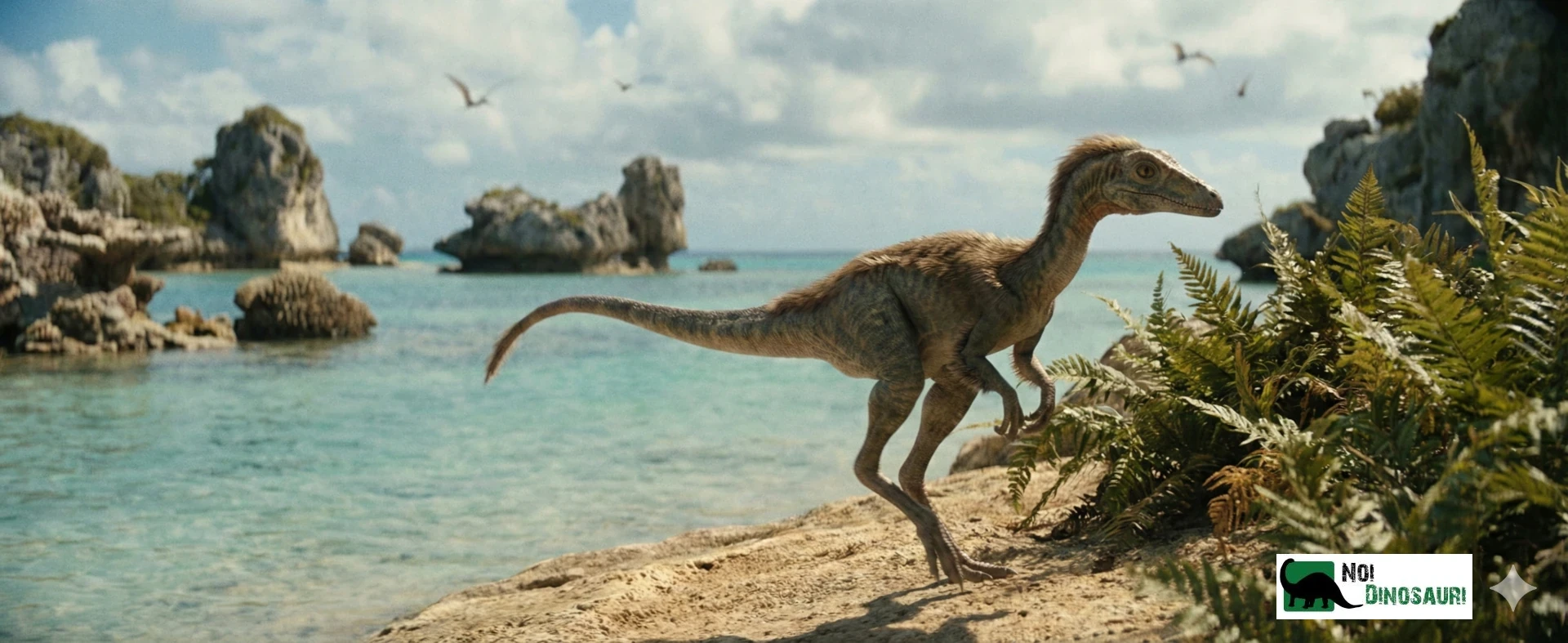
Compsognathus
Compsognathus was a small but formidable theropod dinosaur belonging to the family Compsognathidae. It dominated the island ecosystems of the Late Jurassic, sharing its hunting grounds with the very first birds. Far from being just a "miniature dinosaur," this highly agile bipedal carnivore represents a crucial link in the evolutionary history of feathered dinosaurs.
Compsognathus: History, Characteristics, and Facts
The first extraordinary Compsognathus specimen emerged in 1859 from the famous Solnhofen lithographic limestones in Bavaria, Germany, discovered by physician and fossil collector Joseph Oberndorfer. Paleontologist Johann A. Wagner coined its scientific name, deriving it from Ancient Greek. It translates to "elegant jaw" (kompsos = elegant, gnathos = jaw)—a fitting tribute to its delicate cranial structure.
For over a century, this German fossil remained the only known specimen in the world. That changed in 1971 when researchers unearthed a second, larger, and more complete skeleton in the Canjuers lithographic limestones of France. Today, the Bavarian State Collection of Paleontology and Geology (Bayerische Staatssammlung für Paläontologie) in Munich houses the German holotype, while the French specimen resides in the collections of the National Museum of Natural History (Muséum national d'Histoire naturelle) in Paris.
Forget the earth-shaking giants. The true terror of the Jurassic undergrowth weighed as much as a housecat and moved with the agility of a greyhound.
A Feathered Scalpel
Compsognathus was a living paradox: it had the dimensions of a chicken, yet possessed the infallible instincts of a highly specialized predator. It likely sported a coat of fine protofeathers, similar to the down of a newborn chick, transitioning to smooth scales on its legs and tail. This dual covering would have made it a silent hunter, allowing it to slip through dense foliage without a sound.
Built for Speed
Evolution engineered its entire anatomy for one purpose: blistering sprints. Its long tail wasn't just decorative; it acted as a dynamic balancing rod, allowing the dinosaur to execute impossible zig-zag turns at top speeds. Its legs functioned like coiled springs. To cut weight without sacrificing structural integrity, its bones were pneumatic—hollow and light, much like the frame of a racing bicycle. Modern micro-CT scans of compsognathid femurs reveal a spongy internal architecture identical to that of modern birds.
The Perfect Predator
This micro-killer didn't bother chewing. It grabbed its food and bolted it down whole. Picture the scene: a sudden blur darting through the ferns, ending in a lethal bite from sharp, serrated teeth. The ultimate proof of its ruthless efficiency lies in the Solnhofen limestone. Paleontologists discovered an immaculate fossil containing the intact skeleton of a small lizard, Bavarisaurus, right in the center of the Compsognathus's ribcage. This 150-million-year-old snapshot provides direct evidence that it swallowed prey whole, much like modern snakes do.
Camouflage and Melanosomes
Surviving in a tropical archipelago meant avoiding the jaws of larger theropods, which required master-class camouflage. By examining the exceptionally preserved fossils of its closest relatives (like Sinosauropteryx) under an electron microscope, scientists have identified fossilized pigment sacs called melanosomes. The shape of these cells reveals a striking color palette: a dark back to absorb sunlight, contrasting with a tail banded in vivid orange and white rings. This countershading acted as a perfect disruptive pattern, allowing the animal to vanish into the dappled light and shadow of the undergrowth right before striking.
For decades, popular science books crowned Compsognathus as the "world's smallest dinosaur," mistakenly describing it as chicken-sized. Modern paleontology has thoroughly debunked this myth. The original German specimen—which measures about 89 centimeters (35 inches) long—is actually a juvenile.
The French fossil represents a mature adult and reaches a maximum length of 1.25 meters (4.1 feet). Its true weight also exceeds those early estimates. A healthy adult likely weighed between 2.5 and 3.5 kilograms (5.5 to 7.7 lbs)—roughly the size of a large turkey or an elongated wildcat. Furthermore, later discoveries like Microraptor and Epidexipteryx have vastly surpassed Compsognathus in the "smallness" category.
Compsognathus was an active, opportunistic hunter that patrolled the tropical atolls and lagoons of Jurassic Europe. Its strictly carnivorous and insectivorous diet relied on ambush tactics and explosive chases through the underbrush to snatch fast, darting prey.
It inhabited the islands of the Tethys Sea, a vast archipelago within the supercontinent Laurasia that geographically corresponds to modern-day Germany and France. The local climate was arid and subtropical. Instead of dense forests, the landscape featured low vegetation dominated by seed ferns, cycads (such as Zamites), and stands of primitive conifers, all interspersed with white sand beaches and brackish lagoons.
In this island ecosystem, it shared the skies with pterosaurs like Pterodactylus and Rhamphorhynchus, while Archaeopteryx—the famous first bird—fluttered among the trees. On the ground, Compsognathus hunted alongside sphenodont reptiles and a diverse array of insects.
Curiosity - Did you know?
Compsognathus is one of the rare dinosaurs whose diet we know from direct, indisputable evidence. Inside the ribcage of the German holotype, exactly where the stomach would have been, paleontologists found the perfectly articulated skeleton of a prehistoric lizard: Bavarisaurus. The lizard's intact, natural positioning indicates that the dinosaur swallowed it alive and whole. Shortly after consuming this final meal, the Compsognathus likely drowned in a nearby lagoon, forever freezing a moment of everyday Jurassic life in the rock.