
 IT
IT  DE
DE  FR
FR  ES
ES  PT
PT 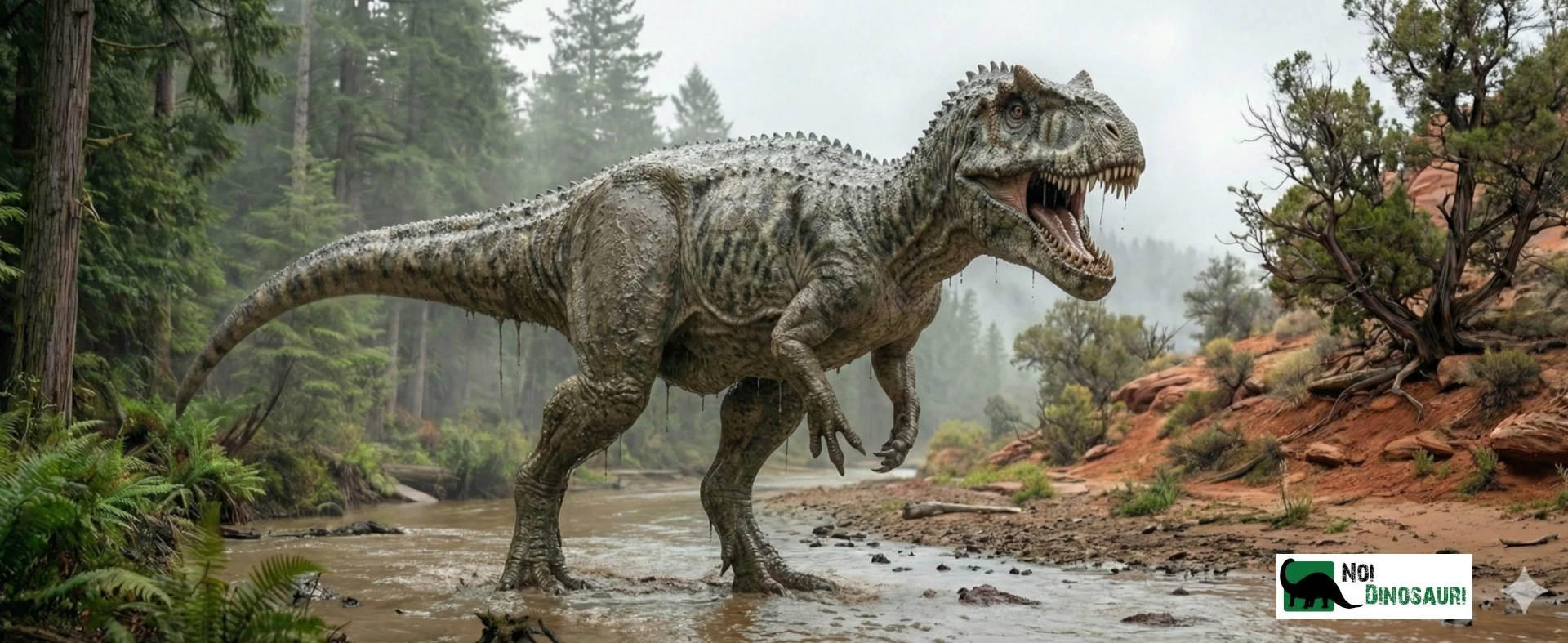
Allosaurus
Allosaurus was undeniably the most iconic and feared carnivore of its era. This formidable predator, a theropod dinosaur of the family Allosauridae, ruled as the undisputed apex predator of terrestrial ecosystems during the Late Jurassic period, roughly 155 to 145 million years ago.
Allosaurus: History, Characteristics, and Facts
The discovery of Allosaurus occurred during one of the most chaotic and productive periods in American paleontology: the infamous Bone Wars. In 1877, paleontologist Othniel Charles Marsh first described the creature's fossilized remains. He coined a name that translates to "different lizard" (from the Greek allos, different, and sauros, lizard). This peculiar name highlighted the unique, hourglass-like shape of its vertebrae. These bones were highly weight-reduced and structurally distinct from any dinosaur discovered up to that point.
Over time, paleontologists have officially recognized three valid species. Allosaurus fragilis is the type species and remains the most abundant and well-studied. Researchers formally described Allosaurus europaeus and Allosaurus jimmadseni later, with the latter finalized in 2020. More recently, in 2024, scientists proposed a fourth species, Allosaurus anax, which still sparks debate within the scientific community. Today, the Natural History Museum of Utah in Salt Lake City and the Smithsonian Institution house the most impressive fossil collections. The vast majority of these specimens originated from the Cleveland-Lloyd Dinosaur Quarry in Utah—a prehistoric mud trap that perfectly preserved dozens of individuals.
The Predator's Frame: Skull and Crests
The anatomy of Allosaurus was a biological masterpiece, forged to blend extreme agility with lethal force. The massive skull was surprisingly narrow and light. Much like the carbon fiber chassis of a modern race car, large bony openings, or fenestrae, reduced its overall weight without sacrificing structural integrity. Two unmistakable horn-like crests sat just above the eyes, crowning the snout. In life, a keratin sheath likely covered these crests. They served primarily as display structures, functioning as species recognition tools and visual intimidation signals during territorial disputes.
Senses of the Ambush: Vision and Olfaction
The senses of Allosaurus were finely tuned for a life of ambush hunting. Its binocular vision was limited to a narrow, 20-degree frontal cone. However, it more than compensated for this restricted sight with an exceptional sense of smell. Highly developed olfactory lobes within the braincase allowed the predator to track prey across vast distances. When the moment to strike arrived, specialized jaw articulations enabled the mandibles to expand outward, opening the mouth incredibly wide for a devastating bite.
The Conveyor Belt: Teeth and Dental Renewal
The arsenal inside that jaw was nothing short of terrifying. Its teeth functioned like serrated steak knives. They were sharp, laterally compressed, and perfectly adapted to slice through thick slabs of meat. Much like modern crocodiles, an Allosaurus constantly shed worn teeth. Backup rows of fresh blades quickly replaced the lost teeth, completely renewing the predator's smile roughly every 100 days. Throughout its entire life, this carnivore never went unarmed.
The Pneumatic Engine: Vertebrae and Respiration
An extraordinary engineering secret lay hidden within its neck and back. Complex pneumatic foramina pierced the central vertebrae, functioning exactly like those seen in modern birds. These internal cavities allowed air sacs to invade the skeleton, drastically reducing the animal's weight while maintaining absolute bone solidity. This system was more than just a weight-saving trick. It formed the core of a highly efficient, bird-like respiratory apparatus capable of flooding the bloodstream with oxygen to fuel its hyperactive lifestyle.
The Hunter's Sickles: Forelimbs and Claws
Unlike the notoriously stunted arms of later tyrannosaurs, Allosaurus boasted unusually long, powerful forelimbs. Each hand wielded three massive, curved claws. These deadly appendages acted like meat hooks or the talons of a giant eagle. The predator used them to grapple struggling prey, pinning the victim securely in place before delivering the final bite.
The Predator's Skin: Integument and Scales
Rare fossilized skin impressions reveal a body entirely devoid of feathers. Instead, robust polygonal scales armored the dinosaur. This tough, leathery hide offered excellent mechanical protection against the desperate scratches and bites of struggling prey. It embodied the classic image of a large, predatory dinosaur: scaled, heavily built, and ruthlessly efficient.
Pop culture and cinema frequently exaggerate the sheer size of Allosaurus. In reality, Allosaurus fragilis averaged about 8.5 meters in length and carried a realistic weight of 1.5 to 2 tons. While isolated fragments suggest a few exceptional individuals may have approached 9.7 meters, the legendary "12-meter Allosaurus" is largely a myth. This misconception stems from historical taxonomic confusion with heavier, closely related theropods. The primary culprits are the controversial Saurophaganax (debated as either a distinct genus or a giant Allosaurus species) and the massive Torvosaurus.
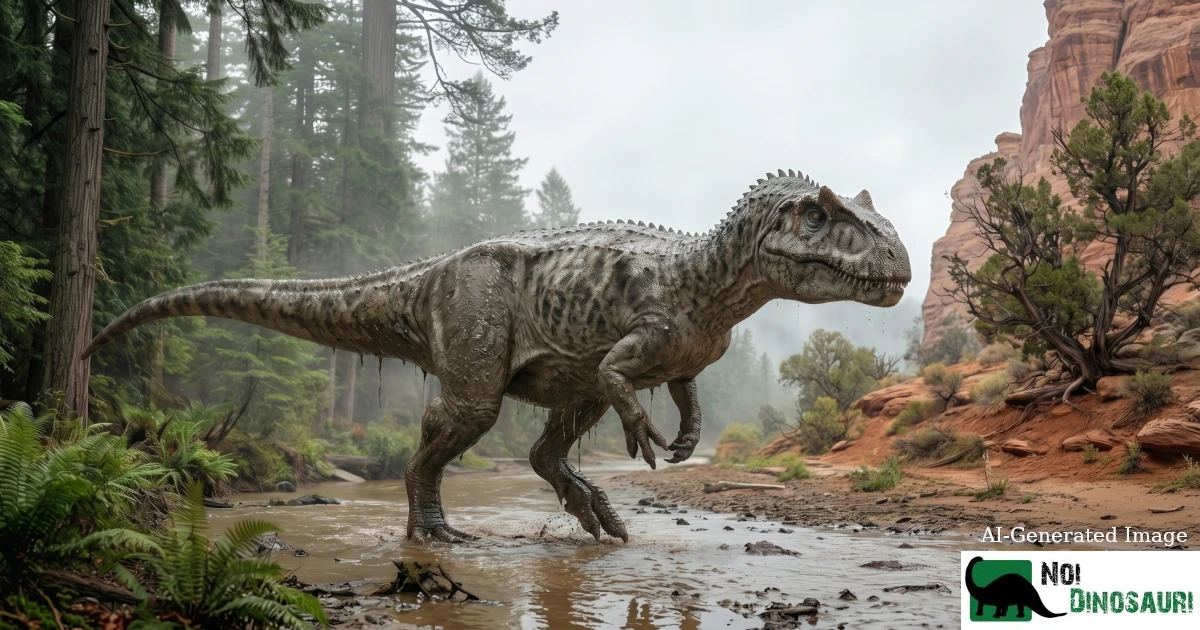
Allosaurus relied on ambush tactics and astonishing jaw mechanics to secure its meals. Leading biomechanical studies suggest it employed a brutal hunting technique known as the hatchet-bite. The predator would open its jaws to an extreme 92-degree angle and drive its upper jaw downward in a violent, snapping motion. Powered by exceptionally strong neck muscles—similar to a modern falcon—it would then violently rip its head backward. Its serrated teeth didn't crush bone; instead, they acted as meat saws, rapidly tearing away massive chunks of flesh. This caused immediate hypovolemic shock from catastrophic blood loss, quickly bringing the prey to its knees.
Geographically, Allosaurus dominated the fertile floodplains of the northern supercontinent, Laurasia. Today, these fossil beds make up the famous Morrison Formation across the American West and Midwest, with additional confirmed remains located in Portugal. Its habitat featured vast, semi-arid prairies crossed by seasonal rivers. Gallery forests of araucaria, ginkgo, and cycads provided cover, alongside a dense undergrowth of ferns. Notably, this ancient world completely lacked grass, which had not yet evolved.
While Allosaurus occasionally targeted massive sauropods like Apatosaurus and Diplodocus, it more frequently clashed with armored herbivores like Stegosaurus. The fossil record vividly documents this epic rivalry. Paleontologists have unearthed Allosaurus vertebrae punctured by thagomizers (stegosaur tail spikes) alongside Stegosaurus plates bearing deep theropod bite marks. As an apex predator, it shared the top of the food chain with other large carnivores like Ceratosaurus.
Curiosity - Did you know?
One of the most intensely studied dinosaur fossils is a subadult specimen unearthed in Wyoming in 1991, affectionately dubbed "Big Al" (specimen MOR 693). This fossil is remarkable not just for its completeness—a miraculous 95% intact—but for the grim medical history recorded in its bones. Paleontologists have identified at least 19 distinct paleopathologies, including healed fractures, severe trauma, and chronic infections.
The most fatal of these was a massive bone infection in its right foot. This agonizing affliction forced the animal to limp heavily, ultimately destroying its ability to hunt. Big Al died a premature death from starvation at roughly 15 years old. The tragic story of this resilient predator inspired the BBC documentary The Ballad of Big Al, and its skeleton now stands at the Museum of the Rockies as a silent testament to the brutal reality of the Jurassic period.