
 IT
IT  DE
DE  FR
FR  ES
ES  PT
PT 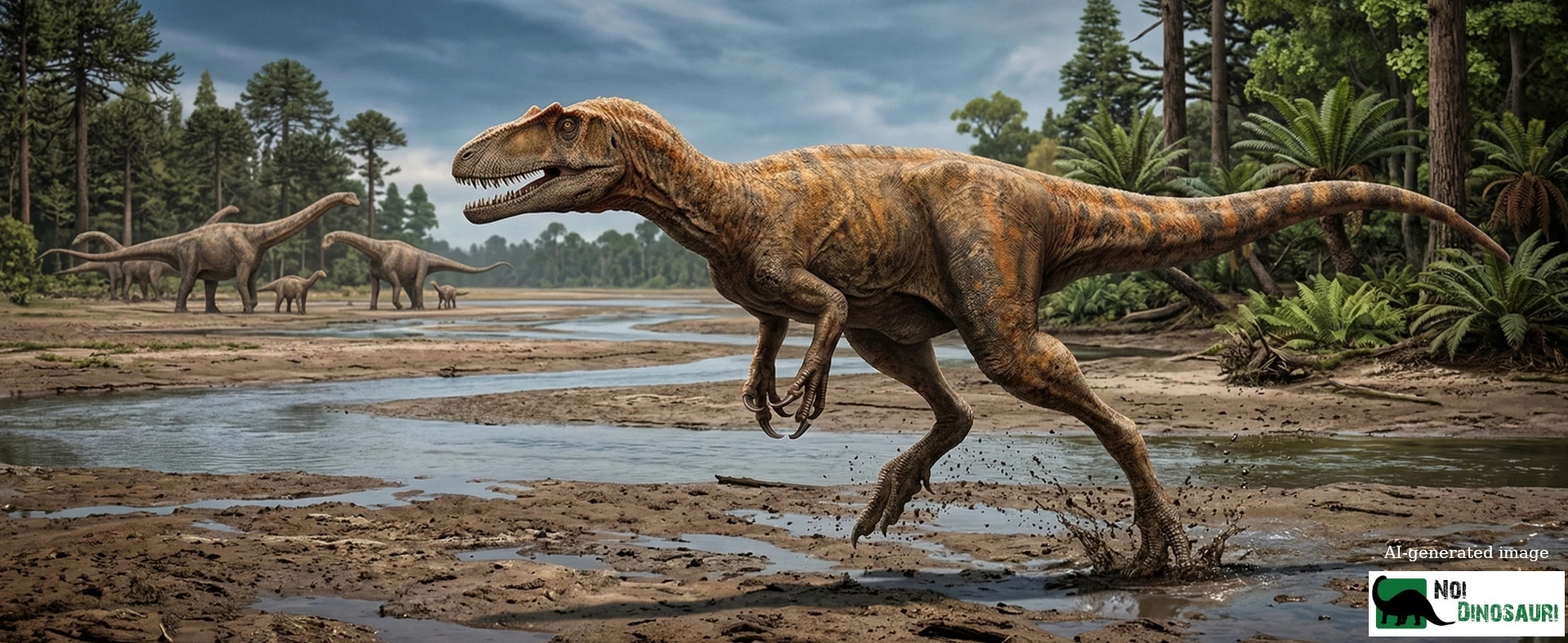
Afrovenator
Afrovenator abakensis was a carnivorous theropod dinosaur belonging to the megalosauroid superfamily. Contrary to early paleontological estimates, this extraordinary predator dominated the ecosystems of the Middle Jurassic. It moved with lethal elegance across regions that now form the arid heart of North Africa.
Afrovenator: History, Characteristics, and Facts
The discovery of Afrovenator represented a watershed moment for the modern paleontology of the African continent. In 1993, an expedition led by the renowned paleontologist Paul Sereno explored the Tiourarén Formation in the Agadez region of Niger. His team unearthed an exceptionally complete skeleton, missing only a portion of the lower jaw and a few tail bones.
The scientific name perfectly captures the significance of the find. Afrovenator means "African hunter," while the specific epithet abakensis pays homage to Abaka, the Tuareg name for the nearby In Gall region. Today, the original remains of this iconic predator safely reside in Niger. However, major institutions like the Field Museum of Natural History in Chicago display perfect skeletal replicas to welcome visitors.
The Aerodynamic Shadow of the Jurassic
The sands of Niger yielded a fossil miracle. The almost entirely intact skeleton revealed a light, slender bone architecture lacking the heavy bulk seen in later apex predators. Afrovenator didn't just walk; it glided silently. Its skin, stretched over powerful muscles, would have felt dry and rough to the touch. Colored in ochre and rust tones, the dinosaur perfectly blended with the shadows of the prehistoric African landscape. This was the silhouette of a predator built for speed, where every kilogram of mass was justified and every centimeter served a functional purpose.
The Fine-Bladed Arsenal
Its skull functioned as a precision scalpel rather than a bone-crushing vise. The narrow jaws concealed dozens of curved, serrated teeth, sharp as high-end steak knives. Three fingers on each forelimb ended in curved claws designed to harpoon fleeing victims. Microscopic analysis of fossilized tooth wear clarified its hunting technique. Paleontologists found no typical micro-damage resulting from violent impacts with bone. Instead, Afrovenator aimed for the soft flesh of the flanks. It would tear large flaps of meat before retreating into the shadows, allowing blood loss to finish the job.
The Elite Sprinter
Afrovenator was a born sprinter. It dashed out to intercept the young of massive, long-necked sauropods, easily separating them from the protection of the herd. Computer-generated biomechanical models, based on the exact proportions of its femur and tibia, demonstrate that its legs operated like high-tension springs. These limbs were engineered for lightning-fast acceleration in open terrain. It was not a predator of brute force, but an elite pursuit machine: light, explosive, and highly unpredictable.
The Geological Passport
Beyond its role as a carnivore, Afrovenator provided damning proof of a changing world 160 million years ago. Finding its remains in Africa was like discovering a passport stamped from two different continents. Phylogenetic analyses—the study of its evolutionary family tree—revealed a surprising truth. The dinosaur was closely related to the megalosaurs living in Europe. This unequivocal anatomical correspondence confirmed that Africa and Europe remained connected by walkable land bridges during the Middle Jurassic, forcing scientists to rewrite the timeline of continental drift.
When we think of predatory theropods, our minds often jump to 13-meter giants like T. rex. The actual dimensions of Afrovenator, however, tell the story of a hunter built for efficiency over brute force.
It measured approximately 8 meters from snout to tail tip, weighing an estimated one ton. This represents a relatively contained mass for a theropod of its length, keeping it far lighter than the bulky North American Allosaurus. This slender build unlocked the secret to its evolutionary success, granting it a decisive advantage in speed and agility over its contemporaries.
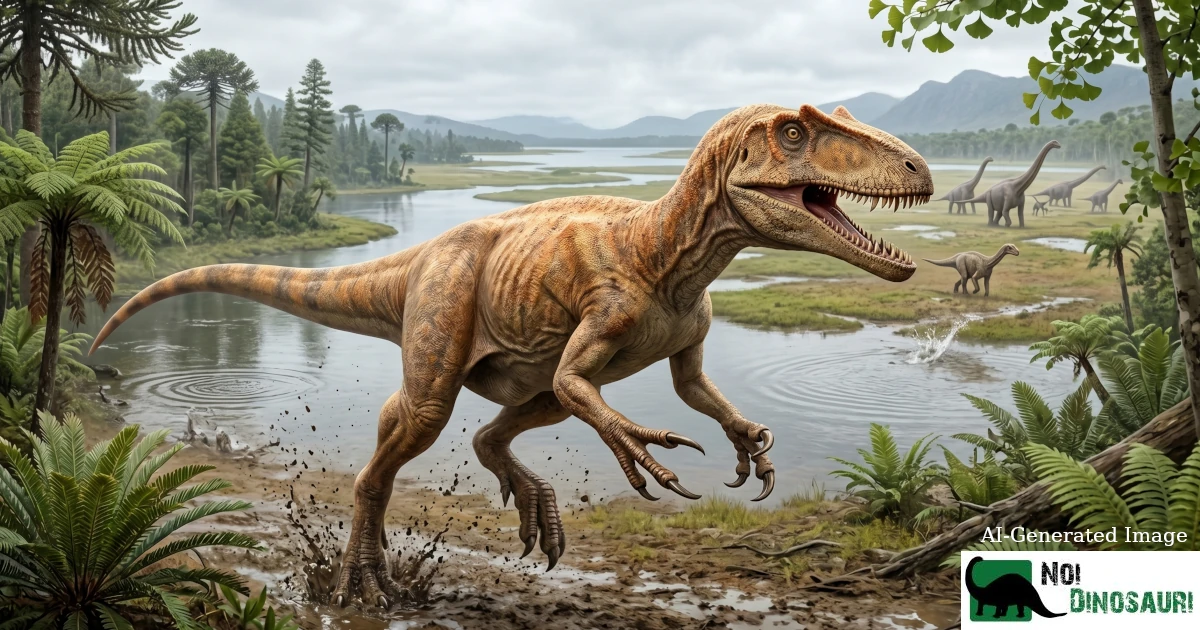
Afrovenator was an obligate carnivore that avoided static ambushes. Instead, it actively pursued medium-sized prey and juvenile dinosaurs, relying on its speed and debilitating bites.
It roamed the vast supercontinent of Gondwana, inhabiting an area that corresponds to the modern Sahara Desert. At the time, however, the environment was radically different. Extensive floodplains, lakes, and rivers carved through forests of primitive conifers, ferns, and ginkgos. It was a lush, humid landscape, unrecognizable from today's arid expanse. Afrovenator shared this vibrant ecosystem with massive herbivorous sauropods like the gigantic Jobaria tiguidensis and the primitive Spinophorosaurus. The calves of these giants likely served as its primary prey.
Curiosity - Did you know?
At the time of its discovery in 1993, researchers mistakenly dated the Tiourarén Formation to the Early Cretaceous period (about 130 million years ago). This generated widespread confusion in the scientific community. Why did an African dinosaur from the Cretaceous look so remarkably similar to the megalosaurs of the European Jurassic? In 2009, a comprehensive geological study corrected the error, proving the rocks actually dated back to the Middle Jurassic (about 160 million years ago). This 30-million-year temporal relocation suddenly made perfect sense of its anatomy. It transformed Afrovenator from an anachronistic fossil into a piece perfectly fitted within its correct evolutionary tree!