
 IT
IT  DE
DE  FR
FR  ES
ES  PT
PT 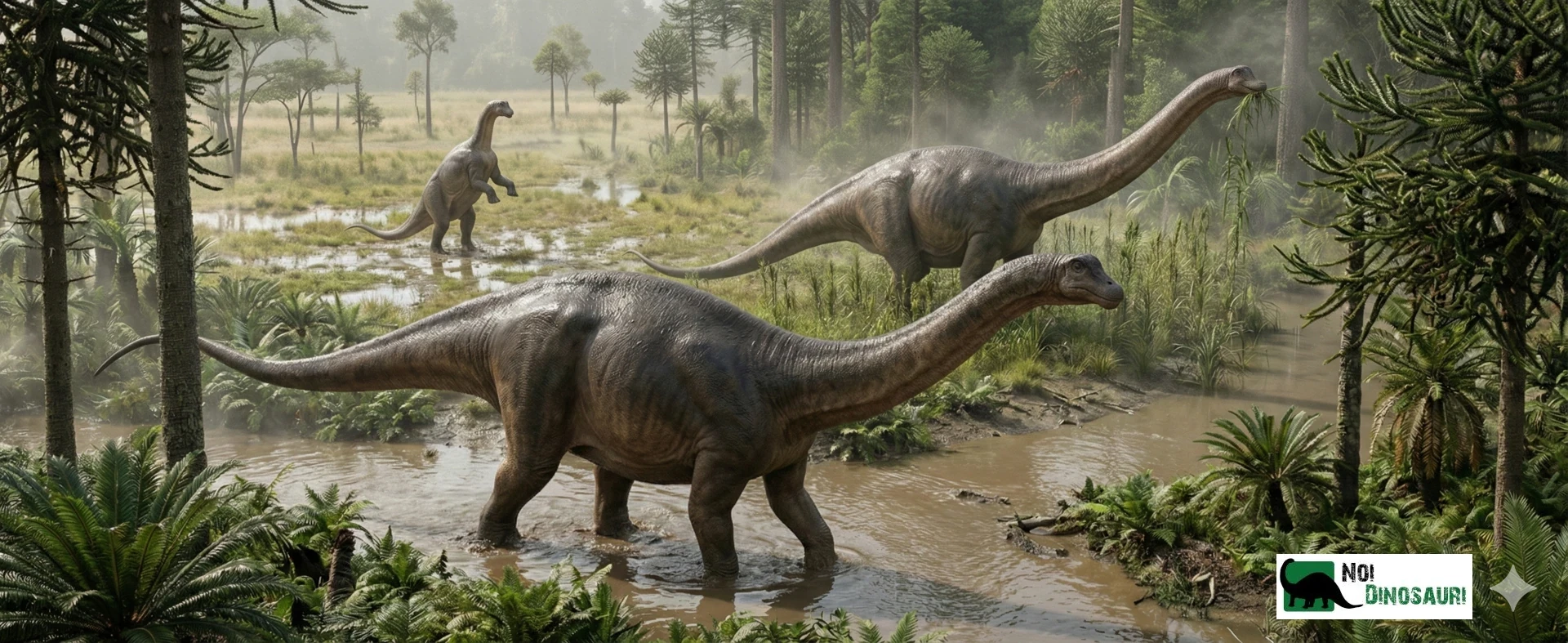
Brontosaurus
Meet Brontosaurus, one of the most iconic herbivorous dinosaurs to ever roam our planet. As a specialized member of the diplodocid family, this colossal sauropod dominated terrestrial ecosystems during the Late Jurassic period. It moved with a heavy tread across the ancient plains of North America. Though confused with similar species and debated by scientists for over a century, we now know this thunder lizard is a distinct, valid genus perfectly adapted to life on solid ground.
Brontosaurus: Curriculum Vitae of the species
History and Discovery
The turbulent taxonomic history of this dinosaur began in 1879 during the infamous Bone Wars. American paleontologist Othniel Charles Marsh excavated a colossal fossil in Wyoming and named it Brontosaurus excelsus. In Ancient Greek, the name translates literally to "noble thunder lizard," evoking the deafening sound of its massive footsteps.
In 1903, paleontologist Elmer Riggs argued the specimen was too similar to Apatosaurus, downgrading the thunder lizard to a mere synonym for over a century. The true turning point arrived in 2015. A monumental phylogenetic study published in PeerJ by Emanuel Tschopp and colleagues analyzed hundreds of anatomical traits, conclusively proving the genus is separate and valid. Today, you can admire spectacular remains of this animal at the Peabody Museum (Yale University) and the American Museum of Natural History in New York.
Anatomy and characteristics
Evolution sculpted this imposing sauropod with one primary goal: supporting a titanic mass.
Biological Pillars and Pneumatic Bones
Four columnar limbs supported its body—true biological pillars designed to carry tons of muscle and bone. The slightly shorter front legs sported a single, powerful claw, acting as a natural pickaxe for defense or digging. An incredibly robust neck ended in a proportionally tiny head. This structure was a biomechanical masterpiece: the cervical vertebrae were highly resistant yet lightened by internal air sacs, functioning exactly like those in modern birds. Modern reconstructions also debunk the old myth of swamp-dwelling giants; their nostrils sat near the snout, perfectly adapted for breathing the dusty air of dry land.
The Fermentation Factory
Don't expect terrifying fangs. Its simple, rake-like teeth evolved solely to strip leaves from branches, not to chew them. The real digestive work happened in the stomach. Here, prolonged intestinal fermentation processed massive quantities of vegetation, extracting every available calorie using billions of symbiotic bacteria.
The Giant's Senses
In the primordial world, smell was its greatest superpower. By studying related species, scientists deduce these giants possessed massive olfactory bulbs to sniff out food, detect chemical signals, and spot lurking predators from miles away. Vision took a backseat. Its laterally placed eyes offered a wide, 360-degree field of view to monitor for approaching carnivores.
Communication and the Supersonic Tail Myth
What kind of voice did such a beast have? CT scans of rare, intact skulls reveal the sauropod inner ear was calibrated to pick up infrasound. These ultra-low frequencies propagate for miles through the air and ground. Its extremely long tail also functioned as a formidable whip to fend off predators. However, a 2022 biomechanics study by Simone Conti demonstrated that no diplodocid could actually break the sound barrier. The tail could lash at an impressive 100 km/h, but generating a true sonic boom would have literally disintegrated the tip, shattering vertebrae and tearing tissue.
Camouflage Armor
Rare fossil casts reveal skin lined with rough, leathery scales and a row of dermal spines along the back's midline. Like modern elephants, it likely sported muted tones like gray, brown, or olive green. It may have used countershading—a darker back and lighter belly—to visually flatten its immense silhouette within the forest.
Actual Size (Myth vs. Reality)
Pop culture often depicts unrealistically massive proportions, forcing these creatures into swamps to prevent their bones from collapsing. The reality is quite different: they were fully terrestrial walkers.
An adult Brontosaurus excelsus reached an estimated maximum length of 20 to 22 meters. Its true weight realistically hovered between 15 and 17 tons, completely debunking the legendary 40-ton estimates of past decades. While this mass rivals three to four adult African elephants, the dinosaur's strong, pneumatized skeleton sustained it effortlessly.
Diet and Paleoecology
This giant thrived on the supercontinent of Laurasia in a primordial landscape dominated by dry seasons and monsoon rains. Today, this region corresponds to the Morrison Formation in the western United States (Wyoming, Utah, Colorado). The habitat featured vast, semi-arid floodplains crossed by rivers and lush forests of conifers, ferns, and cycads.
Using a mid-height browsing strategy, it stripped needles and leaves from the canopy. It shared these grazing grounds with other giants like Diplodocus, Camarasaurus, and the armored Stegosaurus. However, it constantly had to defend itself against the terrifying apex predators of the era, particularly the ravenous Allosaurus.
Curiosity - Did you know?
For decades, scientists believed the tapering, cord-like tail could exceed the speed of sound and produce a deafening crack. Updated biomechanical simulations have thoroughly debunked this myth: a sonic boom would have destroyed the tail entirely. Still, lashing the air at 100 km/h, it remained an exceptional visual and tactile deterrent to disorient carnivores and communicate with the herd!
No. Recent biomechanical studies from 2022 show that while the tail could travel at very high speeds (around 100 km/h) to function as a defensive whip, it could not generate a sonic boom. Breaking the sound barrier would have caused the bones and tissues at the tip of the tail to disintegrate.