
 IT
IT  DE
DE  FR
FR  ES
ES  PT
PT 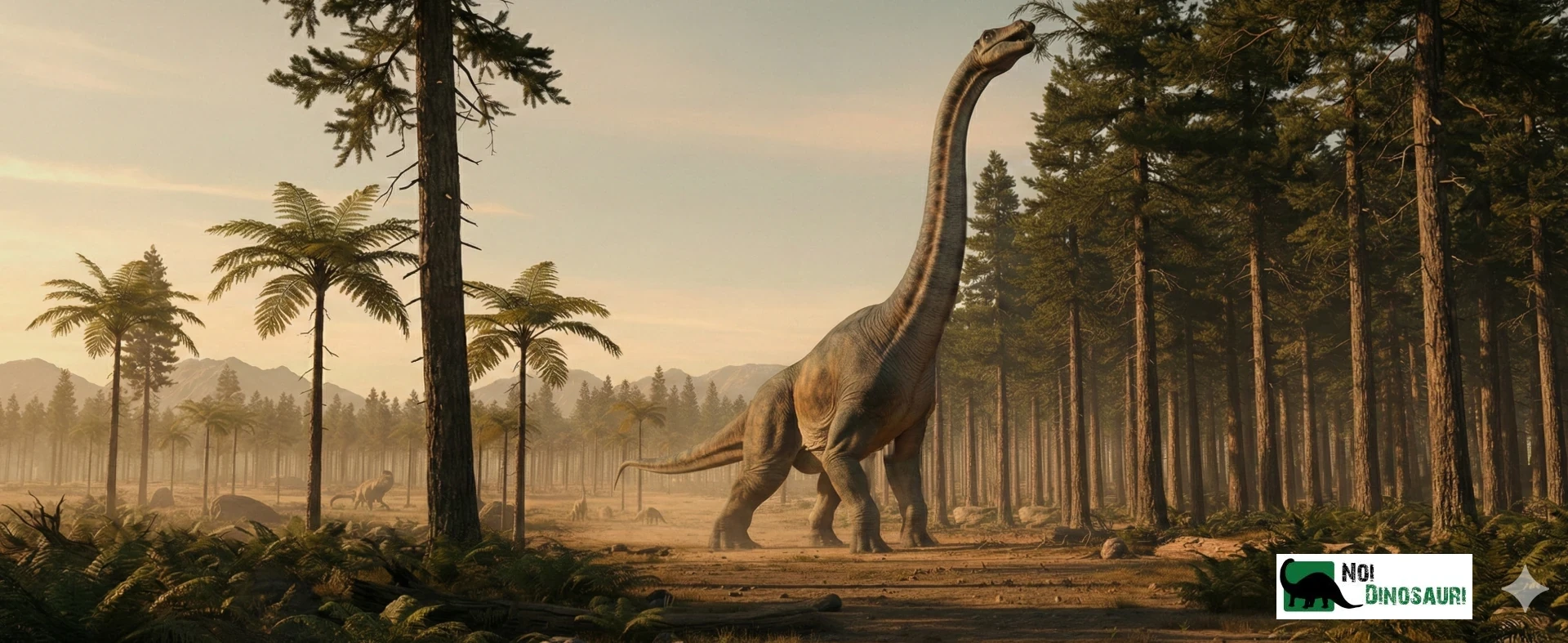
Brachiosaurus
Brachiosaurus stands as one of the most awe-inspiring herbivorous dinosaurs to ever walk the Earth. It thrived during the Late Jurassic period, roughly 154 to 153 million years ago. As a member of the macronarian sauropod clade—long-necked dinosaurs known for their large nasal openings—it serves as the type species for the family Brachiosauridae. Unlike most other sauropods, Brachiosaurus never had to rear up on its hind legs to reach the treetops. Its magnificent neck allowed it to exploit a high-canopy ecological niche entirely out of reach for any other herbivore of its time.
Brachiosaurus: History, Characteristics, and Facts
Paleontologist Elmer S. Riggs unearthed the first fossilized remains of Brachiosaurus in 1900, discovering them within the Morrison Formation of Colorado. Riggs coined the scientific name in 1903. It translates to "arm lizard" (from the Greek brachion for arm, and sauros for lizard). This name highlights the dinosaur's most striking anatomical anomaly: forelimbs that drastically outmeasured its hindlimbs.
Today, the Field Museum of Natural History in Chicago houses the original holotype of Brachiosaurus altithorax. Scientifically, we must distinguish this North American species from the famous mounted skeleton at the Natural History Museum in Berlin. For decades, researchers considered the Berlin specimen an African species of Brachiosaurus. However, paleontologists have since reclassified it as an entirely distinct genus: Giraffatitan.
The Living Tower: Posture and Limbs
The anatomy of Brachiosaurus was a masterpiece of biomechanical engineering designed for extreme verticality. Its gait depended on its forelimbs, which stretched vertiginously longer than its rear legs. This unmistakable posture gave the animal a steep forward incline. It transformed Brachiosaurus into a living observation tower that dominated the the highest forest canopy —a silhouette unmatched by any other Jurassic sauropod.
The Jurassic Crane: Neck and Vertebrae
Recovered specimens show an immensely elongated, disproportionate neck that stretched up to 12 meters. This was not just a flexible tube; it was a precision load-bearing structure. Elongated cervical vertebrae supported the neck, miraculously lightened by internal air sacs—a process known as bone pneumatization. This evolutionary adaptation drastically reduced the animal's overall density, allowing it to maneuver its massive bulk and defy gravity.
The Vegetarian Chisel: Teeth and Digestion
A relatively small, box-like skull sat at the pinnacle of that massive neck. It featured a distinct profile with large nasal openings positioned high on the snout. The dinosaur used its spatulate teeth like robust chisels to clamp down on branches. With a sharp backward pull of its head, Brachiosaurus sheared off leaves and shoots in a single, fluid motion. Because this dentition evolved strictly for stripping rather than chewing, the dinosaur swallowed its food whole. A cavernous stomach did the heavy lifting. There, colonies of bacteria fueled intense fermentation, chemically breaking down the tough prehistoric vegetation.
The Living Bark: Skin and Texture
While skin from Brachiosaurus altithorax hasn't directly fossilized, cutaneous impressions from closely related macronarians give us a clear picture. Brushing against the dinosaur's flank would have felt like touching the deeply fissured bark of an ancient sequoia. Thick, leathery, non-feathered tubercular scales cloaked its body. This armor was essential for sealing in moisture and protecting the dinosaur from the constant scraping of rough branches.
The Color Code: Coloration and Camouflage
What color was this titan? Paleontologists have a solid working theory. When we observe modern mega-herbivores like elephants, rhinos, and hippos, we see muted tones: grays, browns, and sands. Because of its colossal size, a fully grown Brachiosaurus had no natural predators. This eliminated the evolutionary need for complex camouflage. Its true enemy was body heat. Under the Jurassic sun, dark colors would have absorbed too much solar radiation. Therefore, it likely sported light, reflective shades like pale gray, beige, or sandy brown. However, many scientists suspect this wardrobe changed radically with age. Small, vulnerable hatchlings likely sported spots or stripes in forest greens and bark browns. This tactical attire helped them vanish into the dense undergrowth, only to fade away as they grew into invulnerable gray mountains.
Modern paleontology has significantly downsized the size estimates for Brachiosaurus, debunking old myths of a 30-meter, 80-ton monster.
Updated data and 3D modeling indicate that an adult Brachiosaurus altithorax measured 21 to 22 meters in length. Its head reached a height of about 12 to 13 meters, and its weight ranged between 30 and 40 tons. These figures align far better with the limits of terrestrial biomechanics. While neither the longest dinosaur (surpassed by diplodocids) nor the heaviest (eclipsed by Cretaceous titanosaurs), Brachiosaurus remains one of the tallest and most massive land animals of Jurassic North America.
Paleontologists classify the feeding strategy of Brachiosaurus as "high browsing." Utilizing its giant, giraffe-like posture, it sheared pine needles, cones, and fresh fronds at heights exceeding 10 meters. At this level, it faced zero direct competition from other herbivores.
Its natural habitat spanned the western subcontinent of Laurasia (modern-day central North America). This ecosystem featured gallery forests and vast floodplains driven by intense seasonal changes. The surrounding Jurassic flora was lush and primitive, bursting with towering conifers (araucarias), ginkgoes, and cycads. In this lost world, Brachiosaurus coexisted with other giants like Diplodocus and Apatosaurus, which fed much closer to the ground. Meanwhile, its colossal bulk rendered it virtually immune to the apex predators of the era, such as Allosaurus and Ceratosaurus.
Curiosity - Did you know?
The Diver That Never Was
Until the mid-20th century, scientists believed Brachiosaurus was too heavy to support its own weight on land. They pictured it living submerged in lakes or swamps, using the high-set nostrils atop its head as a built-in snorkel. Modern paleontology has utterly dismantled this theory. The hydrostatic pressure of the water at those depths would have crushed its ribcage, making it impossible for the animal to inflate its lungs.
The true physiological miracle of this dinosaur lies elsewhere: its heart. To pump blood against gravity over 8 meters up to its brain, the Brachiosaurus heart likely weighed around 400 kg and generated terrifyingly high blood pressure!