
 IT
IT  DE
DE  FR
FR  ES
ES  PT
PT 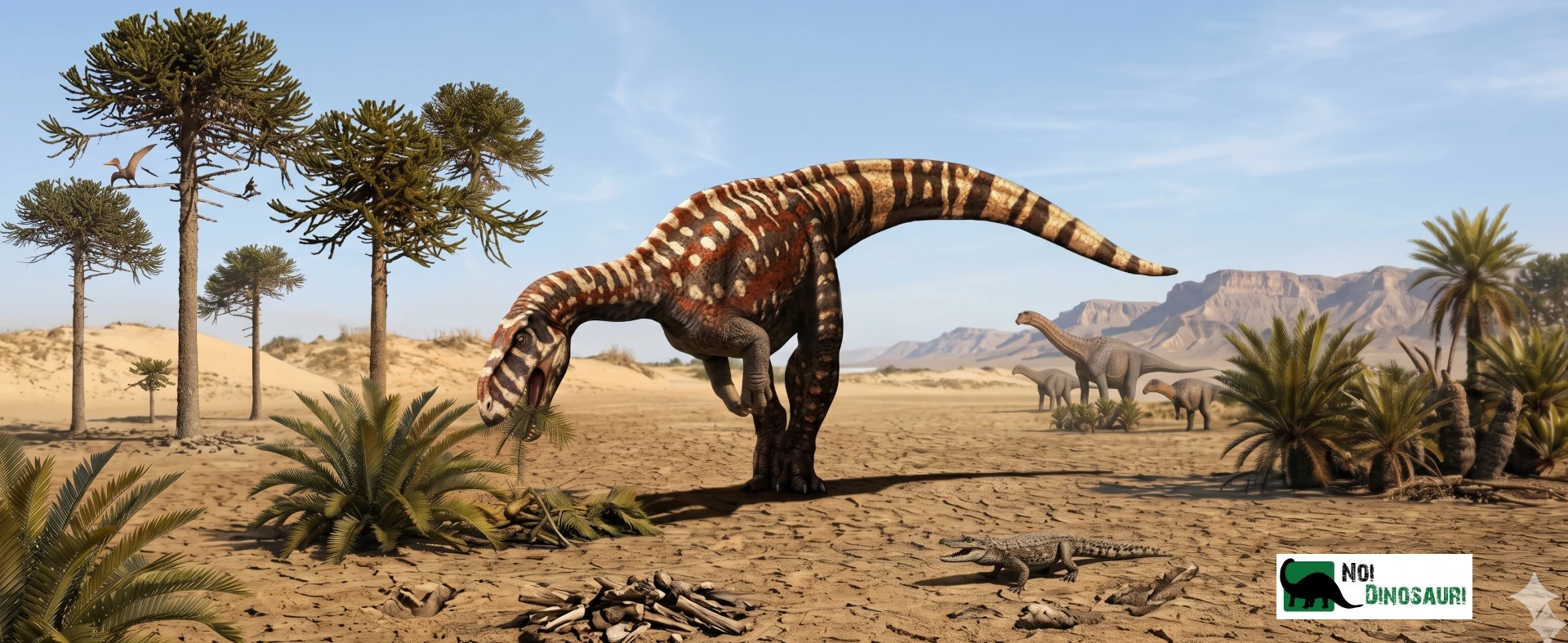
Aardonyx
Aardonyx stands as one of modern paleontology's most fascinating discoveries. It serves as a crucial decryption key, unlocking how dinosaurs transitioned from agile bipeds to quadrupedal colossi. While not a true sauropod (like Brachiosaurus), Aardonyx belonged to the basal Sauropodomorpha clade—the ancient "prosauropods" and direct ancestors of the long-necked giants. Roaming the Earth at the dawn of the Early Jurassic, this animal captures the exact evolutionary moment nature began sculpting the bodies of our planet's future titans.
Aardonyx: Curriculum Vitae of the species
History and Discovery
Paleontologist Adam Yates and his team officially introduced Aardonyx celestae to the world in 2010. They unearthed the fossils in South Africa's Upper Elliot Formation, a geological site renowned for its rich Mesozoic deposits.
The genus name perfectly captures its burial environment: derived from the Afrikaans aard (earth) and the Greek onyx (claw), "earth claw" references the rock-hard, hematite-rich encrustations that tightly encased the bones upon discovery. The specific epithet, celestae, honors Celeste Yates, who painstakingly prepared much of the fossil material. Today, researchers house the holotype at the National Museum in Bloemfontein, South Africa, where it remains a pivotal specimen in studying dinosaur biomechanics.
Anatomy and characteristics
The Bipedal Paradox: Limbs and Locomotion
Measuring roughly 7 meters long and weighing as much as a compact car, Aardonyx dominated its Early Jurassic landscape. It still walked exclusively on its hind legs, yet its arms foreshadowed the future. Its forelimbs lacked agile grasping claws; instead, they bore stubby digits beginning to resemble the columnar structure of an elephant's foot. 3D micro-CT scans of the forearm bones (ulna and radius) reveal tightly interlocking joints. Aardonyx physically could not rotate its wrists to grasp food. Evolution was literally fusing its bones, transforming its arms into weight-bearing pillars to prepare its descendants for a quadrupedal lifestyle.
The Wide-Mouthed Harvester: Jaw and Feeding Mechanics
This dinosaur fed with the brutal efficiency of an industrial harvester. It sported an unusually narrow and elongated snout. Instead of meticulously selecting leaves, Aardonyx stripped entire branches of needles and dry fronds, swallowing massive amounts of vegetation whole without chewing. Fossil skulls show a complete absence of a lateral ridge—the bony crest that anchors fleshy cheeks in many herbivorous dinosaurs. Without cheeks to restrict its gape, Aardonyx could open its mouth incredibly wide. This adaptation maximized the volume of every bite, functioning much like the massive cargo door of a freight aircraft.
Rugged Armor and Social Colors: Skin and Coloration
Crashing into its flank would feel like hitting a wall of coarse sandpaper. Aardonyx likely possessed thick, tubercular scales designed to deflect glancing bites and the sharp thorns of prehistoric flora. However, this heavy runner probably concealed a striking visual profile. Based on the biology of modern archosaurs, paleontologists suggest the skin around its head and neck could flush with vivid colors. These chromatic displays would allow Aardonyx to intimidate rivals and communicate within its herd. Far from being drab "gray lizards," these animals likely relied on strong visual contrasts to navigate complex social hierarchies.
The Relentless March: Gregarious Behavior and Herding
Aardonyx did not roam alone. Group cooperation ensured survival, but extreme climate events could turn this herding instinct into a collective trap. The proof lies in a dramatic bonebed discovered in the Elliot Formation: researchers found the disarticulated skeletons of multiple individuals (including at least two large sub-adults) packed densely together in a single layer of red rock. This shared geological tomb confirms they lived, moved, and died as a herd—likely wiped out simultaneously by a catastrophic drought or trapped by a sudden, muddy flash flood.
Actual Size (Myth vs. Reality)
Popular culture often paints every long-necked dinosaur as a multi-ton leviathan, but Aardonyx shatters that assumption. Osteological studies confirm this animal reached a maximum length of about 7 meters and a hip height of roughly 1.8 meters.
Its estimated weight hovered around 500 kilograms—a far cry from the staggering bulk of later sauropods. Crucially, the specimens discovered so far, while technically sub-adults, had already reached near-maximum size. This wasn't a baby giant; it was a moderately sized species actively forging a new evolutionary pathway.
Diet and Paleoecology
Aardonyx lived as a specialized herbivore navigating the semi-arid, flood-prone environments of the supercontinent Gondwana (in what is now South Africa). Its V-shaped jaw—narrow at the tip and wide at the back—indicates it bulk-foraged by stripping whole branches rather than selectively plucking individual leaves. It relied entirely on a complex system of gastric fermentation to break down the tough plant matter.
Drought-resistant primitive conifers and cycads dominated the surrounding landscape. Aardonyx shared this habitat with other early sauropodomorphs, such as the ubiquitous Massospondylus. Survival meant constantly staying alert for predatory theropods like Dracovenator and swift coelophysoids like Megapnosaurus, which posed a severe threat to younger individuals.
Curiosity - Did you know?
Aardonyx existed in a state of biomechanical paradox. Kinematic studies demonstrate it walked strictly on two legs, but moved quite slowly. It had already lost the cursorial (fast-running) adaptations of its bipedal ancestors, yet it lacked the stable quadrupedal stance of its descendants. It was an animal literally suspended between two worlds. Engineered for stability and slow digestion, Aardonyx traded agility for the capacity to process massive quantities of nutrient-poor vegetation. This temporary evolutionary compromise eventually gave rise—over just a few million years—to the largest land animals in Earth's history!