
 IT
IT  DE
DE  FR
FR  ES
ES  PT
PT 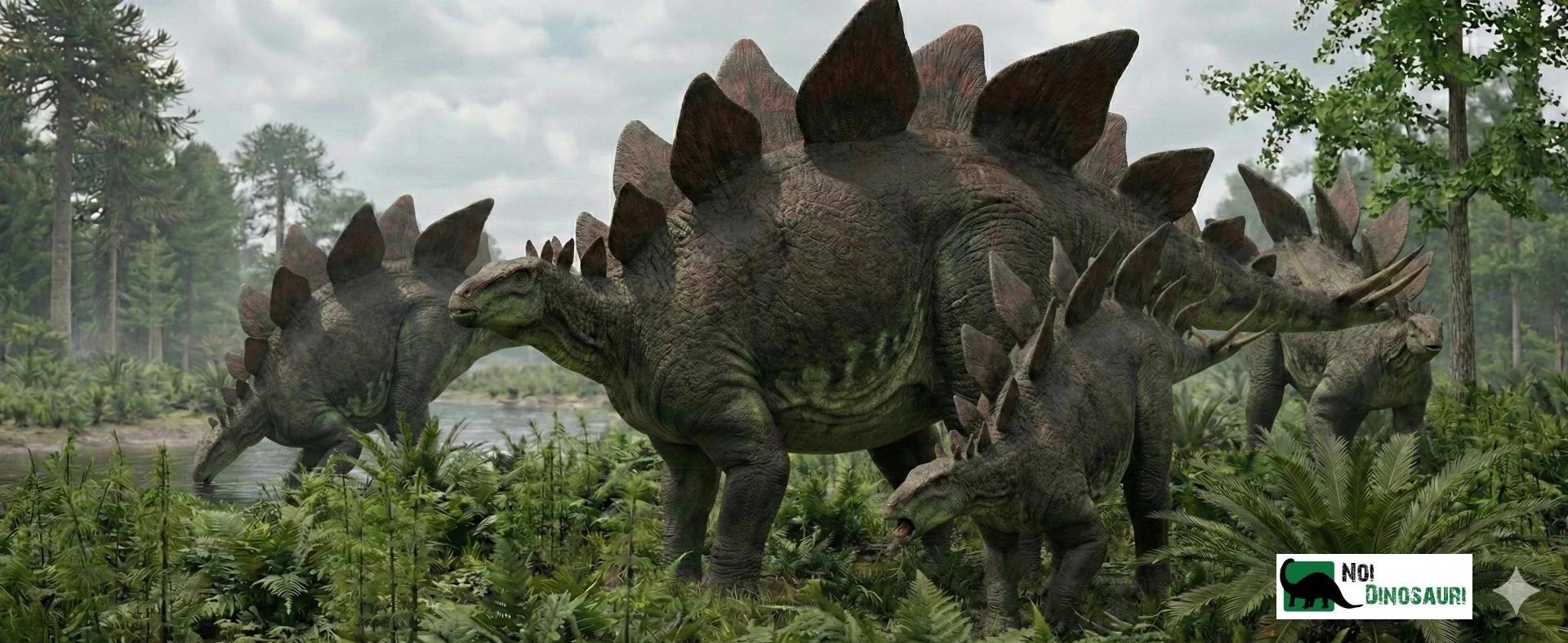
Stegosaurus
The Stegosaurus (genus Stegosaurus) is the undisputed icon of armored dinosaurs. An ornithischian thyreophoran (shield-bearer) that marched across the floodplains of the Late Jurassic, between 155 and 150 million years ago. A masterpiece of evolutionary engineering. Famous for its spectacular double row of kite-shaped plates and a fearsome spiked tail, it navigated a ruthless ecosystem, proving to be a formidable adversary for the apex predators of its era.
Stegosaurus: Curriculum Vitae of the species
History and Discovery
The paleontological journey begins in the turbulent "Bone Wars" of the 19th century. In 1877, paleontologist Othniel Charles Marsh described the first remains found in Colorado, coining the name Stegosaurus: from Ancient Greek, "roof lizard."
Initially, Marsh theorized the bony plates lay flat across the back, overlapping like roof tiles to form a carapace. Only through subsequent discoveries did science grasp their striking vertical posture. Today, impeccably preserved skeletons like "Sophie" (at the Natural History Museum in London) and the recently auctioned fossil "Apex" (2024) allow for cutting-edge biomechanical studies, proving this Jurassic titan still commands global fascination.
Anatomy and characteristics
The anatomy of the Stegosaurus is defined by a stark disproportion between its massive, tank-like body and its remarkably tiny head.
Plates (Osteoderms)
17 to 22 kite-shaped bony plates embedded directly into the thick skin. Highly vascularized, they functioned as a thermoregulation system (like organic solar panels) and a visual display, flushing with blood to intimidate or attract. They did not serve as physical armor.
Defense (Thagomizer)
Active defense relied entirely on the tail. Armed with four massive bone spikes up to 90 centimeters long, it was swung with devastating force to puncture the flanks of attacking theropods.
Senses
>Possessed a highly developed sense of smell. CT scans of the cranial cavity reveal large olfactory bulbs, facilitating the detection of predators, food, and its own kind.
Brain
Minuscule, about the size of a walnut or lime. The myth of a "second brain" in the pelvis is false; this cavity actually housed a glycogen body (an energy reserve for the nervous system).
Actual Size (Myth vs. Reality)
The Stegosaurus possessed a distinctively arched posture, dictated by hind legs significantly longer than its front limbs. This anatomy restricted its mobility, making it a slow, deliberate walker.
- Length: Reached an estimated maximum of 7 to 9 meters.
- Height: Stood roughly 4 meters tall at the hips (including the plates).
- Weight: Modern 3D modeling estimates a true mass between 5 and 7 tons.
- Speed: Its physical limit did not exceed 7 km/h.
Diet and Paleoecology
A low-browsing herbivore, the Stegosaurus fed using a toothless horny beak to crop foliage, while small, leaf-shaped teeth at the back of its jaws roughly chopped the meal. Recent biomechanical studies indicate a relatively weak bite force—comparable to a modern sheep or cow—perfectly adapted for tender plants. Contrary to past beliefs, it is highly improbable that Stegosaurus swallowed gastroliths (stomach stones) to aid digestion, as none have ever been unequivocally preserved with its skeletons.
The species thrived in Laurasia, specifically within the semi-arid floodplains of the modern Morrison Formation (western North America) and parts of Portugal. In this prehistoric world devoid of grass and flowers, forests were dominated by cycads, horsetails, mosses, and low ferns.
It shared the landscape with colossal sauropods, moving in the shadows of giants like Diplodocus, Brachiosaurus, and Apatosaurus. Its sworn enemies were the apex predators: Ceratosaurus, Torvosaurus, and the terrifying Allosaurus. Taphonomy confirms the violence of these epic clashes: paleontologists have unearthed Allosaurus specimens bearing lethal puncture wounds perfectly matching the dimensions of a thagomizer spike.
Curiosity - Did you know?
In rigorous anatomical nomenclature, the spiked tail of the Stegosaurus is officially called a "thagomizer." Surprisingly, this scientific term was born from a comic strip! In 1982, the brilliant cartoonist Gary Larson published a Far Side panel showing a caveman pointing to the dinosaur's tail during a lecture, stating: "Now this end is called the thagomizer... after the late Thag Simmons." The joke was so popular that paleontologist Ken Carpenter began using the term professionally. Today, the thagomizer is a universally recognized scientific concept.