
 IT
IT  DE
DE  FR
FR  ES
ES  PT
PT 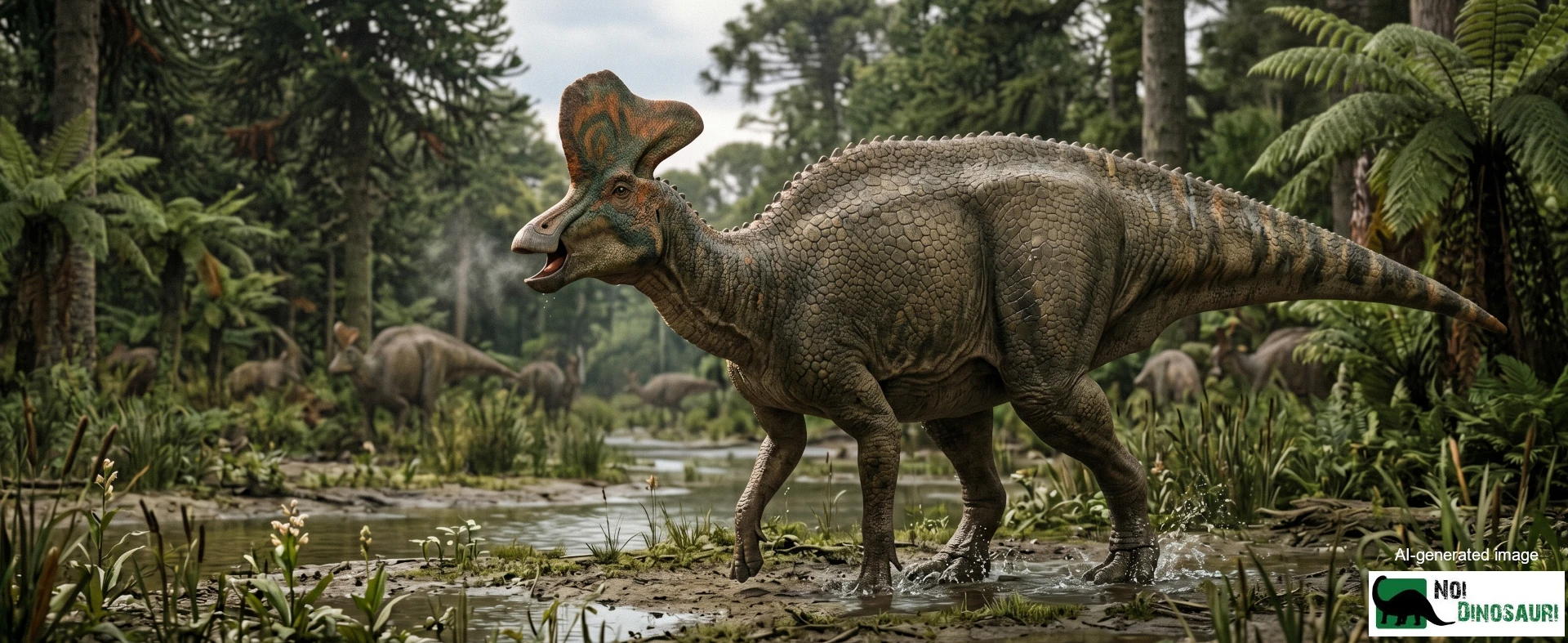
Lambeosaurus lambei
Seventy-six million years ago, in the misty coastal forests of ancient North America, you would have heard a Lambeosaurus long before you saw it. A deep, resonant bellow wouldn't just reach your ears—it would vibrate intensely within your chest. This sound heralded the arrival of one of the Late Cretaceous's most sophisticated dinosaurs. Unlike heavily armored herbivores, this colossal hadrosaur didn't rely on a formidable physical arsenal to survive. Instead, it evolved a highly specialized anatomy that served as an unparalleled biological communication network.
Lambeosaurus lambei: History, Characteristics, and Facts
The fossil history of this species represents a fascinating chapter in North American paleontology. Prospectors unearthed the first fragmented remains in Canada at the dawn of the 20th century. However, the real breakthrough came in 1923, thanks to the meticulous fieldwork of paleontologist William Parks. He named the dinosaur "Lambe's lizard" to honor Lawrence Lambe, the pioneer who initially studied these enigmatic bones two decades earlier. Today, the world's most breathtaking specimens—including exceptionally rare fossilized skin impressions—reside at the Royal Tyrrell Museum of Palaeontology in Alberta, Canada.
The Acoustic Crown of the Cretaceous
Forget spikes and claws; this giant's ultimate survival tool was a built-in wind instrument. Lambeosaurus sported a prominent, hatchet-shaped bone crest projecting forward from its skull. Early paleontologists mistakenly thought this structure acted as a diving air reserve. Modern CT scans, however, reveal a hollow structure housing a complex maze of nasal passages. This functioned much like the wooden resonance chamber of a cello. Covered in a sheath of keratin, the crest likely flashed with vibrant colors during mating season (hypothesis, by analogy with modern reptiles and birds) to attract partners or visually intimidate rivals.
An Agile Behemoth
Despite its massive build, Lambeosaurus moved with surprising grace on both two and four legs. If you touched its skin, you wouldn't feel the cold, slimy texture of a modern reptile. Thanks to rare fossil mummies, we know fine sand preserved the three-dimensional imprint of its epidermis, revealing a tough, continuous mosaic of hexagonal scales. Running a hand over its flank would have felt like touching the rough, granular surface of a worn basketball, stretched taut over a frame of steel-like muscle.
The Botanical Grinder
Behind its broad, flattened snout lay a relentless biological processing plant. The toothless front beak sliced through tough ferns and woody branches with the efficiency of industrial shears. The true engineering marvel, however, resided in the cheeks. Here, the dinosaur concealed a dental battery packed with hundreds of constantly replacing, sharp teeth. They ground down unforgiving Mesozoic vegetation using a complex lateral chewing motion, pulverizing resilient plants with the ruthless efficiency of a millstone.
A Baritone Symphony in the Swamp
The ancient forests inhabited by these creatures were never silent. They lived in massive migratory herds, an ecological reality proven by vast bonebeds where catastrophic floods buried thousands of individuals together. Standing amid their march would have rivaled the deafening roar of a crowded train station at rush hour. When sentinels blew air through their crests to signal a predator's approach, they produced a low, penetrating frequency. This alarm call echoed through the trees like the foghorn of a massive cargo ship traversing the mist.
Early pop culture bestiaries frequently exaggerated Lambeosaurus, depicting bus-sized monsters exceeding fifteen meters in length. Rigorous modern analysis of complete skeletons paints a more accurate picture. A fully grown adult averaged seven to eight meters long and weighed around three tons. Advanced volumetric 3D modeling confirms its bulk was closer to that of a heavily armored transport van—making it a formidable presence in its ecosystem, but not a towering titan.
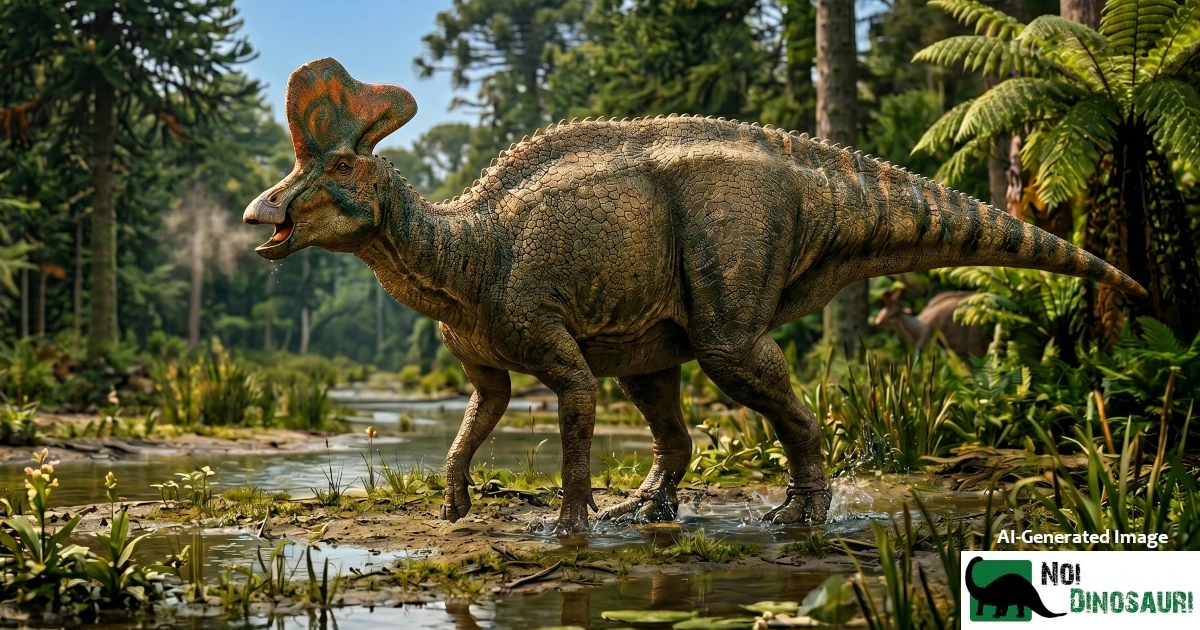
This herbivore thrived in a lush, incredibly humid ecosystem, acting as a relentless landscaper in a world patrolled by apex predators. It inhabited the coastal plains of Laramidia, a lost island continent making up modern-day western North America. The climate was warm and temperate, completely devoid of harsh winters. Wandering through shadowy groves of towering conifers, it spent its days browsing foliage and consuming rapidly diversifying early flowering plants. Lambeosaurus shared this prehistoric biome with peaceful armored giants, all while maintaining constant acoustic vigilance against swift ambushes from tyrannosaurids like Gorgosaurus and Daspletosaurus.
Curiosity - Did you know?
For decades, scientists erroneously believed the bizarre crest functioned as a snorkel for underwater foraging. Modern paleontology has thoroughly debunked this cinematic myth. The internal nasal tubes lacked a top opening, making the snorkel hypothesis biologically impossible. Instead, the size and shape of this extraordinary biological instrument varied drastically based on age and sex—a clear example of sexual dimorphism. Females and juveniles possessed much smaller crests. The towering tubular antenna of mature males served a dual purpose: amplifying their thundering calls and acting as a vibrant billboard to advertise genetic maturity during courtship displays.